Showing posts with label Reviewed by Rob Steiner. Show all posts

Monday, September 15, 2014

Fluency by Jennifer Foehner Wells

Fluency by Jennifer Foehner Wells is what 2001: A Space Odyssey would’ve been if the monolith had actually talked to the crew.

NASA has known about an alien spaceship parked in the Asteroid Belt since the 1960s but has kept the information from the public.  All efforts to establish radio contact have been met with silence.  In the early 21st century, NASA finally develops the technology required to send six astronauts to the ship to discover its secrets. 

Dr. Jane Holloway is a linguist and a reluctant astronaut recruited by NASA to communicate with any possible aliens.  As soon as their capsule docks with the mysterious ship, she begins to hear voices.  She not only has a hard time convincing herself they are real, but most of her crew as well. 

When the mission takes a disturbing turn that not even the highly trained astronauts are prepared for, it’s Jane’s connection to the ship that becomes their only hope for survival.

Fluency was a finely written derelict spaceship story.  Wells’ style and language are beautiful and descriptive without relying on cliché.  Wells does not overly explain the science behind the ship's gadgets, but gives us just enough to make them all seem plausible without bogging the story down. 

I liked how the alien cultures that the ship reveals to Jane Holloway sounded very different from one another, even among individuals within a species.  Too many sci-fi stories depict aliens as one monolithic culture where all individuals share the same values.  I prefer my aliens to be, well, more human and unique between individuals.  Besides drone-like insectoid aliens, that just seems more realistic to me and Wells does a fine job of it in this book.

I only had some minor nit-picks.  The main characters ruminated too much for my taste, making me skip pages at a time to get back to the action.  I also thought the ending was too abrupt; I got the feeling I had just read the opening chapter of a longer work rather than a complete work in itself.  Fluency's sub-title is "Confluence Book 1," so this was obviously by design, but I'm not a fan of the style.

Fluency is Wells' debut novel and an impressive effort that I enjoyed.  It hit all the right notes that a derelict spaceship story should hit.  The novel only hints at the strange galaxy awaiting humanity, so I look forward to the alien wonders that Wells introduces us to in the sequel.

Fluency is available on Amazon as an ebook and paperback.

[Note: Fluency was purchased by the reviewer.]

Wednesday, April 2, 2014

Chained by Fear by Jim Melvin

book cover for Chained by Fear
Chained by Fear, book two in Jim Melvin’s Death Wizard Chronicles, begins the story of Laylah, the beautiful sister of the evil sorcerer Invictus.  Invictus has imprisoned Laylah in a magical tower, hoping that she’ll one day become his queen and rule the world of Triken with him.

Laylah, however, happens to be the sane one in the family. She's repulsed at the thought of marrying her own brother, let alone spending her life with a depraved lunatic with god-like powers. She’s locked away for seventy years—her demon blood gives her long life—before finally escaping with the help of Invictus's former allies.

While on the run, she meets Torg the Death-Knower, a powerful wizard in his own right. We last saw Torg in Forged in Death, after he had escaped Invictus’s vile prison and made some roguish friends. When Laylah and Torg meet, sparks fly. Literally. They are drawn to each other in a supernatural passion that neither can explain. They only know that their fates are entwined and that they will live or die together.

But Invictus has something to say about this. He unleashes his hideous minions to retrieve Laylah and finally destroy the Death-Knower, the one being in all of Triken that can oppose him.

When you pick up a Jim Melvin novel, you know you’re in for two things:

(1) Melvin excels at world-building. Triken’s cultures, magic, and monsters all resonate with real-world mythologies. But Melvin adds unique twists that make them at once familiar and alien.

(2) Melvin’s Death Wizard Chronicles are adult fantasy. Make no mistake, this series is far more G.R.R. Martin than J.R.R. Tolkien due to its sexual content and violence. However, I did not think the sex and violence were gratuitous, and I thought it helped illustrate either the depravity or kindness of the characters.

Chained by Fear resolves a minor quibble I had with Forged in Death. Torg was too powerful in book one, and nothing could hurt him unless he allowed it. It’s the challenge that Superman's writers have dealt with for decades: how do you make readers worry about a character who can’t be hurt?

Melvin solved this by giving Torg cherished friends. He may not die if he fails, but his friends surely will, and in gruesome ways. Torg’s adventures were far more harrowing this time around, and gave him the chance to demonstrate his honor and strength while he protected the people he loves. Melvin nicely sets up a character in Torg who is the polar opposite of the wicked Invictus.

And the fact they love the same woman will make their inevitable battle viciously personal. I’m looking forward to it.

Highly recommended.

Chained by Fear, and the Death Wizard Chronicles, are available on Amazon.


[Note: Chained by Fear was purchased by the reviewer.]

Tuesday, February 4, 2014

The Tattered Banner by Duncan M. Hamilton


The Tattered Banner by Duncan M. Hamilton is not your typical rags-to-riches fantasy story, but it does start out as one. 

The hero, Soren, is plucked from a starving street urchin’s life by a famous nobleman to attend Ostia’s prestigious Academy of Swordsmanship.  Magic is outlawed in Ostia, so the Duchy’s best and brightest become master swordsmen to move up in society. 

It’s an opportunity that’s too good to be true, and Soren recognizes this.  He becomes the hardest working student at the Academy because he knows that one failure could throw him back on the streets; something his rich, noble classmates don’t have to worry about.  It soon becomes clear that Soren has a magical “Gift” with a blade that enables him to defeat almost anyone he faces despite his limited training.

That’s where the story turns away from the typical hero’s journey.

The Tattered Banner is not about undertaking quests or vanquishing dark lords, but how one young man survives from day to day with only his wits and his Gift.  Soren’s journey throughout the book is like a series of random encounters—something happens to him, he makes a choice, and then he blasts off into a totally new direction.  His adventures are certainly thrilling and had me turning the pages.  I suppose random encounters are what real life is like.

Which leads to my one criticism.  The Tattered Banner is well told, but I felt like there was something missing: an overall goal for Soren to work towards that ties everything together.  Soren simply tries to survive from one unrelated situation to the next.  He has an intriguing magical skill with the sword, but that doesn’t seem to be at the top of his “to do list” to investigate.  I was hoping the book would make that Soren’s overall goal, and show how it conflicted with Ostia’s anti-magic laws.  But it never happened.

Though Soren makes some poor decisions, I still rooted for him, nonetheless.  He never forgets that he was once a starving orphan on the streets, which makes you understand his actions when he does things that are, at best, morally questionable.

The Tattered Banner is book one of a series, so I hope future volumes will explore the mystery of Soren’s magical Gift with the sword.  I did enjoy the book very much because of its action and interesting characters, despite my reservations about the plot structure.  

Highly recommended.

The Tattered Banner is available on Amazon.

[Note: The Tattered Banner was purchased by the reviewer.]

Tuesday, October 22, 2013

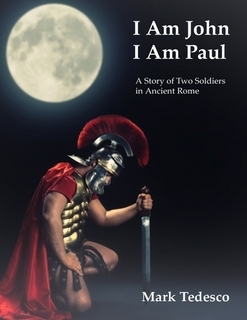
I Am John, I Am Paul by Mark Tedesco

I Am John, I Am Paul by Mark Tedesco follows the lives of two real-life Roman soldiers in the fourth century, Ioannes (John) Fulvius Marcus Romanus and Paulus.  John and Paul form a strong bond of friendship during their days fighting on the German frontier, a bond that is never broken even when John is sent away to Alexandria by a sadistic centurion.

John spends years in Alexandria longing for home and corresponding with his family and Paul in Rome.  While in Alexandria, John is initiated into the Mithraic religion, but his faith in Mithras doesn’t seem to give him the peace he thought it would.

Political upheavals enable John to return to Rome, his family, and Paul.  John and Paul resume their duties in the Legion, and even volunteer to rescue a close family member of Emperor Constantine, who was kidnapped by a rival Roman general. The mission succeeds, and the Emperor is so grateful that he gives them both farm lands and a house in Rome, ensuring they and their families will never again know poverty.

While in Rome, John and Paul discover the ‘Way,’ the nascent Christian movement that threatens the old Roman gods. In the Way, John discovers the faith he always hoped would fill his heart, which strengthens both men when they suffer the inevitable persecution.

I’m a huge ancient Rome geek, so there were many things I liked about this book.

For one, it was well researched.  The author knew his history and provided illuminating details of the lives of average ancient Romans.  Tedesco had a clear understanding of Roman religions, including Roman pagan rituals, Mithraism, and the practices of the ‘christus followers'.  The book was beautifully written in a first-person narrative told primarily by John, with dialogue that had an ancient, almost biblical feel.

Now I offer the following as an observation and not a criticism, as it is more a warning about the book’s style. 

I felt like I was reading John’s personal journal.  And like the journals of real-life people, you won’t find the standard fiction novel plot twists and character conflicts.  For the most part, things just happened to John—he doesn’t really do much (besides plan and execute the rescue mission, which was the best part of the book for me).  Most of the conflict is internal, with John searching for spiritual meaning in Alexandria and Rome.  Tension between characters was minimal.

In other words, read this book for the thoughtful writing about a man searching for his spiritual home, or to experience the lives of everyday Romans during the fourth century.  But skip it if you’re seeking a page-turning adventure story set on an ancient Roman battlefield.

I Am John, I Am Paul is available on Amazon.

Tuesday, September 24, 2013

In Apple Blossom Time by Robert Wack

Note: The author has re-named this novel to Time Bomber. We don't know if there have been any revisions to the story.

In Apple Blossom Time by Robert Wack starts with an interesting Prologue—a time traveler jumps back and forth in time between different locations in World War II Europe tracking another man important to the time traveler’s mysterious mission. It’s a violent struggle, as the traveler sometimes kills his quarry and then sometimes loses him.

The Prologue promised a novel filled with paradoxes and alternate timelines. In my opinion, however, the novel did not deliver on that promise.

Dr. Willem von Stockum is an American mathematician who abandons a lucrative academic career to join the British Royal Air Force prior to the Pearl Harbor attack. He’s disgusted with America’s indifference to Nazi oppression in Europe and wants to do what he can to free his Dutch homeland from the Nazi invaders.

When his bomber is shot down over Normandy during the D-Day invasion, a group of lost American paratroopers rescue him from the wreckage.  They hide from the German army in a French home with members of the French Resistance and two strangers who tell peculiar stories about the fantastical theories von Stockum will one day develop. Von Stockum ultimately has to choose between believing the absurd stories of these strangers, or doing the right thing in the here and now.

There were quite a few good things about this book that kept me reading.

The author knew his material: Details of the Normandy invasion and the mathematics of quantum physics and the Theory of Relativity were all authentically presented within the narrative.

The dialogue was spot-on for the era and expertly rendered; whether it was Americans or British or even the French speaking, I could hear their accents without the author resorting to phonetically spelling them out (e.g., “ve have vays of making you talk!”).

What bothered me, however, was that the book felt like the author expanded a beautiful short story into novel length by adding flashbacks, reveries, and information dumps.  The first third of the book was filled with von Stockum thinking about his past, reminiscing with fellow pilots, or reading letters from home.  He didn’t do much.  I found myself skipping pages of von Stockum reveries just so I could get back to the American paratrooper story lines, which were quite exciting.

The second thing that bothered me was that the time travel element was not as important to the story as I had hoped.  The paratroopers and von Stockum simply thought of the time traveling strangers as either German spies or lunatics, and the strangers didn’t seem to impact the decisions of the main characters in any significant way; if they did, it was way too subtle for a promised 'time travel' novel.

Still, if most of von Stockum’s ruminations were cut out and a more impactful role given the time travelers, I think In Apple Blossom Time would have made a marvelous short story or novella.  But as a novel, I can only give it 3 of 5 stars.

Time Bomber is available on Amazon.

Wednesday, July 10, 2013

Black Book, Volume 1, by Dylan Jones

Black Book Volume 1Black Book, Volume 1, has the first three episodes of the genre-bending Black Book series.  It’s a story that mixes Western, science fiction, and fantasy into a quest that spans centuries.

In Part 1: The Devil’s Blood, we find Sheriff Jack trying to keep the peace in a small, American West town during the 1860s.  But Jack is no ordinary Sheriff.  He has almost supernatural skills that help him survive a bloody encounter with bandits that shoot up his town and kill many of its citizens.  He’s quick on the draw, knows how to use his fists…and can time-travel out of town when a powerful adversary leaves him no choice but to retreat.

In Part 2: Out of Time, we meet Benjamin Freeman, President of the United States in the year 2308.  Ben has directed his time-travel corps to locate Jack, an old military comrade who has gone missing in the distant past.  When Ben personally oversees the operation, he walks into a trap orchestrated by a deadly faction that also wants to find Jack for its own ruthless purposes.

In Part 3: The Wall, Jack arrives in 1862 California.  He meets up with a six-year-old boy and his guardian, a mysterious old man who has met Jack before, though Jack has no recollection.  The old man guides Jack to a hidden object that Jack knows will change his life and the course of humanity.

First the good:

Jones’ scenes in the Wild West were so awesome that I thought I was reading a Zane Grey novel.  In Part 1, I could taste the dust on my lips and smell the body odor of the gamblers in the saloon.  The Western dialogue was spot-on and I could feel the bullets zip past my ear during the gunfights.

Sheriff Jack is an interesting character because he understands the stakes of his mission, yet cannot help himself when he goes out of his way to protect the innocent, even if it threatens the success of his mission.

Most of Volume 1 was about Jack, but Ben Freeman, who appears in Part 2, proved to be an interesting character as well.  Through him, we get a glimpse of the 24th century and how time travel becomes a truly devastating weapon.  Volume 1 only hints at Ben’s military background and his relationship with Jack, so there is still plenty of ground to cover there in future volumes.

And in the Black Book world, lets just say time travel is not for those who fear pain or swimming.

Now for the warning:

I went into Black Book, Volume 1, thinking I'd get three episodes of good serial fiction.  What I got instead were three chapters of a great novel.

Let me explain.

A single episode of serial fiction should be like an hour-long episode of a TV drama -- the characters encounter a situation that they take action to resolve within that one hour.  While there may be an over-arching storyline that ties the episodes together, each one should have a clear beginning, middle, and end.

For me, the three episodes of Black Book, Volume 1, did not have that clear beginning, middle, and end.  They had scenes that felt like set-up for a coming situation...but that situation never materialized, which made the scenes feel pointless within that episode.

But Volume 1's three episodes were what I'd expect from the opening chapters of an exciting sci-fi novel with an intriguing mystery.  Those "pointless" scenes would work well in a complete novel that is a single story with a clear beginning, middle, and end.

The Black Book series promises to be a wonderfully engaging story that I look forward to reading and buying.  I highly recommend it for the storytelling, world building, and quality of writing.

I’m just going to wait for the omnibus version so I can read it all at once.

Black Book, Volume 1, is available on Amazon.


Wednesday, March 13, 2013

In a Season of Dead Weather by Mark Fuller Dillon

Grab a comfy chair by the fire, a hot drink, and a book of good horror stories.  Those rattling shutters outside?  Just the blowing snow.  Those shadows dancing in the corner?  Fire light, nothing more.  And the whispers behind your chair are your imagination.

Maybe.

That’s the feeling Mark Fuller Dillon conveys throughout his short story collection In a Season of Dead Weather. In most of the stories, it was never quite clear whether the “horror” was in the narrator’s mind or if it was real. The reader was left to interpret at the end.

And that worked for me. Each Lovecraftian tale was expertly crafted, with poetic and visceral language describing characters enduring the loneliness and isolation of a long winter in the country or the city. Dillon is a Quebec native, so he’s no stranger to maddeningly endless winters (I’m a west Michigan native, so I can sympathize).

Most of the stories were quite literary and a little confusing to me, a genre reader. But their narrative styles, descriptions, and situations were so unique that I found myself eager to read on just to hear the language rather than find out what happens to the characters.

In the first story, “Lamia Dance,” a medical student takes a break from his studies – and braves the snow – to attend a film festival where see a film that brings back haunting memories from his childhood. The film’s images of violence and anatomy seemed quite erotic to the narrator. “Lamia Dance” was either a story about being pushed into a profession that the narrator did not choose for himself...or about a budding serial killer.

In “Never Noticed, Never There,” Tom Lighden sees ghastly apparitions in terrible pain on the streets of Ottawa. He is the only one who sees them, as every one else simply walks past them without a second glance. Dillon implies that society has become good at ignoring the pain of others, as we are too busy with our own lives to notice.

If you’ve ever been stuck alone in the woods during winter, you’ll understand the characters’ bleak situations in “Shadows in the Sunrise,” “The Vast Importance of the Night,” and “Who Would Remain?” Blizzards keep the narrators from civilization, they lose time, and see clawing shadows. Is it madness, ghosts, alien abductions? The reader is left to wonder if it’s all real or if winter has claimed the characters' sanity. While the three stories had similar themes, their unique characters and situations sufficiently differentiated them.

“The Weight of Its Awareness” had a middle-aged man revisiting a seemingly deserted, walled-off home that he originally tried to explore when he was eighteen. Grotesque sculptures now decorate the gardens, and a dark presence spies him from the home’s blackened windows and infects his mind. The story seemed like an extreme version of “curiosity killed the cat.” It was the weakest of the seven stories for me; although “weak” is a relative term since even this story kept me enthralled.

The strongest story for me was “When the Echo Hates the Voice.” Paul Bertrand is a brilliant, handsome young man who’s always the life of any social gathering and constantly seeks any excuse to be around people. The reason is that he cannot stand to be alone, for that is when the voices and faces visit him. Told by a narrator observing Paul, the story suggests a struggle between two personalities: one that seeks companionship and social reward, and one that seeks to keep us isolated from each other.

As I said at the beginning, I’m a genre reader and rarely read stories just for their styles and language. Dillon’s In a Season of Dead Weather is one of those rare works that can make even a genre reader like me want to take a second look at the literary. Highly recommended.

Available on Smashwords.com.

Monday, December 3, 2012

Forged in Death by Jim Melvin

Forged in Death, the first of six books in Jim Melvin's Death Wizard Chronicles, starts out with a scene from a claustrophobic's nightmare – Torg, the Death-Knower and king of the Tugars, is imprisoned by the evil wizard Invictus at the bottom of a cold, dark pit bored hundreds of feet into a mountain. He can't stretch out because the pit is too small, and he can't lean against the walls, because they're enchanted with flesh-burning magic. He either has to stand or curl into an uncomfortably tight fetal position.

We're only in the prologue, and the book is already giving me the willies. And that's a good thing.

Torg eventually escapes the pit and embarks on an Odyssey-like journey back to his desert home to stop Invictus from enslaving the world of Triken.

Jim Melvin's world-building was at once fantastic and logical, from the unique human cultures to the strange twists on traditional monsters. It's obvious Melvin put a lot of thought into the ecosystems that support his world. For example, Torg discovers a race of monkeys that live deep underground. How do they sustain themselves? By carving meat off a gigantic tentacled monster that inhabits the caverns, like microscopic mites on human skin. How does the monster survive? By eating the monkeys. It's an elegant symbiosis, and Melvin portrays other unique creatures similarly throughout the book.

Forged in Death has a non-traditional magic system – Torg enters a state of temporary death, feeds off the power of the afterlife, and then returns to his body magically recharged (which is why he's called a “Death-Knower”). The evil wizard Invictus, however, gets his power from the sun. This is a switch from most fantasies, which usually have the good guys feeding off the sun and the villains using death for their evil schemes.

The book also felt like a primer for real-world Theravada Buddhism (something the author acknowledges). The characters, Torg in particular, describe the principles behind meditation, karma, the eternal quest for enlightenment, and reincarnation. As one who's ignorant of Buddhist scriptures, I now want to read up on the subject to learn more.

I do have some quibbles with an otherwise outstanding novel.

The hero Torg was a likable character and an all-powerful wizard. But at times he seemed too good and too all-powerful. He won every battle unless he chose to lose, like when he allowed his enemies to throw him into the pit. I wanted Torg to fail or make more mistakes, and then watch him overcome those failures to become a different man by the end of the book.

Also, Forged in Death was a cliff-hanger book. I'm not a fan of the style, but it's a personal nit-pick of mine and not anything Melvin did wrong. Readers who enjoy cliff-hanger endings, however, will see no problem with it.

Forged in Death was beautifully written and a worthy addition to the epic fantasy genre. I hope to see Torg challenged a bit more in future books. I also look forward to learning more about Invictus, whose brief appearances painted him as an “interesting” villain. And the final battle between Torg and Invictus -- Triken's two most powerful wizards -- promises to be truly world-shaking.

Forged in Death is available on Amazon.

Monday, October 22, 2012

Demonworld by Kyle B. Stiff

Demonworld by Kyle B. Stiff is a highly imagined Lovecraftian tale that combines science fiction, fantasy, and horror in a way I've never seen. It's dark and dystopian, but with elements of humanity that hint at a hopeful future in the books to come.

The world is dominated by monsters called “flesh demons." Most human tribes appease the flesh demon “gods” by offering them human sacrifices. But a small hope for humanity exists in a technologically advanced city called Haven. It has survived and thrived by staying isolated on a small, bleak island in the middle of a vast ocean, hidden for hundreds of years from the flesh demons and aggressive human city-states.

Wodan, a gifted teenage boy from Haven, finds himself mysteriously exiled from his home for no reason he can comprehend. Wodan has to battle flesh demons, their twisted minions, and humans just as warped and evil as the demons, to return home to Haven and discover who kidnapped him and dropped him into the middle of the wasteland.

Demonworld was a book of extremes for me.

Many times I was floored by beautiful prose or a brilliant plot twist. The story and setting were intriguing and kept me turning the pages. I was also impressed with the editing, since I didn't find one typo or grammar mistake.

But the next moment, I was jarred out of the fantasy world by 21st century American slang uttered by supposedly primitive tribesmen (I saw “ding-bat,” “nit-wit,” and “weirdo;” one primitive referred to his biceps as “cannons”). The events in the book were far removed from our own time, so I would liked to have seen dialogue with slang and speech patterns that evolved from this strange world, not our present day.

Another issue I had was character “monologue-ing.” A villain went on for pages on how slavery was the natural state of humanity. Later, a good guy went on for pages on why humans had the potential to be more powerful than they imagined. These speeches were interesting in a philosophical sense, but they brought the action to a hard stop. I tended to skip most of them. I think their content would've been more dramatic if presented as an argument between two characters.

It was Demonworld's setting and mysteries that saved the book for me and set up a solid foundation for the projected nine additional books. As long as the author works through these craft issues in future installments, I think the Demonworld saga will be a highly entertaining series.

Demonworld is available on Amazon.

Tuesday, September 4, 2012

Kill Screen by Benjamin Reeves

Kill Screen by Benjamin Reeves is as creepy as a late-night session of Resident Evil in a dark basement. An apt description, considering the book is about a dark and creepy video game that achieves sentience and drives its players insane.*

Jack Valentine, co-owner of the video game company Electronic Sheep, finds his partner and best friend Dexter Hayward dead in a bathtub filled with his own blood. It's a confirmed suicide – something to which Jack is not a stranger – but it spurs Jack to discover why his friend abruptly killed himself. Jack's investigation leads him to Evi, a mysterious computer program embedded in a video game under development at Electronic Sheep. Evi shows Jack terrifying things, including horrors from his own past. To save his sanity, and gain justice for Dexter, Jack has to discover what the program wants and how to stop it from causing more deaths.

Kill Screen is set in San Francisco during the 1990s, a heady time and place to be working in software development. A tech veteran himself, Reeves does a wonderful job depicting the joys and frustrations of developing software on the bleeding edge of technology.

Told in first-person point of view by Jack, we see how tortured and guilt-ridden he is over the death of his wife, something that drives his single-minded pursuit to learn why Dexter killed himself. The secondary characters in the Electronic Sheep offices were stock – the opinionated art director; the uber-coder who programmed at 60-words per minute; the sycophantic newb who never had an opinion until he heard his manager's first – but made me nostalgic for my own software development days during the '90s. I knew people like that. For me, the stock characters only added to Reeves's techie credibility.

Reeves's prose is wonderful, especially in a first-time novel. His metaphors and descriptions are highly original and convey a mood or mental image as concrete as any I've read by more experienced authors. However, my enthusiasm is tempered by the many spelling errors of the misplaced-word variety (“her” instead of “here”, etc.). They were numerous enough to notice, but not so bad as to avoid the book.

I hope this isn't the last we see of Evi. A sequel with Evi escaping onto the Internet would be an entertaining follow-up to a novel I highly recommend to fans of tech thrillers.

Kill Screen is available on Amazon.

* No, I'm not suggesting Resident Evil will achieve sentience and drive its players insane. But it is freakin' dark and creepy.

Friday, August 3, 2012

Oathbreaker, Book 2: The Magus's Tale by Colin McComb

The Magus’s Tale, book two in Colin McComb’s Oathbreaker series, primarily follows young Alton, a boy plucked from certain death by Magus Underhill to become the elderly magus's apprentice.  Alton spends his childhood and adolescence excelling at powerful magic despite abusive treatment from his master. 

Once Alton becomes a magus in his own right, he learns that great power comes with a price—loneliness.  To earn acceptance from his nervous neighbors in the village of Lower Pippen, he uses his magic to cure their ills and protect them from the bitter weather and wild animals that assault their farms.

But what seems like a minor encounter with petty brigands blows up into an unimaginably horrible event that releases a terror upon the world that “threatens life itself.”

The Magus’s Tale is Alton’s story, but we do learn what the main characters from book one, The Knight’s Tale, have been up to.  Sir Pelagir, General Glasyin, and Princess Caitrona are living a relatively quiet life in the small village of Kingsecret—an ironic place to settle, considering Caitrona’s lineage.  While Pelagir is forced to use his Knight’s Elite skills to keep the authorities off their tails, ten-year-old Caitrona displays glimpses of the leadership and tenacity she’ll need when she gets older and fulfills her royal destiny.

McComb’s writing is just as gorgeous in this book as it was in The Knight’s Tale.  McComb spices his prose with imagery and metaphor without drawing attention away from the story or doing so in a way that’s inappropriate for the viewpoint characters.  As with book one, The Magus's Tale is told for the most part in first-person point of view through character letters or confessions.  It’s a rare structure that can be confusing at first—characters arrive that don’t seem to have anything to do with the story up till that point—but you can trust McComb.  He brings these multiple threads together in an explosive finale that I certainly never saw coming.

The book ended on a downer and a cliff-hanger, but this is book two of a series, and McComb apparently does not intend for each book to be stand-alone.  I do ignore my stand-alone preferences for a “cliff-hanger” series that is well done, and Oathbreaker is such a series.  You fellow "stand-aloners" out there should do the same.

Both books in the Oathbreaker series have the character development of Rothfuss, the grittiness of Erikson, and the efficient prose and world-building of Cook.  The Magus’s Tale has made me an official fan of Colin McComb.

Thursday, July 19, 2012

Weight of Blood by David Dalglish


The Weight of BloodHarruq and Qurrah Tun are half-elf/half-orc brothers who've been mocked and beaten their whole lives for their mixed blood. They eke out a living in squalid conditions through odd jobs and thievery, only wanting to be left alone. But trouble always finds them in the form of silent scowls on the street, drunken fools eager for a fight, or corrupt guardsmen tossing them out of the city for being "elfies."

One day they meet a mysterious dark mage named Velixar who promises them respect and wealth in exchange for their allegiance. With nothing to lose, the brothers accept the bargain and gain more power then they ever dreamed.

Harruq had always desired strength and martial prowess to fight back against those who would bully him and his brother—Velixar grants him two magical swords, magical armor, and thirty extra pounds of muscle.

Qurrah had always desired arcane knowledge so he could rule, rather than be ruled—Velixar teaches him to wield dark magic, enabling him to haunt the dreams of his enemies and kill with a single word.

Velixar then gives the two brothers the overwhelming desire to use their new power. They do terrible things to appease their master, things that ultimately start a war between the humans and elves.

To further complicate matters, Harruq secretly trains with a beautiful elf-mage named Aurelia, to whom he owes his life. She is the only joy Harruq has in his dark existence, and he desperately clings to the happiness he experiences during their sparring sessions, even as he later performs dark deeds for his master. Harruq keeps his two lives secret from one another, for his brother is deeply loyal to Velixar, and Harruq fears Aurelia's horrible reaction if she learns what he and Qurrah do for for their dark master.

But Harruq is ultimately forced to choose between his brother and the elf woman he loves. In the author's words: “To side with one means to turn on another. No matter Harruq’s decision, someone he loves will die.”

Weight of Blood is very much an anti-hero novel, and anti-hero novels are tricky. The author needs to make the heroes sympathetic while they perform deeds normally reserved for the villains.  Dalglish does a good job describing the hard lives of the characters, which gives readers insight into how Velixar can talk Harruq and Qurrah into doing such vile things.

Despite knowing Harruq and Qurrah come from a troubled background, however, it was still hard to care about them because of the things they did. Near the end, when they had a moment of clarity to ponder the evil they inflicted on innocent people, they simply shrugged it off, as if they stole an apple rather than committed mass murder.  I had hoped for more of a guilty conscience, which would've given me a reason to root for them rather than just pity them.

The author mentioned in the Afterward that Qurrah and Harruq will “stand on their own” in future novels.  I hope that's true. These two characters could be really fascinating, and I'd love to see them in a story where they are the masters of their own destiny and not pawns of someone else.

Despite my reservations with the anti-hero structure, I thought Weight of Blood was beautifully written and well-edited. It hit all the right beats for a fantasy adventure novel, and I highly recommend it to fantasy fans who grew up with Dragonlance and R.A. Salvatore novels.

But just know going in that you won't find heroic protagonists within its pages.

Weight of Blood—and the rest of the Half-Orcs Series—is available in print and all ebook formats through ddalglish.com.

Thursday, June 7, 2012

Second Skin by Peter Darrach

Second SkinPeter Darrach's Second Skin is set in 2125. Humanity is out and about in the solar system, living in self-sustaining colonies on Mars, mining the asteroid belt, and building massive space stations that process the raw materials.

But the solar system is a dangerous place. Tensions mount as Earth tightens its control over an increasingly independent Mars, and “pirates” steal the minerals and ice mined from the asteroid belt in ever bolder raids.

Add to this mix average joe asteroid-miner, Max Cody. A strange cosmic event during one of his missions gives him extraordinary powers. With the help of his girlfriend, Elaine Zhou, he uses his powers to thwart a team of pirates and prevent a megalomaniacal villain from taking over the Earth.

Second Skin read more like a super hero novel to me than hard science fiction. That's not a criticism but an observation. I couldn't help but notice how it followed the classic super hero origin storyline—a strange event gives an ordinary man super powers; after reluctantly coming to terms with his new abilities, he uses them for good. With great power comes great responsibility, and all that. I was hoping to get more explanation of the "event" that gave Max his powers, but the story hinted those details would come in later books.

The author certainly knows his science. I was impressed with the in-depth descriptions of asteroid mining logistics, space station specs, and life on an independent Mars colony. While the information was interesting to a space/tech geek like me, it got a bit info-dumpy at times and I would've preferred to see it explained when crucial to the conflict in a scene, not as an aside.

Which leads to my main criticism of the book, and that is the lack of conflict in the second act. The first and third acts had plenty of action that kept me turning the pages. But the second act had lots of staff meetings where everybody got along, dinner parties where everybody got along, shopping trips where everybody got along... Even the two main characters, Max and Elaine, never had any sort of disagreement. I realize they're in love, but even romance novels keep some tension between the lovers throughout the story.

Second Skin is a plausible sci-fi tale about what life might be like in the solar system in the next 100 years (it's especially timely with Google and James Cameron now financing the same colonial vision). While the book didn't work for me in novel length due to the weak middle, I think it would have made a fine novella if the author had cut and/or streamlined most of the second act.

Second Skin is available in print and ebook formats through peterdarrach.com.

Monday, January 16, 2012

Lacuna: Demons of the Void by David Adams

Lacuna: Demons of the Void by David Adams starts with a bang. Literally.

One day in the year 2029, three Earth cities -- Beijing, Tehran, and Sydney -- are destroyed in a sudden and vicious alien attack. Accompanying the attack is a brief transmission from the aliens: “Never again attempt to develop this kind of technology.”

Fast-forward eight years. Earth has ignored the alien threat and used its naughty technologies to build three massive starships, each armed to the teeth with nukes, rail guns, and blast cannons for close fighting. Each ship has anti-gravity technology that enables normal Earth gravity on board. And each has the ability to “jump” to any position in the universe. It's that jump technology that has the aliens so annoyed.

Chinese Navy Commander Melissa Liao captain's one of the starships, the Beijing. Her mission -- hit back at the aliens and make them sorry they kicked the human hornet's nest.

Adams has written an action-packed story that doesn't get bogged down in detailed descriptions of the science behind his contraptions. To many SF readers, that's a bug and not a feature. But I'm among the SF fans who feel story trumps gadgets, and Lacuna does that with just enough plausible science when it's appropriate to the story.

The tale is told exclusively from Melissa Liao's point of view, and her actions are consistent with her motivations throughout the novel. Among the other primary characters are James Gregoire, the Belgian captain of the Beijing's sister ship, Tehran, and Liao's love interest; Summer Rowe, an Aussie scientist with a nerdy (and typically foul-mouthed) rejoinder to any attempt to order her around; and Saara, a captured alien that adds insight into the Toralii, the aliens who attacked Earth.

While Lacuna is a solid first effort by Adams, it could have been better in a couple of ways.

First, it could've used another round of copy editing. The version I read had numerous places where words and periods were repeated and/or missing, a few instances of awkward phrasing, and inconsistent italicizing of the ship names.

Second, I was looking for a brief explanation on how the world could build three, 500-meter-long, interstellar warships in the year 2037 with an America in economic collapse. Now I can buy that, but I would've liked a quick paragraph on how the EU, China, and Australia survived the elimination of a quarter of the world's GDP, yet still had the resources to build these warships from scratch. It's not a huge deal in relation to the story, but it's something I wondered throughout the book.

Lacuna: Demons of the Void is a fast-paced, entertaining read that kept me hooked all the way to the end. Highly recommended for fans of straight-forward alien invasion stories.

Lacuna: Demons of the Void is available on Amazon Kindle.

Friday, December 16, 2011

Oathbreaker, Book 1: The Knight's Tale by Colin McComb

Oathbreaker, Book 1: The Knight's Tale by Colin McComb, is a riveting debut fantasy from an author who knows what fantasy fans love (he wrote adventures for TSR, after all) – visceral prose; logically sound and creative world-building; and fascinating characters that do not follow genre conventions.

Sir Pelagir, a Knight Elite in the Empire of Terona, faces a terrible choice – serve the Empire or serve the King. There is no middle ground. Either choice means he will break an oath and be hunted for the rest of his life. But a choice he makes, and it is one that makes him a marked man and sets the Empire on a destructive path from which it may never recover.

Right from the beginning, we know we're reading an author who knows what the heck he's doing. From the Prologue:

He rode, his proud face bleeding and grim in the light of the setting sun. He cradled a sleeping baby in the crook of his left arm, the reins of the metal horse in his right fist. With a few swift kicks, he urged the steed ever faster westward. His eyes squinted into the setting sun, and beads of perspiration—or were they tears?—coursed down his unlined cheeks. The gleaming hooves of the steed tore great clumps of sod from the grassy hills as it sped through the spring dusk.

Miles behind him, the city burned on its mountain. Steel-clad knights thundered from the great city’s gates into the dying day on their own metal stallions or took to the air with mechanical wings. The military dirigibles Retaliator and Heaven’s Will rose slowly from the heart of the city, flames spitting from their engines, and turned their massive noses to the west.

The knights sought the oathbreaker, the thief of their princess, the betrayer of their king. They swore bloody vengeance on Pelagir of the King’s Chosen, son of Pelgram, and raced to be the first to have his head. He had betrayed the most sacred of their oaths, and their rage burned as brightly as the flames in the capital city.


I dare any fantasy fan to stop reading at this point. I mean, the whole book is like this. And don't worry, McComb's prose serves the story, and not the other way around like so many first-time authors. Not a word is wasted.

The dialogue is unique to each character – you'd know who was speaking even without attribution. Some of the characters even tell their own tales in first person narration, giving the reader better insight into their goals and desires.

The settings are not overly described, but given one or two descriptive elements that lock them firmly into your mind, enabling your imagination to fill in the rest. While Oathbreaker was a short book – around 40,000 words – I did not feel like it was a “thin” book. McComb gave me a thorough introduction to his Empire of Terona, yet left enough mystery for me to look forward to the next book.

The only nitpick I had was that the ending felt more like the end of the first act rather than the climax of a complete story. I know, this is only Book 1 and, yes, that Tolkien fellow did the same thing, but it's never been one of my favorite novel structures. Plus, I had to find some nit to pick in this otherwise spectacular fantasy novel. My credibility as a reviewer demanded it. :-)

Highly recommended.

Originally posted at Quarkfolio by Rob Steiner.

Monday, December 5, 2011

Creepers by Bryan Dunn

I have a confession to make. You know those cheesy monster movies on the SyFy channel, the ones on Saturday nights when only the geeky or married are home? The ones with eye-catching names like Mega Python vs. Gateroid?

I love them all. Some people like Dancing With The Stars, I'll take Man With The Screaming Brain any day.

So when I saw Creepers by Bryan Dunn in our review queue, I snatched it up. It promised a story about a “zany group of characters struggling to save their home after a genetically altered creeper vine invades their small desert town with an insatiable thirst...and a taste for human blood.”

That alone should get you to download a sample, but here's a bit more.

An eccentric biologist living in the Mojave Desert creates the creeper vine as a way to “green up” the desolate landscape. But things go awry, as they always do in these stories. The vine escapes its confines and runs amok near the small desert town of Furnace Valley. It's up to Sam Rainsford, a local date rancher, and Laura Beecham, a beautiful botanist, to rally the town's sixteen residents – and a group of teenage campers – to escape the blood-thirsty vine and destroy it before it takes over the desert and the state.

Creepers follows the same pattern as my beloved SyFy movies – cut-out characters, dubious science, mortal peril for all involved.

But that's what I love about those movies and this book.

Creepers does not pretend to answer, or even ask, profound questions about the human existence. It's all about monstrous vines tearing apart buildings, animals, and people. It's a story you'd tell your friends around the campfire on a clear night in the desert. I can almost see the author winking at me as he relates one humorous/horrible scene after another. It's obvious he had fun writing this book, and the reader (at least the fans of B horror movies) will have fun reading it.

On the technical side, the book was well-edited without any grammar errors or typos that I could find. It's a fast-paced story (once things get going – see below) and a quick read at around 54,000 words.

There were a couple of spots where I thought the book could have been better.

One, in a few scenes Dunn revealed the horror behind the closet door, so to speak, in an omniscient view point before the characters saw it. That took away a lot of suspense that would've been there if the horror were experienced first through the characters' eyes.

Two, Creepers started a bit slow, with the main characters simply thinking about how they ended up where they were. The backstories would have been more dramatic if shown through character interaction and dialogue rather than naval gazing. However, the pace did pick up once the characters were fully introduced around 10% into the book.

All in all, Creepers is to books what Flu Bird Horror and Mansquito are to cinema – glorious fun.

Creepers is available on Amazon and Smashwords.