Showing posts with label bizarro. Show all posts

Wednesday, November 6, 2024

Escalators to Hell: Shopping Mall Horrors

book cover for Escalators to HellThis anthology's theme is horror stories that have some connection to shopping malls, those dying bastions of consumerism. Not that consumerism is dead, mind you. It's that we're transitioning from roaming their vast corridors of myriad wares to surfing the digital versions on our phones and laptops. To wit, the editors thought that the demise of shopping malls would make for an excellent theme for a horror anthology. And I thought so too.

The stories cover a wide gamut of horror sub-genres, so it isn't all about gore. There's a "Content Warnings" section—something I've never seen in a horror anthology—which I thought was odd. I mean, it's horror. If your mental health is such that certain things will trigger a traumatic emotional reaction, maybe you shouldn't be reading horror. I know that there are certain aspects that I won't read because of my issues. So I guess a content warning is considerate of the authors, can one find it before purchasing it?

Author representation is quite diverse. While North American authors are present, there are stories from African and Asian authors. Also, there are many non-binary authors in this collection.

Ok, onto the stories. Of the 22 stories in this collection, I liked 15 of them. Of those that I didn't enjoy, a good deal of them were too focused on gender identity, with the mall serving as mere setting. A couple of the others were too esoteric or allegorical to connect with.

On with the good stuff! The opening story, "Hard to Be a Mall God," was excellent. It deals with a demonically possessed escalator. "The Intercessor" shows how retail associates deal with trollish customers. "Why I Won't Eat at the Food Court" is part of the Generation Dead series. It drags in some cosmic horror for teen mutant superheroes to deal with but doesn't forget to add a dash of humor. "A Plague Upon Both Our Houses" is Romeo and Juliet with Zombies in a mall. "A Quick Trip to Ryan's" delves into masochism on a whole another level. "Kim, Ray, Trey, and Morgan" delves into drugs as a mind expanding experience with a dash of cosmic horror.

Some stories confront serious matters. "You Must Drop Buy" tackles the subject of rampant materialism and false promises made by deceptive marketing. In "Poseurs," a teen girl deals with her father's suicide by re-enacting a drama with mannequins.

In case anyone feels I'm being unfair to non-binary character stories, there were good stories that had non-binary characters and authors. These stories didn't lose sight of the objective. For example, "The Basement of Crowley's Artefacts and Interests of the Occult" has some non-binary teens dealing with demonic invocation in the supply room of an odd store in the mall. "Cherry Cola Lips" features a woman reflecting on her first crush back in high school, a girl who wouldn't come out and later disappeared. Rumors are that she was murdered, but the truth is stranger.

My favorite story was the closer, "The Temple of All." Makoma is forced by ritual to take her dead husband's remains into the ancient ossuary. It's a post-apocalyptic story with a touch of Handmaid's Tale where the ultimate act of rebellion is to live.

Yes, I'm glad I read this anthology. While I wish some of the stories were better, the good stories made it worth the price and my time.
Full Disclosure: I backed this book on Kickstarter and received a digital copy as a reward.

\_/
DED

Friday, May 13, 2016

Cloud Country by Andy Futuro

Book cover for Cloud CountryWell, that could’ve gone better. Saru had found the blue-eyed girl alright, but she’d blown up half of Philadelphia in the process. Whoops. Now she was a fugitive, robbed of her implants, relying on her "wits," hunted by aliens, Gods, and the monstrous spawn of fornicating universes. It was a crap deal, but it wasn’t all bad. She’d stolen a plane, a luxury model with a fully stocked minibar. And she had company, a rogue Gaesporan named John. And there was something strangely liberating about having screwed up so badly you couldn’t really do worse.

Cloud Country is the sequel to No Dogs in Philly and picks up within hours of its end. The story reads a bit like a bad acid trip version of Alice in Wonderland—I don't mean that as a complement. It's all about Saru wandering around aimlessly in real and imagined landscapes, encountering people, aliens, and monsters who want to do her harm. It isn't until about three-quarters of the way through that the point of it all was made clear. And that's far too long. If the first book hadn't been so good, I wouldn't have finished this one.

Saru remains an unlikable character. I like strong female characters, but I don't want them to be petulant brats. In the first book, I rooted for her. In this book, I was rooting against her. Self-confidence is sexy, but self-absorption is a turn off. I wanted her to fail so that maybe a shred of humility would creep into her consciousness and make her aware of how much of a jerk she is. I felt sorry for (almost) every other character that had to deal with her. Again, it was at that three-quarters point that we see any glimmer of hope that she realizes that it's not all about her. She actually cares about her native city of Philadelphia, though I'm not sure why. At the climax of the story, she finally shows some compassion, but I don't know if it made a lasting impression on her soul.

Unfortunately, the editing in this book is terrible. My experience was marred by comma problems (missing or too many), capitalization issues (gods not Gods), a lack of transition from narrator's voice to Saru's thoughts, scene inconsistencies, and run-on sentences. Sometimes Futuro tried to cram as many adjectives and phrases into his sentences as possible. It was like he was having a Special K power trip and was feverishly writing everything down that came to him. Here are a few examples:
She howled and leapt from her crouch at the nearest doctor, and the pain raced up to her brain, where it echoed like a tolling bell and grew and grew, so that her vision shook with its vibrations, and her legs spasmed like skewered insects, and the blackness filled her head again, her few seconds of consciousness swallowed by pain.
There was a whoosh and skitter, and tentacles wrapped around her body, ankles, shins, thighs, navel, breasts, arms, neck, wrapping tight, barbs digging into her skin with hornet-sting pain.
She took deep breaths, the stench bursting the vessels of her nose to gush blood, the air cutting her throat and jabbing acid holes in her seared lungs, lips burned and curled away, eyelids burned, the eyes steaming and boiling in their sockets.
She remembered this, this conversation, the two of them huddled in their makeshift sleeping bags in the tree fort back in the woods, the secret fort to get away, to hide, clinging to each other to stay warm, ears pricked, hearts pounding at every snapping twig and scuffling squirrel, alert, alert, alert, waiting afraid.
If the editing in No Dogs in Philly didn't bother you, then it won't here either.

In summary, Cloud Country is a disappointing sequel to No Dogs in Philly. The hard-boiled cyberpunk Lovecraftian vibe is gone, replaced with a bizarro fantasy that wanders aimlessly for far too long before getting to the point. This is reflected in the author's tendency to make sentences as long as possible through the use of commas and conjunctions. There's the kernel of a decent story here—you can see it in the imagery the author evokes—but the manuscript needs to be sent to an editor to bring it out in some coherent fashion.

For more information, please visit the author's website.

Thursday, August 16, 2012

We Live Inside You by Jeremy Robert Johnson

We Live Inside YouI first heard about Jeremy Robert Johnson (JRJ) from Girl on Demand's POD-dy Mouth blog back in 2006. Her enthusiastic review of his short story collection, Angel Dust Apocalypse, led me to my first indie book purchase. I was not disappointed.

After writing two short novels, Siren Promised (co-written with Alan Clark and nominated for a Bram Stoker award) and The Extinction Journals, he focused on his publishing company, Swallowdown Press. Unlike most indie authors who form a publishing company under false pretense of being anything other than a vehicle for the author's own work, JRJ actually publishes the work of other indie authors that he enjoys (Forrest Armstrong, J. David Osborne, and Cody Goodfellow to name a few). We Live Inside You is JRJ's second short story collection, featuring his work published between 2006 and 2011. When I found out that JRJ finally got around to publishing another collection of his short stories, I had to pick up a copy.

From the cover it would be easy to dismiss We Live Inside You as a collection of parasitic body horror. But that would be a big mistake. Yes, there are three stories in which parasites appear but only in one of them, "When Susurrus Stirs", is it the focus of the story. In the other two, "Cathedral Mother" and "Laws of Virulence", the parasite's presence is secondary, a means to an end. The former is the story of how a young woman went from free love hippie to hardened anti-human ecoterrorist. The latter is the confession of how a guy who couldn't quit partying screwed up his last chance to salvage his marriage.

We Live Inside You is really about the emotions, needs, and ideologies that drive us and rule our lives. And in these stories they typically lead to terrible outcomes. The loneliness of a socially awkward orphan turns him into a thrill seeking cat burglar ("Persistence Hunting"). A father's mounting healthcare bills drive a daughter to stealing from drug dealers ("The Gravity of Benham Falls"). Ashamed of his father's weakness for alcohol, a young man joins a survivalist cult that believes the weak need to be culled from the human race ("Trigger Variation"). How people deal with the loss of a loved one is explored in "The Encore" and "States of Glass". A car accident doesn't faze a social Darwinist in "Consumerism". In fact, it solidifies his ideology. Tired of human suffering, a group of Buddhist monks decide to impose Nirvana (the state of mind, not the band) on the human race ("The Oarsman").

I'm trying not to spoil these stories for you. I couldn't even write anything about the emotional pain that lies in "Cortical Reorganization" without giving the story away. I'm trying to show that JRJ didn't write a bunch gross out stories; but the emotional monsters he throws at you are, in their own way, just as horrific as the physical ones burrowing underneath your skin.

We Live Inside You is available through Amazon.

Friday, May 20, 2011

"Editorial" by Arthur Graham and "Lief" by Ryan Tressel

I have just finished reading Arthur Graham's Editorial and Ryan Tressel's Lief. They offer an interesting contrast in authorial voices. On the surface, the books are remarkably similar. Each follows a main character over a disjointed timespan: in Editorial we follow mostly one character over thousands of years (he is apparently immune to the nuclear catastrophes that kill off most of the world's population, and in one guise clutches a black leatherette notebook that serves as the tale's Maguffin) and in the other book, we follow the title character, Lief, at four-year intervals (she is a Leap Year baby) that go back and forth through her life.

EditorialAlthough Editorial switches between the first and third person (and between human and snake species as it indulges in a little shape-shifting), this reader was at a loss to identify any emotional investment in the characters by the author. If someone spends time as either a human or a snake, I want to know more about what it is like to, pardon the expression, experience humanity through snake eyes, and vice versa. I want to know what the kid being raised by an “aunt” and “uncle” really ate for his meals, why he exulted in their frequent fights, how he learned to read and write when being raised on dirty magazines (almost as an afterthought, deep into the story, we learn that he also attended school). The protagonist talks about using sex for currency in the world economy (I imagine it would make it very complicated to go to a movie) and generally displays a misanthropic Weltanschauung (“And this was what the people of the world, if they learned anything in their short, ignorant lives, learned on that day.” … “An ugly man and woman and their doubly ugly children [what happens when ugly multiplies] sat continuously yammering … ”) that, in itself, could still make for interesting reading if it weren't for the overall impression that Graham doesn't underpin the complicated narrative with much in the way of character development. There are scattered illustrations (one of which my Kindle couldn't handle), but they don't really add much.

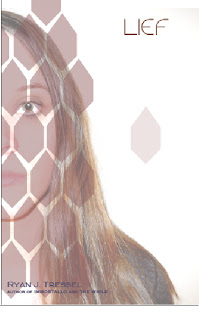
LiefLief is a woman whom we glimpse every four yeas on February 29, from age four to forty, but out of order. We are invited to read the chapters in any order, but this reader chose to read them in the order written, which is still non-chronological. One is given a vague sense that she, too travels in time in an unusual manner. She is a rather ordinary person, a bashful child and a slightly anxious adult who goes to college and tries to sort out her complicated familial and social relationships. But the level of emotional investment by Tressel in his characters is what transforms the story. Leif is shy. Her mother is a left-wing radical who occasionally ignores the children when she is caught up in her political campaigns. The father is quite affable, and gives everyone nicknames (he reminded me, for some reason, of the father in the movie Juno). The mother dies offstage, as it were, and when we notice the name of the brother changes and he is not an older brother but a younger one we fear that he, too (the older brother), may be dead, and are relieved when we learn he was estranged from Lief and later takes steps to get back together. These are the things that draw the reader into a story, any story. Lief often refuses to wear her glasses; she has an occasional problem with excess saliva that leads to apologies and self-deprecatory remarks. If she existed as a snake for part of the narrative she would be self-conscious over a patch of dull scales and would worry about where she was going to lay her eggs. She is always cold, because it is always February 29.

Both books need editing. Both use the term “alright,” which to me is like fingernails on a blackboard. One is not squeezed in a vice but squeezed in a vise. On the plus side, I learned a new spelling for “jissom.”