Showing posts with label Reviewed by Podler. Show all posts

Friday, May 7, 2010

The Editor’s Lexicon by Sarah Cypher

Reviewed for The New Podler Review of Books by Libby Cone

This is a very helpful book. It gives names to many of the pitfalls we try to avoid in our writing, such as scope (which I would call “getting bogged down in one little detail”) and info-dump (nobody wants to know that the conference table was rectangular or the taxi was drive-by-wire). The author even has the courage to use a passage from Stephenie Meyer’s Twilight to illustrate weak style! She includes typical editorial comments to demonstrate how one might come across the terminology, as well as book  excerpts illustrating good and bad execution and concepts that might otherwise seem obscure. It is a very short book, but its treatment of editorial lingo gives writers another tool for looking at their work with a bit more objectivity.

Technorati Tags: ,

Sarah Cypher is the author of "The Editor's Lexicon: Essential Writing Terms for Novelists" (Glyd-Evans Press, 2010) and runs a two-woman editing and book design shop, The Threepenny Editor.

Friday, April 2, 2010

Armistice Day by David Drazul

Armistice Day A firefight is unexpectedly interrupted by the arrival of aliens in the gripping opening chapter of Armistice Day.

Some fifteen months after the Overlords show up and lay down their brand of law, Aaron Osborne’s private security company is hired by Jeekyri, a Queezal, one of the races subservient to the Overlords, to provide security for the Armistice Day ceremony because of the possibility that members of the resistance will try to disrupt the ceremony.

In skipping the invasion battles, Drazul focuses his story on the aftermath of intervention and the keeping of the uneasy peace between the old defeated order and the new masters. Not everyone is happy with the new order, of course, and clandestine actors are secretly plotting to plunge Empire back into war.

As Aaron prepares for the event, several mysteries hang in the air, one involving the the other security company hired by the Empire, Bergen Security. Aaron doesn’t know much about them or even who had hired them. Neither does Jeekyri, at least initially. The company is based in Topeka, where a break in at the Imperial armory occurred. One of Aaron’s friends, Sal, thinks the company may somewhere be involved. There is certainly something suspicious about an outside company being hired when there were plenty of good, local outfits capable of doing the job.  Could Bergen Security be a front for the resistance? But how were they able to get the Imperial contract? Whatever the truth, one thing is certain, someone is playing a game and Aaron could be caught right in the middle of it.

Drazul creates respectable level of tension in the story as the moment of the ceremony approaches while the possibility that a conspiracy will disrupt it remains open. One of the more interesting plot twist comes when Aaron and his team are implanted with subdermal transponders by the alien who hired Bergen, though I suspect that greater suspense would be generated if Aaron did not know the alien’s connection to Bergen. When the mystery is finally solved, the story blooms into a thriller as Aaron is on the run for his life while trying to prove what really happened.

Armistice Day is not just an excuse for action, the store is informed by a surprisingly sophisticated appreciation of conquest politics, revealing it to be a world of secret games played by the Empire in order to subdue the conquered for their own good. These are dirty kinds of games involving betrayals and setups—alibis all for a more aggressive intervention by Empire. I wish, however, that Drazul had given us more here—his story of intervention certainly makes the reader wish Drazul had filled in more of the spots on the canvas of his vision: more about the Empire and its politics, more about the world chafing under its forces and perhaps a less optimistic ending would elevate this book from good to great.

This book is available from Amazon.

Tuesday, March 9, 2010

Null_Pointer by Ken McConnell

Null_PointerNull_Pointer is a fresh take on the amateur sleuth mystery genre with a hacker turned detective at its center.  The action takes place in a world just enough removed from the ordinary to make the story interesting. The high concept at its core makes it surprisingly satisfying.

The book opens with the mysterious death of an unnamed programmer from what appears to be a new type of malware that transports the victim into a deadly virtual reality.  Who is behind this and what do they want? And how can anyone kill with sounds and with images on the screen?

Josh Jones suffers from insomnia, a psychologically induced condition that is the result of his tragic past. When he was sixteen, his parents were killed in a car accident that he blames himself for causing. Now in his early 20s, Jones makes a living as a coder at RegTech and does well, he drives a Porsche. But he is a target of an clever and deadly enemy who has been stalking him for years.

Because he can’t sleep, he makes his way to work at a very early hour and discovers that one of the other coders, Glenn, is dead, slumped over by his terminal. At first the death appears to be nothing more than a consequence of poor lifestyle choices finally catching up with Glenn. Still, when Jones gets back home from the police station, he finds that he is rattled by the death. But when his friend Dancia drops by, Jones learns that a hacker called Zemo was found dead by his parents. Zemo’s death was not accidental: a hidden message suggests that someone has killed Zemo and that others are on the target list. Could Glenn’s death and Zemo’s be connected?

As Jones investigates, he discovers that the apparently unassuming coder at RegTech who went by the name of Glenn was really Themis, a hacker with whom Jones worked over the Internet on a college project called MyMovies. Jones discovers a secret message in the computer code—someone is targeting the members of the MyMovies programming team and Jones and Dancia are next.

Null_Pointer does a great job imagining the life of young computer geniuses. McConnell’s characters talk the secret language of root kits, localhosts, virtual machines, C sharp, kernel level access, shells and on, giving the reader a taste of what real hackers living inside a secret hacking culture might talk like. It is a largely hidden world of mostly young men with exceptional skills who make their own rules.  It is a murky world, too. Many of these computer demigods are only known by their aliases, making distinguishing between friend and foe difficult: you never know who hides behind the alias. Communication is done through IRC chartrooms and bulletin boards forums. Rarely do the players actually meet in the offline world. But the death of Zemo occasions a rare meeting between Jones and a security expert known as Psycho in search of clues.

A good part of the detective work involves finding system logs and tracing Glenn’s computer activity. Because nearly all of Glenn’s life has left a digital trail, Jones soon comes across the “how” of the murder -- not only can the images and sounds steamed from the Internet kill, they can also make you do things that you would not normally do:  the story is based on a clever concept that is likely and frightening and just maybe not developed enough. But the “who” turns out to be much closer to Jones than he imagines and much more involved with his family past than he knows.

See http://jjmysteries.ning.com/ for more information about the book.

Author’s website is http://ken-mcconnell.com/

His newest book is Starstrikers.

Sunday, February 14, 2010

Honor among assassins: Lines of Neutrality by S.B. Jung

No matter what your line of work, there’s always some kind of unspoken, professional ethic to it. There are certain things you are expected to do, and certain things that you just should never do. In my line of work, nicking someone else’s kill is at the top of that list. —Christian

Two assassins, both members of the shadowy Society of Assassins, are hired to kill the same target, a mobster named Dimitri Oshenka, causing one of them to break one of the unwritten rules of the game.  This turn of events rises the question, who hired two assassins to take on Oshenka and why?

Lines of Neutrality Christian recognizes Raven through his rifle scope as she kills Oshenka, and he decides to take her on to address the violation of unwritten professional assassin code. As a caged bird -- a term used to describe an assassin who is pledged to an outside organization -- Delacroix is of lower rank than Raven Yin, therefore risking a great deal, for she ranks above all others outside the inner circle of the Council itself, and her words as well as her actions are law: If she kills him, his death will mean nothing to the Society. But pride and anger won't let him walk away.

The two meet at Yin's favorite hangout, The Raven's Roost. Delacroix not only intrudes on Yin's place of rest, he sizes her up and makes her reveal her name in a public place – all highly disrespectful moves on his part that require, according to Society law, a blood duel to to settle honor. They make their way to her apartment where she gets rough with him and the truth comes out: they were both hired to do the same job by Tommy Marzano. The question that now remains is, why?

Part of the reason why the book was chosen by me to review was its interesting concept – two assassins hired to kill the same target – and its clever use of two alternating first person points of view that promise to take the reader on an unusual journey through the mental scape of unusual characters. As Raven and Christian tell their story, the reader gets a view into the workings of their minds, which is the best part of the story.

While the choice is interesting and initially compelling, it seems more suited perhaps to a story about how Christian and Yin develop a relationship rather than a struggle to unravel a mystery. Also the action sequences are lessened because they are described from the point of view of someone presumably used to them and therefore they come across as unremarkable. Indeed, the more you think about the point of view choice, the more it becomes apparent that an assassin like Raven would only consciously think about any action and killing if it had somehow been remarkable, given her experience. So all those sequences when she kills—Raven wouldn’t think much about them. That’s the problem with first person in this type of thriller, where presumably part of the attraction for the reader is the action: from a first person point of view of the assassin, such action wouldn’t be very noteworthy unless the action is fundamentally challenging and out of the ordinary for Raven, creating the need for her to plan and plot in her mind. But all we get are just reports on how she easily walks in and out of Marzano’s trap and other places and this makes for a reduction in tension and suspense.

The writing overall is fluent and clean, and it is much better edited than the average self-published book. But there are some issues, the biggest of which is plot, which is hardly a surprise as plot is the element that always disappoints in many self-published books. In Lines of Neutrality, the plot underperforms as well.

While the complication that Delacroix and Yin face in having been assigned the same target is compelling, it does not lead to the creation of a clear line of action that climaxes with the revelation of the answer. You expect the first part of the story conflict to be essentially defined by the problem of discovering the reason for Marzano having hired both assassins to kill the same target. For instance, you expect that the subsequent action follow some set of steps Raven and Christian would take, steps unique to who they are and to their world, in order to unravel the mystery. What is the process, for example, they would go through as members of the Society? Surely the Society must have some way of finding these things out, as it is more than likely that such a thing has happened before. But such issues don't inform the narrative's progress.

The next story movement has Yin go to collect the other half of her fee from Marzano. But how that relates to her problem of finding the answer to why he hired her and Christian is unclear. In this story movement Marzano tries to coerce Raven to work for him, a somewhat odd move on his part since he presumably knows about the Society and the fact that Raven, given her high standing, is not someone you can simply push around. No matter how stupid Marzano was, he wouldn’t be that dumb. The outcome has Christian assassinate Oshenka. Some other sequence is needed here, perhaps one that begins the process of making inquiries. Indeed, the only way, it would seem to me given this situation, that she could find out why would be to agree to work for Marzano. But getting rid of Marzano before they can find out from him why he hired them both, or before they can use him to ferret out the answer, is confusing. The question that began to the story—the why of Marzano’s actions—remains open. Rather than creating suspense, however, the open question only engenders confusion because Marzano’s death does not deliberate it.

Subsequent events are, consequently, somewhat confusing as well. It is unclear so as to whether Raven going to see Carlos Corazon is her taking a new assignment or Christian’s. The reason for the confusion is the bit in the apartment where Raven and Christian first meet. There she has a look into the envelope and sees him next assignment, but we never find out what this assignment is. If Corazon is a new assignment, then more is needed: How do assassins get their assignments? Is there a secret Society website? Do they get messages on the Blackberries? Or do they have to come into an underground center where they all meet and get new assignments? Such bits add to the verisimilitude of the story and make it fun. If someone else is the target, then that needs to be raveled, too, for keeping it a mystery seems to serve no deeper story purpose.

S.B. Jung's novel is certainly based on a promising concept and Jung can write fluent, clean copy, but Lines of Neutrality is lessened by its ineffective plotting.

This book is available through Amazon.com

Tuesday, December 1, 2009

Shooting an Albatross

Shooting an AlbatrossRevenge takes a generation to come to fruition in Shooting an Albatross, Lundin's above average first horror thriller. One day the lonely life of a ninety-something Floyd Akerly is interrupted when he receives a stranger into his home, thinking that the man is there to keep him company and listen to his stories. But the uninvited visitor with an unusual interest in events that took place over six decades in the past has a different agenda. Only Floyd's careful recollection of the past prevents the stranger from carrying out his plan right away.

As Floyd begins tell of the events that transpired during the late summer of 1943 in Hollywood, what emerges is a story of Floyd's jealousy and humiliation that eventually leads to a murder. In 1943, the PGA Golf tour is suspended because of the War, but that does not stop an admiral and an Army general from descending on Hollywood's' El Rancho Golf Course to settle a bet through a game of golf. Because neither man can play, each partners up with a serviceman who can play golf. Evan Wilkins is chosen by the Army general and taken out of the normal Army chain of command, a move that annoys his commanding officer, Major Floyd Akerly. He becomes upset by Even's unexpected entry into the world of Hollywood's power elite and his relationship with a mogul's beautiful daughter, Amanda. The relationship between the young Amanda and the serviceman deepens into true love. The two end up kissing, an act witnessed by Floyd. In a fit of madness, jealous Akerly decides to sabotage Evan's chances of winning the game in hopes of destroying the private. But Floyd's plan backfires and he loses everything. Demoted to private, Akerly decides on taking the life of a man he blames for everything.

Shooting an Albatross is a smart horror novel that excavates the darkness that dwells in the hearts of men with assured sophistication. Floyd is not portrayed as a caricature, as evil characters often are in fiction; rather, Floyd Akerly is shown to be a man who does not seem to be able to feel or love. He is attracted to external manifestations and pursues them with external means, and in his path he leaves destruction and maimed lives. In a way, he is a tragic character because he unknowingly creates evil as he tries to fulfill his desires, for if he were able to perceive the inner lives of others, he would probably not act as he had. But we all must face the fruits of what we sow, and so Floyd Akerly comes to face in his latter years the man that he created. Lundin's plot in Albatross is of literary quality, and Albatross is a study in the nature of evil, deliberating on its origin and tracking its progress through human lives as it leaves a trail of destruction and suffering, moving from one generation to another, from one life into another, like a terrible infestation poisoning all that it touches.

Available on Amazon.

Saturday, April 4, 2009

A Death on Skid Row

ThresholdTHRESHOLD
by Bonnie Kozek

Available from Amazon.com

Only in her mid-twenties, Honey McGuiness is already an old soul who seems to have lived a life twice as long. A self-described loner and outsider with no connections and no meaningful relationships, she hides from life in a self-imposed exile from society in Los Angeles' Skid Row, wallowing in the gutter along with the rest of the damaged persons. Of course, Honey is not like them; she could be somebody, as one of the other characters insists, but Honey neither believes that, nor does she want to hear it from anyone. There is something dark in Honey's past, something that she's not yet ready to accept and deal with, and that something is killing her chances at life and living.

Honey is not completely isolated, however. There is one person in the world of the homeless that she has a thing for. Not that this thing could ever be anything other than it is, a simple a connection that's pretty special to Honey's jaded self. Billy himself isn't much. For one thing, he is blissfully unaware of the world around him, including Honey's attention. And he communicates in seemingly random rhymes out of the words that he hears around him, like a parrot. But there seems to be something innocent about Billy, something genuine, something that draws Honey. Billy is the only person she cares about.

Working at the urban mission, living in a building targeted by developers, and Billy seem to be the building blocks of Honey's new life in hiding. But Honey's skid row honeymoon from reality is shattered when Billy is shot by unknown assassins. Dying in her arms, he whispers “mother.”

Shattered by the death of her simple friend and thirsting for vengence, Honey launches on an all out, one-woman investigation into Billy's death. That a recording device was strapped to Billy leads Honey to suspect that Billy was being used by the police, a turn of events that she finds particularly upsetting for how the system had used Billy's innocence.

In her quest to get even with the slimy players responsible, Honey encounters the last boyscout, an idealistic cop who still lives by long-gone values of right and wrong, joining the force in order to do some good. The two become close, ersatz partners, each on an idiosynchratic quest for justice. In order to turn up some leads into Billy's death, Honey herself must descend into the local drug scene. The first real contact she meets is Abel, the street boss and drug dealer with an unlikely conscience. But is this the same man whose name is mentioned on the tape she recovered from the recorder on Billy's body? Through Abel she meets another player in the drug scene, Mr. V. But Honey is treading in dangerous waters, for Mr. V knows far more than Honey suspects, and before she knows it her world erupts with violence.

Threshold is stellar writing, a work populated with complex characters, and a story with a hypnotic narrative pull. And Bonnie Kozek is a talent to watch.

Saturday, March 28, 2009

Have you made the deadly exchange?

Deadly ExchangeDEADLY EXCHANGE
by Geoffrey Gluckman
Published by iUniverse 2007
Available on Amazon.com

Jennifer Chance is not the person she thinks she is. Apparently an über successful motivational speaker, Chance is more than a corporate drone without a life outside her job. She is a person whose past has been erased five years ago through a combination of drugs and mysterious electronic frequencies by a sinister cabal in control of a nefarious technology, a technology that they plan to use on the public at large under the guise of a workplace enhancement technology. Their goals are simple—to hold America hostage, and the world. If you like the FOX Dollhouse series, you'll probably enjoy the ideas behind Geoffrey Gluckman's Deadly Exchange, a rather frightening entry in the mind control genre of thriller. But Deadly Exchange is more than just a thriller. It is also a warning.

Despite the drugs and the transmitter she wears constantly on her person, Chance's artificial persona begins to crack after she reads a mysterious line in an obscure book. This seems to trigger a personal crisis for Chance, one she decides to deal with by requesting a break from her work.  This request does not go over well with her handlers, but they reluctantly accommodate her, setting in motion a chain of events that makes them wish they hadn't been so understanding, for it brings her in contact with someone from her past, a man the cabal spent a great deal of effort making her forget.

Frank Revere is still blaming himself five years after the loss of his beloved Sarah in an apparent hit-and-run. One of the more troubling aspects of the event was the mysterious disappearance of her body, a fact that Frank could never resolve. The need to take care of some last unfinished business brings him to San Diego, where he meets Jeniffer Chance and the two begin a relationship, both unaware that they have a common past that had been taken from them by a malignant cabal.

People as playthings of sinister, shadowy powers manipulated into doing things that they would not otherwise contemplate doing, stolen memories, and frequencies that kill make for a fascinating and scary scenario underlying Deadly Exchange. One question that always suggests itself in those types of books is whether or not the characters ever free themselves from these sinister manipulations. They do face very clever and resourceful foes that seem to be way ahead of them at the start. Can Jennifer Chance regain her past? And will she be able to live a life of freedom, once she does? Eventually, she and Frank will have to take on the unsavory characters at the heart of the murderous conspiracy whose aim is to hold the world hostage with a mind-altering electronic frequency weapon if they hope to ever be free. Good thing they have help from men like Peter Wellington and others with the skills and knowledge to go up against the Director's cabal.

Fast moving, filled with realistic action and dialog, based on careful research and clever extrapolation, Deadly Exchange is a riveting spectacle of thrills and chills that comes with a heart and soul, filled with hope that true love is never lost and that there are greater powers at work in the universe than the plots of men who dwell in the houses of clay. More than just some thriller you put away after a reading, it is also a warning about making bargains with personal freedoms, deadly exchanges that in the end produce a bitter harvest.

Wednesday, March 4, 2009

Ether

Ether Ether
by Kristine Williams

Daniel's uncle Frank was a man with a penchant for the fantastic. He was certainly a source of great stories that Daniel fondly recalls from his childhood. But there were also props, toys and objects that his uncle claimed were proof that his fantastical stories were true after all.

When Daniel inherits his uncle's house, he does not expect to receive a key that opens a doorway into an alternate reality and adventure. But when Daniel uses the strange key on the key ring to the house, he falls out of his reality and right into the path of oncoming traffic. The traffic altercation brings Daniel and Ian Foster to the attention of Sheriff Murphy, who interprets Daniel's disoriented behavior as proof of his otherworldly status. He's had plenty of experience, for there were others, visitors from Daniel's world, who had come passing by on their travels through Ether. Daniel has a problem, however; in order to get back home, he must use the key, but his key is left back in his reality, still stuck in the door lock. His only hope now is to find another key, hidden somewhere in Ether.

Soon, Daniel faces his new reality and a quest for the second key, traveling through Ether courtesy of Ian Foster and his balloon ship, which is not completely unfamiliar to Daniel—he had seen it before, a model of it in his uncle's house. Their journey takes them to a giant forest, where people dwell inside trees hollowed out by enormous worms. Daniel takes part in a worm hunt and earns a tooth keepsake from the beast.

Each environment they pass through offers some sort of danger. In the swamp there is the Tree of Lives, a particularly nasty things that uses the sense of the victims for its own. And in the maze there is the mold that can make you forget your name, then more, until you forget to live. Then there are the zombified, who have lost their memories due to the spores, roaming the maze aimlessly until they die.

Ether is an imaginative adventure story that's worth checking out if you love Dr. Who or watched Sliders or the Stargate series. Though smaller in scope, Ether still manages to be entertaining for those who love the idea of traveling between different worlds.

Friday, January 16, 2009

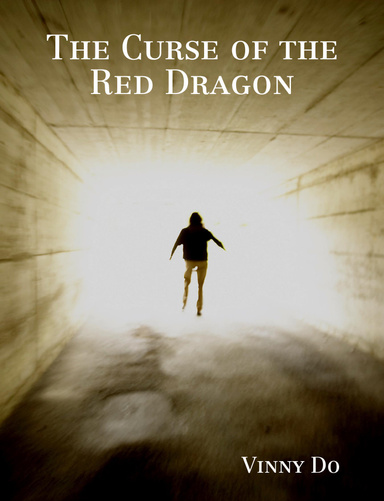
The Curse of the Red Dragon * * *

book cover for the curse of the red dragonTitle: The Curse of the Red Dragon
Author: Vinny Do
Genre: crime drama
Pages: 136
Available from Lulu

Lee is a teenage boy living with his mother when he first kills a man in an initiation into one of Melbourne's underworld factions, a triad called the Red Dragon. Will he continue on his path of violence, encouraged by the dark father figure of John Lang, the triad boss, or will he bail out before he becomes like John?

Lee's home life is saddening, for it is filled with deep emotional pain. There are many reasons for this pain: he doesn't have a father in his life; he is a failure, unable to be the man of the house and take care of his mother; and he is unable to succeed in the mainstream world. Understandably, he also wants to make good in the only way that seems, to him, to make sense.

Gangster John Lang, the boss of the Red Dragon triad, takes Lee under his wing, testing him, shaping him through various assignments into a gangster like himself all the while remaining unusually gentle with the boy. But Lee's course is complicated by the desire of his heart for meaningful human contact, which he finds in the embrace of a prostitute, who listens to his story. She is the only person he opens up to, revealing to her the hole in his heart. But in revealing this he makes himself vulnerable and puts himself in danger. It also causes a problem for John, for Lee is more than just another kid to him.

The Curse of the Red Dragon presents characters with real dilemmas. A young man searching for fulfillment. A deeply flawed father who tries to make his son see the world in the way that it appears to him. And the rest of the cast whose lives are empty and flawed because they have given up on faith in love and in humanity. One of the lessons that John wants to teach Lee that love doesn't exist. His intent is to spare his son the feelings of failure and despair that come when love ends. Money is the source of power, John believes, and the only saving grace. To teach these lessons to Lee, John orders him to kill two members of a rival triad.

One thing that's missing in this book, and in many self-published books for that matter, is a better sense of place and time. Some writers may feel that by generalizing, they make their work universal. But nothing could be farther from the truth. Don Maas, in his masterful book, Writing the Breakout Novel, argues that it is the powerfully evoked sense of time and place, which creates a powerful sense of reality, that marks the breakout work from the average. I tend to agree. For example, I would like to see the place and time of The Curse of the Red Dragon more clearly evoked in the story. It would certainly add to the story's power if the reader knew more about the particulars of the life of Lee, John Lang, and the Asian world in Melbourne.

Wednesday, December 17, 2008

The Ant King & Other Stories * * * * *

book cover for The Ant KingThe Ant King & Other Stories
Benjamin Rosenbaum

A surrealist masterpiece of fantasy that's hilarious and macabre, reflecting our strange reality in its mind-bending world, The Ant King is filled with soul-shuddering wisdom. This brilliant collection is about integrity, love, belonging, the loss of place of the male in the social order, Jewish Diaspora, God, good and evil, and being alone in a universe that is ambivalent, unavailable, incomprehensible and filled with suffering. Rosenbaum begins in fantastic places, then adds on more layers of fantasy besides and before long you seem to lose your footing, carried along on a fun house ride through the absurd landscape of the human experience.

In the first story in the collection, Stan goes on a quest to rescue his former love from the Ant King while his gumball empire evolves and mutates to the point where Stan, it's founder, ends up seeking employment at the company which he founded. The story expresses the absurdity of corporate and personal life in which people no longer act like people Stan imagines that they should act. They act as they want: they lack integrity, change at a moment's notice, and ultimately leave him alone and abandoned. But reality changes in bizarre and incomprehensible ways and before long Stan is back in the revolving kaleidoscope, stumbling toward some unknown end like a character in a computer game.

In "The Orange," an Orange rules the world from a Florida orange tree branch, but is then picked, traveling from the branch, through the national fruit distribution system, dispensing miracles and graces along his way, finally ending up in the mouth of the narrator. The last two paragraphs come like a thunderclap:

I bought the orange who ruled the world for thirty-nine cents at Safeway three days ago, and for three days he sat in my fruit basket and was my teacher. Today, he told me, “It is time,” and I ate him.

Now we are on our own again.

In a story titled "Fig," a tragic story of unrequited loyalty runs its sad course. Another stunning piece is "The Blow," where detective receives a blow to the head from the villain, then spends the holidays at the villain's house, unaware at whose table he's eating his sweet yams and ham.

A theme that runs through the collection is that of a problem of perception and the sorrows that it confers on those unfortunates whose perception is flawed. The more we hang on to what we imagine the world should be like, the more we suffer because the world isn't nice, denying us our dreams. Where have these perceptions come from? The perfidious Greeks: Aristotle and the Athenians imagined an orderly world which is surmounted by the ideal of ideals, the highest good. The Medievals continued this hopeless project, imagining a hidden order and a Plan. But the world isn't simply that simple. It's much more complex and our attempts to reduce it to a formula we can comprehend is at once a sad expression of our arrogance and hubris and a lost cause that brings us only suffering.

Rosenbaum's genius excavates an unknown world of wonder and terror that lies buried just under the surface of our perception, showing us that reality is much more complex and unknowable than we thought.

Rosenbaum's interview at Locus
Rosenbaum's website

Tuesday, December 9, 2008

Waiting for Spring * * * *

Waiting For SpringWaiting For Spring
by R.J. Keller
Available from Amazon

Waiting for Spring opens with an image of a path on which nothing will grow. The earth is just too hard, having been long trodden, to admit new life. Such is the heart of Tess Dyer, the protagonist, who lives in a world marked by emotional abuse and the absence of love. Tess yearns for spring.

The place was hidden from the road by thick, bushy pines and naked maples. The driveway was a little rough but already plowed, which was a good sign. The house itself was white. Two story. Small and very old. Old enough to explain the low rent. Enclosed porch with lots of windows. There was no garage or barn, but there was a decent sized shed beside the house. It was white, too, but looked much newer than the house. And beside that stood a little orchard; five bare, snowy apple trees.

There were no other vehicles in the driveway. I parked facing the orchard, kept the car running. Stared out the window at the trees. The heater was running at full blast. I still shivered. I’d been shivering for five months. No. I’d been shivering longer than that.

My heart was Titanium White. Arctic Wasteland. Hard, trampled soil covered with ice. The frozen orchard seemed to say that it always would be and the tears came. Finally. Stinging and bitter, but quiet like always, and I looked away from the trees, looked down at the dashboard. Oil light flashing, neon red. I stared at it, tried to imagine my engine; tired, hot, low on precious blood. The neon light liquefied, blurred, floated as my eyes filled past the point of choking it all back. I glanced up to let them spill over, hoping I’d be able to dam up what would want to follow. Squinted my eyes against the tears.

And that’s when I saw it.

Bare, icy trees; eerie and still. They almost looked dead, but they were really only sleeping. Waiting for spring. The red light caught in the pool of tears; refracted, projected, and I could see it. I could see what the orchard would look like covered with blossoms. In the spring. Alizarin Crimson, Dusty Pink--starry, superimposed on the wintry scene. Like covering a photo with a clear sheet of plastic then drawing on it with dried out marker; shadowy and transparent. But real. So real.

When her marriage to the small town sports hero ends in a divorce, Tess, an unsuccessful artist making a living as a cleaning lady, moves to a small rural Maine town of New Mills, where the beloved local cleaning lady had been murdered by rampaging teens, to start a new life. Conveniently, her new neighbor, Brian LaChance, happens to be an available attractive male with whom she can start something new. Despite a wound of a broken marriage, Tess finds herself attracted by the small-time charm of the younger man as she tries to fill her life with something. Will she be able to find love or will spring never come? What can break through the hardness of heart?

There are many impressive things about Spring that I want to mention. What impresses me about Waiting for Spring the most is the writing. R.J. Keller is a good writer, as you can tell from the excerpt above, and there are some good lines in the book that are worthy of a good independent film.

But Ashley had a suggestion.
“You can come, Brian. If you want. That way you can keep an eye on her.”
He didn’t even miss a beat. “Nope. We already have plans.”
She looked at me and I gave her an eyebrow.
That’s right, honey. While you’re getting drunk and stoned with your little friends he’ll be in my bed. Fucking me. Stuff that in your training bra.

Another impressive aspect of Spring is the humanity of its characters—Tess and Brian seem human for two reasons. They have personal struggles resulting from understandable yearnings and conflicting emotions. But the two are not the only characters who seem real. All of the characters in the book are trying to make love grow but fail miserably in their attempts, generating only enmity and conflict. All are deeply flawed. Brian's sister, Rachel, struggles with a drug problem that boils over into violence. All are deeply needy, but they are unable to give one another what they need. All have become hardened of heart as a result of being in one another's lives. And all are yearning for rebirth. Perhaps the most awesome moment in terms of character comes at Thanksgiving, when Tess and Cass have a conversation. The contrast between what Tess had been told and what she herself tells Cass reveals how she had evolved as a person in a moving and poignant way. Not only are the characters real, they inhabit a realistically portrayed world populated by secondary characters who seem alive. Someone once said that you should write about that which you know, and R.J. Keller certainly knows the world that she chose to portray in her novel. I think that there are more books to be written about the characters in these two towns.

Waiting for Spring deals with a perennial theme in popular American literature—the yearning for rebirth and the desire for a second chance—in an honest and human way. But there is a way to be too honest, and Spring is not what it could be because it does not stray from reality much. Part of the tragedy of the characters in Spring is their inability or unwillingness to express themselves or to understand others. Tess's tragedy is that she has no actionable goal, and therefore no hope of achieving it. Wanting a new life is not a goal; it is a desire that is dramatically irrelevant until a character particularizes it in terms of a specific goal. She lives a real life, and failures and pain are a part of that life. But we don't want to read about how characters fail or about how life really is. We want to read about the potential for hope expressed through struggle for something that stands for that hope. Characters who hope for something are deliberate in their action. They are always moving toward some goal. Tess isn't acting toward a goal. When Rachel dies, there is nothing she can do to keep Brian in her life. But Tess should have something, some lifeline, that she can use to stay with Brian. She must be able to do something.

Waiting for Spring is a story of lives in the small world of rural Maine, filled with ordinary humanity of flawed men and women as they hope, pray, and suffer their way toward rebirth of spring and new life.

Wednesday, November 14, 2007

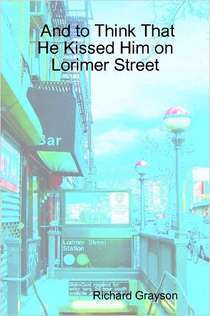
And to Think That He Kissed Him on Lorimer Street by Richard Grayson (A)

And to Think That He Kissed Him on Lorimer StreetRichard Grayson is a prolific writer of over 200 stories, articles, and books. In the 80s, he staged a satiric run for the White House against Ronald Reagan. He has obtained a J.D. degree from University of Florida with honors and is, in addition, a master satirist and a keen observer of the American scene from his own and unique viewpoint. Grayson writes in a deceptively simple style that is, nevertheless, hard to imitate. Using this kind of autobiographical method, bordering on a confessional, Grayson looks through shifting viewpoints (gay and straight; white and black; American and immigrant; young and old) at the people, times, and palaces of a fictional Brooklyn.

In these fictions, Grayson meditates on various topics, mostly race, sexual identity, age, and change by using the device of popular culture, mixing in liberally the icons of pop culture with persons and places from memory to construct a solid literary edifice.

The collection is filled with resonant stories about the lives of ordinary people, and this focus is what makes them interesting and memorable. Somehow, though Grayson's master touch, the ordinary becomes fascinating and highly readable literature. Many of these stories, however, reflect a deep sadness that exists in the heart of the common man and his experience. Nothing seems to happen for the protagonists in these stories, their lives stupefying their subjects. Grayson reminds us with his fiction that our lives are, in the end, rather banal, revolving around the mundane, the ordinary, and the common. At the same time, there seems to be a kind of weird current of apathy that flows beneath the surface of the stories. In the title story, we wonder, for example, whether the narrator is incredibly open-minded about his son's sexuality and the kiss between the boys, or whether he's just too apathetic to care, and we wonder because the title seems to be a kind of subconscious expression of protest by the protagonist. Apathy, or more precisely, a kind of stupefaction, perhaps synergized by the bathos of pop culture, rears its head in "Shirtless Tea-bag Eating White Boys", in which two characters, one stupefied by Haldol, the other just tranquilized by American culture, watch internet videos, which somehow are appropriate for the mentally dysfunctional character and the young elementary school teacher; the first prefers to watch a purple hippo, and the latter prefers to view shirtless tea-bag eating white boy clips.

Some of these stories are biographical, and those are the stories that I like the best. Especially likable are "Branch Libraries of Southeastern Brooklyn", in which Grayson's character reminisces about the libraries that he had known and how they had evolved over the years-this one is probably my favorite story, as I do love libraries, and it seems that Grayson is a true lover of the library as well-and "The Lost Movie Theatres of Southeastern Brooklyn and Rockaway Beach", another story of nostalgia and memory, where we are treated to reminiscences about the various theatres that the author remembers. "1001 Ways to Defeat Green Arrow" deals with change in gay relationships and the longing and emptiness that result. "My Life in The New York Post" is a collection of strange but somehow funny clips from, apparently, the Post regarding a fictional Grayson's plots and schemes.

Other stories that I liked were "In the Sixties", a kaleidoscope-like summary of the Sixties; "Diary of a Brooklyn Cyclones Hot Dog", which deals with the life of a lesbian Uzbek immigrant who is promoted to being the Relish in a Hot Dog Race; and "Mohammad's Therapy Monkey", in which the protagonist, a college student with some issues is assigned a roommate with a pet monkey, which helps him find acceptance and a relationship of his own in a place that he detests.

Grayson chronicles the real through his funny, sometimes sad, but always genuine, if slightly offbeat, fictional world.

Richard Grayson has a website at https://www.richardgrayson.com/
Grayson has been interviewed by Geoffrey Philip.
Grayson's Wikipedia entry is here.

Thursday, November 8, 2007

Legends of the Plastic Chairs by Patricia Curtis (C)

Legends of the Plastic ChairsLegends of the Plastic Chairs is our first non-fiction submission and it comes from Patricia Curtis. I was mildly interested by the title when the pdf file first entered my mailbox. What are the legends of the plastic chairs? I decided to start reading.

Legends is a memoir of spiritual journey, written by a mystic, and a story of the ultimate reality of life-the battle between good and evil, light and darkness, in each and every person, and the path that Patricia Curtis walked through that battlefield, leaving her scarred, frightened, but ultimately victorious in the end thanks to a mysterious presence of light that was always at her shoulder, encouraging her when things seemed to be at their worst.

There are some aspects of the story that may seem a bit far fetched if not outright false, especially the Voice, that was at Patricia's side, and I think that the more cynical readers might find the book unbelievable or worse, but I find it meaningful because it is unflinching about the truth of basic human experience-yes, there is evil in the world, and that evil comes from, as the author calls it, a hardness of human heart. A hard heart cannot hear a soft voice-how true that is! But there is also light, and those who chose to walk in light are ultimately victorious. Reading this book, I am also struck by how similar it is to the books written by Saints and other mystics through the ages. All of those people have glimpse some other reality, been in intimate contact with forces and beings of light, and so is the author of this book. What might set off the cynical reader, however, is the often spare portrayal of the people, places and events in the author's life.

The force of darkness in this life experience was the author's father, a man filled with hate and anger toward his daughters, a man would could not see the good in himself or anybody else. He was a man who deals with his despair and emptiness by being abusive toward his three daughters, blaming them for their mother's mental illness, and even abusing one of them sexually.

The narrator manages to free herself of this toxic influence and sets out on her own. But the experiences are, again, painted with a broad brush, and the lack of detail really undermines the story being told. I'd like to know more about her life as she worked in the auto parts store, more about who her friends were, and more about her experiences. More about running a business and so on.

Although I like the underlying story, I have some problems with the execution--one huge problem is the lack of more details; the author tells and summarizes too much instead of really getting into the moments of her life by vividly presenting events in form of scenes. This lack of detail makes the story seem thin and sometimes less than believable. This is too bad because the story is an important one.

Realm Shift by Alan Baxter (A)

Realm ShiftIsiah, once a mortal man, is an agent of The Balance looking for Samuel Harrigan, a man whose untimely death is about to upset the balance of powers between the gods and between good and evil. Isiah leads an interesting existence, wandering the earth as a kind of divine repairman. Now he must repair a doozy.

Realm Shift is an inventive and action-packed story set in the shadow land where the supernatural and the mundane meet head on. One of the more inventive aspects of the story is the idea that people create their own god simply by believing in them. Of course, this means that there are many such gods and that without The Balance, a mysterious force that keeps the order, there would be chaos and, eventually, one god would reign supreme. Harrigan is a man who can prevent such a thing, and Isiah must keep him alive and guide him to fulfill his destiny of killing an assassin. Will he succeed against the full fury of the Devil and his minions who want Harigan's soul before he can fulfill his destiny? Will he snatch Harrigan's soul from the very bottom of Hell and Devil's grasp?

I liked the narrative drive and the interesting concept that Realm Shift is based on. I think that it would make an excellent movie - Realm Shift is definitely a hot concept property waiting to be plucked by a Hollywood creative exec.

Author's Website

Friday, November 2, 2007

Turtle Boy by Kealan Patric Burke(A)

book cover for The Turtle BoyThe Turtle Boy is a powerful story about ghosts of the past and about how those ghosts can wreck havoc in the lives of those who uncover their secrets.

It begins with two boys, Timmy and Pete, trying to figure out how to spend their time. As they consider various options (digging a hole, playing by the rain tracks) they end up near Meyers Pond, where they discover a strange kid is sitting at the bank. This boy is not only a stranger, but he is also strange-looking, and he has a secret that will change Timmy's life. The idyllic mood is broken when the boys see the way in which this stranger is feeding the turtles. The revelation is doubly shocking because it is set against the peaceful background of the boys' lives. Through it, a horror enters into the life and the imagination of Timmy and won't let go, causing thoughts of speculation about what he'd just witnessed to spring unceasingly from his perturbed mind. The impact of the event continues, like poison spreading from a bite wound, seeping into the friendship between Pete and Timmy, destroying it, and causing pain and sorrow for Timmy through the realization of the true feelings that Pete's father has toward Timmy's father.

Turtle Boy is a simple but masterful story. The author skillfully reveals, through superb writing, the power of thoughts, realizations, and ideas in shaping who we are and how we think: he shows how what happens can alter who we are, even if we don't want to change. Timmy has no choice in what is happening, no choice in facing the revelations that alter him and his life forever. He has no choice because he is part, as we all are, of a web of existence in which each life touches and influences another, sometimes years hence.

The story is masterful because, on the surface, nothing much seems to have happened—two boys saw something weird and strange—and yet so much happens as a result of what they see. This is masterful, character-based, writing where a simple alteration of the ordinary unearths a wealth of implications and forces things to change in unexpected ways. Indeed, the incident unleashes a great deal of anger from Pete's father, a man who's taking the death of his wife hard, and whose temper is on a short leash, shortened all the more by abuse of alcohol. At first, the reaction creates a mystery-why would Pete's father react as he did? Is he merely concerned about Pete's safety, or are other factors at work in his reaction? As the story progresses, it becomes clear that Marshall is a troubled man, haunted not only by events of the present but by the events of the past, but the full extent of his troubled character is only revealed, linking itself to the story of the Turtle Boy, in a shocking finale. Timmy, however, finds no peace in the resolution, only questions that continue to trouble him.

Turtle Boy shows us that horror is all around us, but it is hidden away in the folds of time and memory, waiting to be unleashed and to ruin those who are unlucky enough to pierce that curtain. Turtle Boy is definitely a memorable story.

The author has a website at kealanpatrickburke.com

Tuesday, October 30, 2007

Mind + Body by Aaron Dunlap (B+)

book cover for Mind + BodyA sudden death of his father, a large inheritances, strange new powers of mind and body-these are the elements that suddenly disrupt the ordinary life of teenage Christopher Daniel Baker's life in Mind + Body by Aaron Dunlap. Aided by his friend Amy, Chris goes on a search to find answers to these puzzling events, trying to figure out who he really is. Before long, it becomes clear to Chris that the government is somehow involved: some mysterious entity is paying off the principal of Chris' school to keep him out of trouble.

Mind + Body is story that manages to create a mystery that is involving, particularly because it touches on some interesting subjects such as multiple personality, and the psychology and genetics of love and mating. The characters seem to find not answers but only new threads of something mysterious that seems to keep growing in magnitude. One wonders how are all these things are related to what is happening to Chris. This is, of course, the way that all good mysteries are supposed to be-some unexpected, incongruous, event takes place, compelling the character to search for answers, only to have him find new unknown elements that somehow relate to some huge mystery. There certainly is a huge mystery at the heart of this story, and it has to do with Chris and who he really is.

Another nice feature is the wealth of information that the writer infuses into the story, stuff like Austrian passbook accounts, USB drives that steal information, and a few other bits that remind of Clancy. Thrillers gain from a richly imagined world, and Dunlap is infusing his story with such rich and interesting detailing that it makes you feel as if you're participating in the story by learning. This is one reason why Clancy's stories were so popular-the reader was learning the secrets of global politics, submarine warfare, and other neat stuff, even if it was all pulled strictly out of thin air. Learning can be involving and can increase the reader participation. Something of that sort is at work in Mind + Body.

Of course, there are some glitches in this offering. For one, there seems to be no antagonist, the guy or guys who are out to do our protagonist in. In the Bourne Identity there were people who were trying to kill Bourne, but there is no one who is chasing Chris in Mind + Body, and I think the story would be better if there were. Nevertheless, Mind + Body is an interesting story written by a writer with some talent.

Reviewed by Podler

Thursday, October 25, 2007

Autumn by David Moody (A)

AutumnAutumn is the story of post-apocalypse England, and it opens with these blockbuster lines:

Billions died in less than twenty-four hours.
William Price was one of the first.
A brief, terrifying prologue follows, and like lightning it augurs a story of a world after a calamity. The first chapter plunges us into the world of Carl Henshawe as his ordinary routine is slowly being disrupted by the epic disaster at work in the world at large. I was instantly gripped by the way that the disaster seeps into Carl's world. We are eased slowly, one small incident after another, into something incredible.

The writer takes his time drawing us in, and this creates a great deal of suspense as to what is happening, and why Carl seems to be unaffected by the apparent plague that strikes down everyone around him. Slowly, the creepiness and horror of the events sink in as Carl proceeds down the motorway, discovering cars crashed or stopped abruptly, their occupants suddenly dead.

There is something of Hitchcock here in the way that an existential terror is evoked by the action of a lone character going down the highway, discovering dead drivers in their cars. By the time he reaches Norwitch, his hometown, he has seen about fifty bodies. By now, dreadful tension fills the story as we watch Carl proceed toward his home, he only just becoming aware, because of the shock he had already suffered while discovering the bodies on the motorway, that his family is probably dead. When he reaches home, he finds his wife, baby, and mother dead. We're glad for Carl because he didn't have to watch them suffer as Price did in the prologue. But the effect on Carl is shattering:

I spent hours stepping through the bodies just shouting out for help.

This ending to the first chapter is simply awesome - in one sentence the author has reveled the humanity of the tragedy and bound our sympathy to Carl's plight. But what Carl went through is only a tease of things to come, a foretaste of the horror that Michael Collins witnesses as he speaks before a class.

What is happening to the world? The question arises as one reads about the events. Any number of answers are possible, creating a degree of tension and suspense. But the ultimate explanation is hidden, only to be revealed latter one cold morning.

Autumn is the story of Carl, Michael, Stuart, Emma, four among a number of survivors of the plague that turns the dead into zombies. I like the way that the author shocks the reader—first presenting the survivors in the community center, trying to cope with the loss of their loved ones, trying to decided what to do next in the unimaginable situation—then ups the ante as Michael ventures outside one morning and discovers that one of the dead is apparently alive.

The living dead are made believable because the author develops horror from the ordinary slowly turning into the terrifying. This is the true method of horror and it works well in Autumn. A less skilled writer would have had us witness some violence and gore, but that would only make the story unreal and indistinguishable from the cliché. In Autumn, the reality of the vision is reinforced because the author stays, wisely, away from the violence motif that permeates zombie stories, and focuses on what might, arguably, happen in such a situation. Instead of immediate violence and flesh eating, there is a more nuanced approach here as the survivors try to learn more about what is happening rather than immediately reaching for the gun to defend themselves. By once more focusing on the ordinary reaction-the curiosity of the survivors-the story maintains realism and horrific tension. Here the survivors approach one of the living dead and try to get her inside to study her in the hopes of figuring out what's happening:

Emma jogged the last few steps and moved round to stand in front of the body. She looked up into her glazed eyes and saw that they seemed unfocussed and vacant. Her skin was pale and taut, as if it had been stretched tight across her skull. Although she was sure that the body couldn't see her (she didn't even seem to know she was there) Emma respectfully tried to hide her mounting revulsion. There was a deep gash on the woman's right temple. Dark blood had been flowing freely from the wound for some time and had drenched her once smart white blouse and grey business suit.

"We want to help you," she said softly.

Still no reaction.

I think that this is much more terrifying and the horror is so much greater than what would have been had with simple violence. A tense situation results as the corpse interacts with the survivors. The scene is developed with humanity and objectivity that enhances the scary nature of the situation, creating a creepy sense of calm.

After a while, Emma, Michael, and Carl set out on their own, find a house tucked out of the way and the tension drops as the biggest threat seems to be boredom. But it becomes clear in the days that follow that the undead are becoming increasingly more alert and aggressive, roused somehow by the noise that the survivors create. But the challenge that the undead pose to the living comes across as a kind of nuisance rather than a genuine danger, and this make the tension and suspense evaporate. A sense of foreboding is created, however, by the knowledge the characters have that there seems to be no place where the undead cannot find. I am a bit disappointed by the way the undead behave, and the consequent loss of tension and suspense in the story. Tension and suspense should mount, and here it seems to evaporate. Another thing that is disappointing is the lack of a clear resolution—the question whether there is a place where the characters can lead a semblance of a normal life remains unanswered at the end of the volume.

The author has a website where you can find this and his other work. Autumn is being made into a movie.

Wednesday, October 24, 2007

Undercover White Trash by David Kilpatrick (A)

Undercover White TrashComedy is hard to pull off, but David L. Kilpatrick does just that in Undercover White Trash. The novel begins when Big Billy Barnes, owner of a chain of BillyMart stores, questions the advertising campaign put together by the Dickey advertising agency.
“A typical American family?” Barnes repeated as he lifted up the ad with one hand and pointed at it with the other. “What’s this man wearing, son?” he asked as he pointed to the father figure.

“A...suit. A suit and tie. And a white shirt,” I observed.

Barnes replied softly, “A suit and tie. And a white shirt, right?” I nodded.

Barnes’ face suddenly flushed and he shouted at me so loudly, I could smell his cigar breath all the way across the conference table. “Son, the only people who come into my stores wearing ties are cops looking for one of my employees for a parole violation! And the broad; she looks like she just stepped out of the Neiman goddamn Marcus catalog, pearls and all.” Barnes took a deep breath and continued. “You ever been in one of my stores?” he asked. I thought for a minute and shook my head. He then looked at the other executives. “Any of you shitbirds ever been in a BillyMart?”

And so begins the quest of Edward Prescott III to discover the ins and outs of the white trash culture. Undercover White Trash is a good piece of writing. The first thing that impresses me is the simplicity of the concept—a guy enters an alien culture incognito in search of its secrets. Kilpatrick spins the spy trope in a fresh way and shows what creativity is at it’s best—taking what is already familiar to the reader and spinning it in a new way. The author also moves directly into the protagonist’s problem—living in a different culture than that which he comes from, creating tension by juxtaposing a privileged young man with a subculture that is as alien to him as something in the pages of National Geographic, then plunging him into it, “like Jane Goodall with the monkeys”

As we witness Prescott pack for his three month adventure, we can’t help but wonder how he will be altered after contact with the world he’s about to visit. How will the people and events that are about to happen to him change him? There are many dangers that he flirts with: being swallowed up by the world into which he ventures, his lines of communication and safety cut off and him becoming a stranger to his old friends; or becoming entangled to his detriment in relationships with the member of this subculture.

The book shows differences between the world of privilege and want in America as the protagonist goes in search of the BillyMart consumer, a missing link between rural poor and suburbanites. Prescott inserts himself into a trailer park community, then uses a bait in order to start a relationship with Conley, the father of the family that Prescott decides to study. As he enters the lives of the people he studies, he learns that they are pretty much okay, and learns that his old environment is filled with backstabbers.

Undercover White Trash steers clear of pastoralizing the underclass or taking the well-worn road of cheap humor at their expense. There is in this story a lot of humanity with which Kilpatrick treats his subject and characters, making the book one of those rare independent novels that are worth a read. I wouldn’t be at all surprised if this one was optioned by a movie producer because it has cinematic potential.

I had a bit of a gripe with this ending—too hopeful for my taste—and I would have liked to see more comedic tension milked out of the near encounters that the protagonist has with his privileged pals—more dramatic irony, please--but despite my pet peeves, the book is, still, very good, and Kilpatrick is a totally talented writer whose work will most likely end up on the big screen.

(This review is not based on a submission but a reaction to reading a free ebook on the Author's Site)

Update 3/16/11: Mr. Kilpatrick's website is gone.

Friday, August 10, 2007

Fallen Heroes by Barry A. Nugent (C)

Fallen HeroesBen is a thief known as The Hand, but during a job in Tokyo he is set up for a much more than just a simple exchange job. Reeling, he goes underground to try to figure out who set him up and why, his only clue-an encrypted disc. Meanwhile, TORCH, the UN special security force, operatives are dispatched to figure out what happened at the Tokyo lab, the Hand being their prime suspect. The shadowy forces responsible for the explosion want Ben dead and the disc destroyed. Into the mix is added another element-a murdered padre come back to Earth to mete out God's justice.

Fallen Heroes is an interesting, action packed novel, and Barry A. Nugent is obviously talented writer who will hopefully continue to write and hone his craft. But the book has some problems, and it's hard to keep reading past the first 40 pages because of their presence.

The first complaint I have about Fallen Heroes is the lack of standard formatting of the text. I don't know whether this is only a matter of a .pdf that the author sent me, but the formatting definitely must be fixed out of regard for the reader.

Another problem, one that is more serious, is the lack of attention to plot. Take the first major sequence of action: Ben enters a secret UN lab to make an exchange, but the action makes us believe that he's going into a highly secure facility to steal something. What is the reason for this when such an exchange could have been done in any location? It turns out that we've been misled, and not in a good way because the reversal is a letdown, not a true reversal, which would be, for example, if Ben had to steal something and found that it was already gone. Instead, Ben enters Fort Knox in order to have a chat with some guy who gives him a disc. This just doesn't work at all because no thief would agree to enter such a risky place merely to have meet and greet and exchange things. There must be a clear and compelling story reason as to why Ben takes this huge risk of walking into a beehive of security, but no such reason is provided.

It may seem that I am being pedantic about this by insisting on attention to plot, but great writing is in the details; indeed, good writing of any kind rests on masterful arrangement of details. When the opening action presents such a giant hole, the reader is left to wonder whether the book is worth reading at all.

Author's Website

Friday, July 20, 2007

The Martinet by Brad Barber (C)

The MartinetThe Martinet takes place in a dystopic future America, offering a vision that is somewhat clichéd and reminiscent of 80s movies like Robocop, thought a bit more fascist--

On the TV, music began playing. Ash recognized the song as the national anthem. The title was "Through Fire, We Prevailed". The black and dark red flag fluttered on the screen. Large columns of soldiers marched through the streets of New York City in a parade. It was nothing more than an army-recruiting attempt.

The story beings with Ash, a Martinet, being reassigned after a failed mission to provide discipline in a school. Once there, he decides to inquire about the fate of Caitlin's brother, who is at a gulag. I have a problem with Ash simply doing what the girl asks, a choice on his part that is unbelievable given the world in which he exists. It is unclear why he decides to help Caitlin. I mean, let's be realistic, if we can: life is tough, much more so in the world created by the author; it is very hard to get a stranger in the position of authority to do you a favor in present day America; it would be that much harder to get Ash, an enforcer for a Fascist regime, to do a favor for this girl, who is, after all, a member of a lover class.

A lot more development is required here of Ash's character, and of Caitlin's. There should be, too, conflict between them: she wants him to investigate, why should he even listen to her request? Sex? Okay, that seems like a motivation, or at least a beginning of one. And how does she approach him? She seems to have a kind of attitude that is inconsistent, perhaps delusional, in a world where people are sent to gulags. Without careful development of their characters, paying attention to the context that the world that they live in creates, the story loses credibility and authenticity because the characters and their world and their actions that the characters make do not seem to be organic.

Another unbelievable moment comes when Ash decides to share what he has seen at the gulag with Caitlin. Again, why would he do this? As a result of what he sees at the gulag, he becomes disillusioned and ends up becoming a fugitive or the run with Caitlin, heading over to the other side of America that lies beyond The Wall.

The Martinet is a nice creative effort from a promising writer.

You can find The Martinet on Lulu.