The 2021 Self-Published Science-Fiction Competition just finished.
Check out the top ten covers. A lot of WOW!
\_/
DED
Showing posts with label science fiction. Show all posts
Showing posts with label science fiction. Show all posts
Friday, July 29, 2022


Sunday, November 7, 2021
Tethered Worlds: Bankrupt Star by Gregory Faccone
 Jordahk
isn't sure who or what he is anymore, and just trying to be “normal” is becoming increasingly challenging. As
adulthood looms he'll face his greatest challenges yet both personally and in space.
Jordahk
isn't sure who or what he is anymore, and just trying to be “normal” is becoming increasingly challenging. As
adulthood looms he'll face his greatest challenges yet both personally and in space.
For Janus hasn't been idle. His schemes within schemes will launch the First Cruiser into the most audacious stratagem since the Sojourners' Crusade. Perhaps only the mystic technology from that era has a chance to stop the Prime Orator's designs.
But neither Jordahk nor his grandfather can currently operate on that level. When the most eclectic space battle in centuries begins, only desperation will bring one side to victory.
This is book three in the Tethered Worlds series. With over a thousand pages published so far, this isn't a series you can pick up in the middle. You really have to start from the beginning. Here are links to spoiler-free reviews for books one and two.
If you've made it this far into the series, you're familiar with the universe that Faccone has built and the factions contending with one another for power in this space opera. You need to be, of course, as Faccone doesn't offer a refresher in what's already been published besides the occasional character reminiscing about past incidents.
Right off the bat we're back with Jordahk's family in the midst of a training exercise. But before you get disgruntled with a "not another one", Faccone throws a cyborg assassin at them. The encounter gives the reader some idea as to how far Jordahk has come in developing his fledgling sojourner skills.
After this confrontation has played out, we learn that trade negotiations are planned at Aventicia, one of the worlds in the Banking Confederation. Janus has plans in place to affect the outcome favorably for the Perigeum and himself, but the Trade Union sends a fleet of their own to provide security. And then a pirate fleet shows up to toss a match on the powderkeg.
"Sadly, war is but politics stripped of every civilized façadeWhile this is the longest book in the series, 569 pages, I found that it had less filler than in the two previous books. However, the inevitable confrontation that ensues when plans are set in motion takes up about half the book. While one major story arc comes to an end, it's clear that the author has more stories planned for this series.
Characterization, plotting, and world-building all remain strong. Faccone proved that in the first two books. The personalities of the various characters are well-developed and distinct. The setting is rich with detail. Unfortunately, typos remain an issue: My notes highlight misused or missing apostrophes and spelling errors.
Bankrupt Star is a fine addition to the Tethered Worlds series. While there isn't as much exploration or side quest action as the two previous works, the plot is more focused and the stakes are just as high. It's still big and bold space opera with a protagonist you can root for as he grows to fill some very big, heroic shoes.
Series website
4 stars
\_/
DED
Friday, June 12, 2020
The Liminal Zone by Richard Abbott
 Nina Buraca, investigator of possible signs of alien life, has heard tales of mysterious events on Pluto's moon Charon, where a science outpost studies extrasolar planets. Facing opposition from her colleagues, she nevertheless travels from Earth to uncover the truth. Once there, she finds herself working with a team of people who have many secrets. To make progress, she has to take sides in an old dispute that she knows nothing about. Can she determine who – or what – is really behind the name "selkies" that the station's staff have given to this uncanny phenomenon?
The Liminal Zone is the third book in Abbott's Far From the Spaceports series, and like the others, it's a standalone. While the first two books (Far From the Spaceports and Timing) featured the same characters, this one introduces us to a whole new cast with a completely unrelated plot. It isn't necessary to read those first two to read this one, but if you like The Liminal Zone, you should check out the others.
For those unfamiliar with this series, humanity has colonized the solar system, and artificial intelligence (AI) has come to fruition. Space travel has improved, it still takes weeks, sometimes months, to travel from one celestial body to another. As such, there's a bit of self-governance each place enjoys, and adults are very much in charge. No dystopia here.
AI entities work alongside humans and have personalities that are barely distinguishable from them. Just as the gods of Mount Olympus suffered from the same emotional shortcomings as humans, so too do Abbott's AIs. As such, people and "personas" work together, live together, and form friendships. They're each other's besties. When Nina announces to her persona, Aquilegia, that she's headed to Charon to investigate the Selkie mystery, the latter balks at going. A fight ensues, and the two of them break-up. As theirs had been a six-year relationship, Nina is devastated and feels very much alone.
All the while that Nina investigates the mystery, her encounters with other people and personas and exploration of the Charon settlement and surface, she can't help but reflect on her feelings. She's the outsider trying to fit in among a group of people. Some are paired up; some work alone. Some are friendly; some stymie her every move to make progress on either the mystery or fitting in. The story is very much an introspective journey as well as an investigative one.
Having a character journey over 30 AUs to find herself may seem unusual, but is it really any different than someone traveling halfway round the world? You go where the path leads you. I confess that I was more interested in the secrets Nina strove to uncover than her personal journey, but I chalk that up to being in a healthy relationship for 26 years. One last thing I'd like to point out is that I haven't read this much about characters drinking tea since Ancillary Justice. I kid. All of this makes for a charming read. Having taken us to the asteroid belt, Mars's moons, and now distant Charon, I'm wondering where Abbott will travel to next.
4 stars
Just to be clear. This book was not submitted to us. I went out and bought it on my own. Now, back to hibernation!
\_/
DED
Thursday, September 14, 2017
Timing (Far from the Spaceports #2) by Richard Abbott
Hi all! Briefly coming out of hibernation to post a review of the sequel to Richard Abbott's Far from the Spaceports.
 When quick wits and loyalty are put to the test...
Mitnash and his AI companion Slate, coders and investigators of interplanetary fraud, are at work again in Timing, the sequel to Far from the Spaceports.
This time their travels take them from Jupiter to Mars, chasing a small-scale scam which seems a waste of their time. Then the case escalates dramatically into threats and extortion. Robin's Rebels, a new player in the game, is determined to bring down the financial world, and Slate's fellow AIs are the targets. Will Slate be the next victim?
The clues lead them back to the asteroid belt, and to their friends on the Scilly Isles. The next attack will be here, and Mitnash and Slate must put themselves in the line of fire. To solve the case, they need to team up with an old adversary - the only person this far from Earth who has the necessary skills to help them. But can they trust somebody who keeps their own agenda so well hidden?
It was good to get back to Abbott's Far from the Spaceports series. In the first book, we're introduced to Mitnash and his AI companion, Slate. They work for the financial regulatory body ECRB (Economic Crime Review Board) and are periodically sent off-world to investigate financial shenanigans. I found Abbott's world-building solid and his take on AI refreshing (full review here).
This book adds more of the travelogue aspect of this series. Abbott sends his duo to Phobos and Mars before their return to the Scilly Isles, a cluster of settlements in the asteroid belt that was the setting for the first book. Abbott provides more detail on life on Phobos, demonstrating how the geology of the fragile moon has shaped the culture of the settlements there.
Abbott also delves more into the characters' relationships. Mitnash struggles with maintaining a long distance relationship (astronomical units!) while a local woman intrigues him. And it's not just Mitnash's relationships, but Slate's as well. I don't know how we'll imbue emotion into AIs, but in Abbott's universe, it happened and each AI has a unique personality. With their consciousness capable of living the human equivalent of decades in a fraction of the time, they seek out relationships with other AIs, hoping for a match. Mitnash is put into a situation where he has to consider that Slate's feelings are no less valid than his.
While the story remains non-violent, save for a couple of off-camera incidents, Abbott manages to build tension, primarily through the "old adversary" mentioned in the blurb. Mitnash is slowly learning that life (on multiple fronts) is seldom as simple and straightforward as it seems. There are complications during the investigation, and Mitnash finds himself in a predicament that isn't easily remedied and will hang over his head as his story continues.
4.2 out of 5 stars. I'm looking forward to the next book in the series.
Just to be clear. This book was not submitted to us. I went out and bought it on my own. Now, back to hibernation!
\_/
DED
When quick wits and loyalty are put to the test...
Mitnash and his AI companion Slate, coders and investigators of interplanetary fraud, are at work again in Timing, the sequel to Far from the Spaceports.
This time their travels take them from Jupiter to Mars, chasing a small-scale scam which seems a waste of their time. Then the case escalates dramatically into threats and extortion. Robin's Rebels, a new player in the game, is determined to bring down the financial world, and Slate's fellow AIs are the targets. Will Slate be the next victim?
The clues lead them back to the asteroid belt, and to their friends on the Scilly Isles. The next attack will be here, and Mitnash and Slate must put themselves in the line of fire. To solve the case, they need to team up with an old adversary - the only person this far from Earth who has the necessary skills to help them. But can they trust somebody who keeps their own agenda so well hidden?
It was good to get back to Abbott's Far from the Spaceports series. In the first book, we're introduced to Mitnash and his AI companion, Slate. They work for the financial regulatory body ECRB (Economic Crime Review Board) and are periodically sent off-world to investigate financial shenanigans. I found Abbott's world-building solid and his take on AI refreshing (full review here).
This book adds more of the travelogue aspect of this series. Abbott sends his duo to Phobos and Mars before their return to the Scilly Isles, a cluster of settlements in the asteroid belt that was the setting for the first book. Abbott provides more detail on life on Phobos, demonstrating how the geology of the fragile moon has shaped the culture of the settlements there.
Abbott also delves more into the characters' relationships. Mitnash struggles with maintaining a long distance relationship (astronomical units!) while a local woman intrigues him. And it's not just Mitnash's relationships, but Slate's as well. I don't know how we'll imbue emotion into AIs, but in Abbott's universe, it happened and each AI has a unique personality. With their consciousness capable of living the human equivalent of decades in a fraction of the time, they seek out relationships with other AIs, hoping for a match. Mitnash is put into a situation where he has to consider that Slate's feelings are no less valid than his.
While the story remains non-violent, save for a couple of off-camera incidents, Abbott manages to build tension, primarily through the "old adversary" mentioned in the blurb. Mitnash is slowly learning that life (on multiple fronts) is seldom as simple and straightforward as it seems. There are complications during the investigation, and Mitnash finds himself in a predicament that isn't easily remedied and will hang over his head as his story continues.
4.2 out of 5 stars. I'm looking forward to the next book in the series.
Just to be clear. This book was not submitted to us. I went out and bought it on my own. Now, back to hibernation!
\_/
DED
Friday, October 28, 2016
A Sickness in Time by MF Thomas and Nicholas Thurkettle
 |
| Cover: A Sickness in Time |
In 2038, the human race is in a death spiral, and most people do not even know it yet. Technology that was supposed to make us better and stronger instead is birthing a strange and terrible plague we may not be able to stop. When the young daughter of Josh Scribner, a wealthy tech entrepreneur, starts to succumb to the illness, he dedicates his fortune in a desperate effort to save her life. Working with a friend & celebrated physicist, Josh develops the ability to send objects back through time. Their goal to recruit an agent in the past who might change our fatal path.
In our present day, a broken and traumatized Air Force veteran finds a strange message in the woods, drawing her into an adventure spanning decades. All humanity is at stake, as she and her small group of friends become the unlikely heroes taking up the secret fight against our future doom.
MF Thomas and Nicholas Thurkettle, authors of the acclaimed sci-fi thriller, Seeing by Moonlight, are back with this time-twisting adventure that asks if our own destiny can be healed.
A Sickness in Time, by MF Thomas and Nicholas Thurkettle, is set in two time periods: one in the present day and one in 2039. It is a time travel plot with carefully defined limitations around what can be sent and how far back. The constraints are, of course, what makes the plot interesting. There can be no free-for-all in which the timeline gets increasingly muddied, but the various characters have to plan out very precisely what they intend to do. And the nearness of the two time periods—under twenty years—is very intriguing. There is no grandfather paradox here: the overlaps are much more immediate.
But before you reach the time travel elements of this story, and running along in parallel with it, is a plot dealing with the crossover between human and artificial intelligence. In this case, the artificial part takes the form of augments to human capability, rather than alternatives. The book's title refers to the discovery that the augments have a shadow side, the extent of which is largely unknown. They are not the unequivocal benefit first assumed, though puzzling out what the problems are takes a lot of time.
This story really worked for me. I liked the interplay between the different periods and the gradual alteration of the future line in response to successive changes. It's hard to tie up all the loose ends once you invoke time travel, but the authors do a convincing job. Inevitably, well before the halfway mark, you find yourself wondering how the tangle is going to resolve. Without giving anything away, the resolution had a clever twist. Every reader will—like me—wonder if that was the best choice to make, but it has certainly been done creatively.
There are two pairs of main characters, one pair in each of the two periods. But the pairs are contrasting in several ways rather than parallel. The authors do a good job of exploiting these contrasts. I found all four of the protagonists very credible, and quite individual.
In short, A Sickness in Time is well thought out, well planned, and well executed. If you like science fiction which doesn't just tell a story, but probes the difficult interface between scientific, social and ethical areas, this could be the book for you. I certainly really enjoyed it.
The book's website can be found here.
Monday, October 3, 2016
The Human and the Hunted by R.A. Burg
 Earth. 11,000 BCE.
A galaxy wide war between sentient machines rages and Earth is in the crossfire. Oblivious to the deadly peril above, Far Runner and his tribe face their own struggles. An unstable climate forces the group to migrate south and into the sights of a ruthless human foe.
A merciless attack tears Runner away from his family and friends.
A wounded alien cyborg soldier is stranded on Earth. Her views and identity are challenged when she finds herself face to face with a determined human named Far Runner.
As if there weren't enough problems, Moorr, a radioactive four-legged freighter pilot, prospector, and drug smuggler, is displaced by a relic of the war. Lost, he searches for his kin, but finds Earth instead. The defenseless planet is ripe for exploitation.
There's only one way for Far Runner to save his People. There's only one way for the stranded soldier to return home. And only one way Moorr's dangerous presence can be dealt with.
Earth is in peril. Time is running out...
Yeah, the cover isn't so good, but the story is. Rather than depicting an alien over a galactic backdrop, it would've been better if it had portrayed a scene from the book that included the alien.
The story is told from the viewpoint of Runner (human), En (alien #1), and Moorr (alien #2). Each brings a unique perspective to the story, and Burg gets points for how she handles them. The people of 11,000 BCE strike me as realistic, and the aliens are definitely alien. The humans are in transition from Paleolithic to Mesolithic—given to spirit worship and demonstrating a limited understanding for how the world works. En, the cyborg, is pictured on the cover. "Her" species was saved from extinction by a faction of sentient machines who don't believe that organic life sucks and has to die. Moorr's species are guided by taste and odor, and that's been built into the instrumentation of their spaceships. Moorr expresses surprise that life arose in water on Earth, but I don't recall if it was explained what Moorr expected. And Moorr's biology functions with radioisotopes. Yes, they're radioactive. That sets up an obvious problem when Moorr encounters humans.
Neither Moorr nor En is the omnipotent alien that is often portrayed in non-invasive human-alien encounters. Both aliens stumble in their attempts to understand human language and behavior, not to mention Earth's other native life. En even attempts to dispel Runner's belief that she is a sky spirit. The misunderstandings aren't limited to human-alien interactions, but alien-alien behavior as well. The confusion makes for some light humor when it's harmless, but when it turns serious the tension rises.
A good deal of the novel is centered on En helping Runner find the members of his tribe that were kidnapped by raiders. In the process, Burg showcases how Runner's hunter gatherer tribe's ways are losing out to those that have settled down and built villages. The rise of agriculture and the prospect of a steady food supply has a strong allure towards those who wake up each morning wondering where they'll find their next meal, or if they will at all. While this has some appeal from an anthropological perspective, it slows the pace down. One village is interesting; three becomes a bit tedious.
As for the technicals, the manuscript could've used another round of proofreading. Unfortunately I found plenty of spelling, capitalization, hyphenation, and punctuation errors. At times, Burg is guilty of too much telling and not enough showing. The end of the book had a couple of chapters that would've been better suited for the next novel in the series. It takes away from the feeling of closure for this book. But if these things don't bother you, then ignore me.
Despite these flaws, The Human and the Hunted is a good story and makes for a solid debut. Burg avoids first contact clichés and delivers two interesting aliens and believable prehistoric humans during a time of major sociological change.
For more information, please visit the author's website.
Monday, August 29, 2016
100 by 100: Stories in 100 Words by M.L. Kennedy
 100 by 100 is a collection of 100 stories that are each 100 words long. Mathematically, that makes each worth 1/10 of a picture. Some of these 0.1 pictures are scary, some are funny, some are funny and scary, while others are just odd.
Reading this book reminds me of beer (or wine) tastings. When you finish sampling one and wish to try another, it is recommended that you cleanse your palate with some water. You're resetting your taste buds so that your new taste experience won't be unduly influenced by the previous sample. This book is like that. When switching from one novel to another, this book would serve as a great literary palate cleanser. It's refreshes your brain and has the bonus side effect of entertaining it as well.
Most of the stories have a twist at the end. But as I think about it, how else can one neatly wrap up a story that's only one hundred words long? The author quickly sets up the premise and then (bam!) there's the ending. I found that 93% of the stories worked (I kept track), and most of them relied on that format. It didn't matter if the twist was spooky, ironic, or humorous. That's what worked. Those that didn't just trailed off.
The stories cover the gamut from quirky sci-fi, suspense & horror, bizarre fantasy, and conversational satire. Santa Claus, vampires, clowns, ghosts, interdimensional travel, and alien invasions all make appearances. With a few exceptions, the stories remain light-hearted.
If you've just finished some 500-page behemoth and you're not ready to start the next one, but you need to read something, then consider 100 by 100. It's light and refreshing, and you'll be done with it in no time.
To learn more about 100 by 100 or M.L. Kennedy, please visit his website.
Friday, July 29, 2016
Guns, Gods & Robots by Brady Koch
 Brady Koch's Guns, Gods & Robots is a short story collection whose tales fall into one of those three categories. Three out of the seven stories had been released as standalones, but now they've been combined into one collection.
The collection opens with "Numbers 16:32", which was originally released as a standalone story, and I reviewed it here. The original blurb: Joseph's Sunday morning routine of church, beer and solitude is interrupted by a ragged screaming coming from the far side of his farm land. What he finds there will challenge his resolve in ways he hasn't faced since losing his wife or facing the horrors of the Korean War. I re-read the story and discovered that it had been slightly re-worked and edited. There was a definite improvement which increased my enjoyment of the tale. It makes for a solid opening to the collection.
"X-mas for a Half-Life": The story starts off with a typical "Dear Santa" letter, but the kicker is that it was written by a little girl living in an underground bunker after a nuclear war. So how do you make a child's Christmas wish come true when day-to-day survival is a struggle? A charming story in the face of grim circumstances.
"Popular Mechanics for Young Widows": A dying engineer builds a robot butler for his wife. Years later, she struggles to cope with his death and what the robot represents. I wasn't sure where this one was headed, but I suspected it would end tragically. Koch deftly resolves the situation.
"Fighting Weight": A son reflects upon the ritual of his mother cutting his hair. That doesn't sound like much of a story, but it actually provides a window into a destructive co-dependent relationship. I was so focused on the obvious developments that Koch presented that I didn't see the end coming.
"Sangrimal": A girl’s birthday wish comes true when she gets to spend an afternoon on a manhunt with her lawman father. I found this one to be the weakest in the group. The story is told from Katie's POV, so when events transpired, I didn't understand why. I don't recall there being any clues that the reader should've picked up on that Katie wouldn't because of her age.
"Timothy": In a world beset by a plague, human missionaries of all faiths have been replaced by robots. Something goes wrong with a robot named Timothy, and it is up to a pair of human engineers to figure it out before its malady spreads to the other robots. It's a story that explores faith in an interesting way. Tied with "X-mas for a Half-Life" for favorite story in this collection.
"3rd Flight": A marathon runner sets out for the third run of his life—tradition says it will be last. To say anything more would give too much away.
There's a Bradbury current running through the sci-fi stories. I don't know if the author is a fan, but I sense the vibe in his writing, enough to say there's an influence. The horror feels a bit more like King (short story King, not bloated novel King). He lacks Bradbury's poetic flourish, but Koch definitely has his own voice, which I imagine will grow stronger over time. But it's how everyday people deal with extraordinary circumstances, be they wonderful or horrific.
Unfortunately, I found a bunch of typos. I didn't let them distract me from my enjoyment of the stories, but they could've easily been caught by a proofreader. Other than that, the composition of the stories was sound.
Guns, Gods & Robots is a delightful collection of short stories by an author who's truly emerging in his own right. Any of these stories could've been sold to a zine for publication (after some tweaking for length). If you appreciate older sci-fi (and horror) that focuses on upheavals in the lives of everyday people (rather than grand galactic sagas or dystopian dramas), then check out Guns, Gods & Robots.
For more information, please visit the author's website.
Tuesday, July 12, 2016
Union of Souls by Scott Rhine
 Reuben Black Ram has been a hacker for Special Forces, a DJ for pirate radio, and a real pirate who hotwires spaceships. The richest Goat in the galaxy, he is being asked to give up everything to save a race of alien mimics and his Human girlfriend. To accomplish this, he must cross Union space to reach the Convocation of Souls. The space battles, spies, and dangerously experimental tech don’t bother him as much as what MI-23 expects of him—to grow up and become a world leader. Reuben still has a few tricks up his bulletproof sleeves, including a psi talent that up until now has only made him an object of ridicule.
Before I get into the review, I'd like to comment on the cover. Each of the books in this series has been told from the POV of a different character. In the first two books, that character was human and featured on the cover. Not this one. The main character is a "goat"—humans have applied Terran animal nicknames to many of the alien races they've encountered—but we don't get to see him on this cover. I was disappointed by that decision. And the spaceships on the cover don't look like the one the heroes fly around in. It's just a generic sci-fi cover. Don't get me wrong; it's a competent cover. I was just hoping that the main-character-on-the-cover trend was going to continue.
I've enjoyed watching Reuben evolve over the three books in the series. In Void Contract, he meant well, but was a screw-up. Max saw potential in him, especially considering his lineage, and made him his pupil. By the time we're knee deep in Supergiant, Reuben has matured into a responsible member of the crew, though one that wears his heart on his sleeve.
Early on in this book, Reuben is forced to come to terms with the events that came at the end of Supergiant. While he's still young and emotionally malleable enough to adapt and prepare for his destiny, Reuben faces many challenges along the way. There are many temptations, and he knows he has to resist them, well, most of them anyway. He longs for what he's lost and on come the temptations of sex and booze. He feels a burning need to right the wrongs that were inflicted upon his people by Phibs and Bankers and on comes the temptation to misuse the power of government to exact revenge. Rhine deftly steers Reuben through these challenges in believable ways.
Whereas Void Contract was primarily about the assembling the cast of characters, the series' plot lines were introduced, though Rhine barely scratched the surface. Supergiant went into detail about those plot lines and their implications. The stakes were raised, and the urgency of our heroes' mission was understood. Those plot lines are (mostly) resolved in Union of Souls, and it is Reuben who is the key to accomplishing this. So it totally makes sense for Union of Souls to be told from his perspective. Unlike Supergiant, which was told from Roz's perspective and where many action scenes took place "off camera", Reuben is in the thick of it. The reader doesn't miss out on anything.
Rhine's writing continues to be efficient. There are no wandering tangents or paragraphs of purple prose. Dialogue, internal and external, serves to advance the story or provide insight into the characters. The same goes for the action scenes.
The manuscript has been meticulously edited and is of professional quality.
Union of Souls is the best book in what has already been a great series. Reuben is an immensely likeable character due to his relatability. He has flaws like everyone else, but is thrust into a situation of great political power with debauchery and corruption tempting him all the time. Rhine does an excellent job resolving the plot lines he introduced in the first book. Switching the narrative character POV with each book has been a smart move as it enables the reader to be in on events as they unfold. It will be interesting to see who narrates the story in the next book in the series, Glory Point.
For more information, please visit the author's website.
UPDATE 7/27/16: The author informs me that he and his cover illustrator tried to come up with a proper sketch for Reuben, but they were unable to make one that did him justice. The cover is actually a scene from the huge convocation at Giragog that takes place at the climax of the story.
Thursday, June 16, 2016
Far from the Spaceports by Richard Abbott
 Quick wits and loyalty confront high-tech crime in space.
Welcome to the Scilly Isles, a handful of asteroids bunched together in space, well beyond the orbit of Mars. This remote and isolated habitat is home to a diverse group of human settlers, and a whole flock of parakeets. But earth-based financial regulator ECRB suspects that it’s also home to serious large scale fraud, and the reputation of the islands comes under threat.
Enter Mitnash Thakur and his virtual partner Slate, sent out from Earth to investigate. Their ECRB colleagues are several weeks away at their ship’s best speed, and even message signals take an hour for the round trip. Slate and Mitnash are on their own, until they can work out who on Scilly to trust. How will they cope when the threat gets personal?
While the story got off to a slow start, it certainly wasn't dull. Abbott introduces us to Mitnash and does just enough world-building to hook the reader with an intriguing future. Humanity has colonized a good chunk of the solar system, and artificial intelligence (AI) has come to fruition. It's something that the technorati would approve of. And while space travel has improved, it still takes weeks to travel from Earth to the asteroid belt. This remoteness allows for a bit of self-governance that libertarians could find comfort in—it isn't anarchy or the Wild West. It does mean that there will be no cavalry coming to Mitnash's rescue should he get into trouble with the locals. He is very much alone, surviving by his wits.
The AI entities work alongside humans and have personalities that are indistinguishable from them. In this age of never ending Terminator films and Kurzweilian singularity worship, it's actually refreshing. One drawback is that Mitnash relies heavily on Slate to do the heavy lifting. While that comes in handy for number crunching, "she" executes some of the best action, leaving Mitnash as spectator too often. The story is told from his point of view so the reader misses out on Slate's version of events. Mitnash does get in a bit of peril when he finds himself unable to rely on her, and this winds up being the most tense scene in the book. I think I would've liked a bit more of that. They're a team, for sure, but it seemed to me that Mitnash needed Slate more than she needed him.
There's a tremendous attention to detail, which threatens to be too much for the casual reader, but Abbott stops short of going too far. It plays into his world-building. While it isn't all essential to the story, it does help the reader get the feel of the place. I never got a proper understanding of the local gravity—one-fiftieth that of Earth—but I'll chalk that up to my being stuck on Earth my whole life.
Only found a handful of typos, so the editing gets a thumbs up from me.
Far from the Spaceports is a delightful read. Abbott's characters are very personable and make for good companions as he carries us to a promising future. There's no dystopia here; man and machine work together to fight crime through skill and wit rather than heavy-handed government oversight or firearms. David Brin would approve.
For more information, please visit the author's website.
Wednesday, June 1, 2016
Muses of Roma by Rob Steiner
Reviewed by Erin Eymard.
 Marcus Antonius Primus began a golden age for humanity when he liberated Roma from Octavian Caesar and became sole Consul. With wisdom from the gods, future Antonii Consuls conquered the world and spawned an interstellar civilization.
Three weeks before the millennial anniversary of the Antonii Ascension, star freighter captain Kaeso Aemelius, a blacklisted security agent from Roman rival world Libertus, is asked by his former commanders to help a high-ranking Roman official defect. Kaeso misses his lone wolf espionage days—and its freedom from responsibility for a crew—so he sees the mission as a way back into the spy business. Kaeso sells it to his crew of outcasts as a quick, lucrative contract…without explaining his plan to abandon them for his old job.
But Kaeso soon learns the defector’s terrifying secret, one that proves the last thousand years of history was built on a lie.
Can Kaeso protect his crew from Roman and Liberti forces, who would lay waste to entire worlds to stop them from revealing the civilization-shattering truth?
Rob Steiner's Muses of Roma is unlike any alternate history novel I've ever read. The premise of the novel is simple: Imagine that Rome never fell and is now bent on conquering the stars.
Steiner seamlessly blends historical fact into his story, slightly altering bits, but pulls no punches in this process. This is first evident with the quote preceding the prologue: "I found Roma a city of marble and left it a city of steel" - Marcus Antonius Primus. This is a play on Augustus Caesar's quote "I found Rome a city of bricks and left it a city of marble" (marmoream relinquo, quam latericiam accepi). The book is peppered with enough Latin phrases and tidbits to make the Romanophile in me giddy.
The prologue starts with Marcus Antonius taking the eternal city aided by cannons and muskets. His march through Rome amidst gunfire and smoke is a surreal scene. Steiner goes on to explain that deep in the deserts of Egypt, Marcus Antonius is bestowed upon "by the gods" the secrets of advanced technologies.
One of my favorite lines from the prologue is:
The shock of the prologue (especially after the author deftly explains the rapid technological advancement) serves as a warning to the reader that this is going to be a wild ride.
Fast forward 1,000 years and we are on the streets of Roma. The city has all the feel of ancient Rome even after the characters catch a bus. A young woman, Ocella, is trying to smuggle a boy, Cordus, off planet, which is where the true sci-fi aspect of the book takes hold.
We meet Kaeso, former Umbra (secret agent) and captain of the Caduceus, as he is trying to keep his spaceship flying. His crew is a hodgepodge of people running from their pasts all with their own secrets. Kaeso’s own secrets could put the lives of his crew in jeopardy. The interaction between the crew is not unlike the Malcolm Reynolds' crew in Firefly. They fight like a family and would give their lives for their crewmates.
After a disastrous job and an injury to a crew member, Kaeso’s past catches up to him and he is tasked with returning to the eternal city to retrieve Ocella and Cordus. In the process, they discover a millennium's old secret that could change the course of humanity.
I have never gotten so wrapped up in a book. I will be purchasing the remaining books in the series but only once I have time to devote myself to being locked in a room and do nothing but read this. This is not a series that one reads in small spurts. Steiner constantly pulled me in and held me captive for hours on end.
For more information, please visit the author's website and read this interview.
The reviewer purchased a copy of this book. A review was not solicited.
Marcus Antonius Primus began a golden age for humanity when he liberated Roma from Octavian Caesar and became sole Consul. With wisdom from the gods, future Antonii Consuls conquered the world and spawned an interstellar civilization.
Three weeks before the millennial anniversary of the Antonii Ascension, star freighter captain Kaeso Aemelius, a blacklisted security agent from Roman rival world Libertus, is asked by his former commanders to help a high-ranking Roman official defect. Kaeso misses his lone wolf espionage days—and its freedom from responsibility for a crew—so he sees the mission as a way back into the spy business. Kaeso sells it to his crew of outcasts as a quick, lucrative contract…without explaining his plan to abandon them for his old job.
But Kaeso soon learns the defector’s terrifying secret, one that proves the last thousand years of history was built on a lie.
Can Kaeso protect his crew from Roman and Liberti forces, who would lay waste to entire worlds to stop them from revealing the civilization-shattering truth?
Rob Steiner's Muses of Roma is unlike any alternate history novel I've ever read. The premise of the novel is simple: Imagine that Rome never fell and is now bent on conquering the stars.
Steiner seamlessly blends historical fact into his story, slightly altering bits, but pulls no punches in this process. This is first evident with the quote preceding the prologue: "I found Roma a city of marble and left it a city of steel" - Marcus Antonius Primus. This is a play on Augustus Caesar's quote "I found Rome a city of bricks and left it a city of marble" (marmoream relinquo, quam latericiam accepi). The book is peppered with enough Latin phrases and tidbits to make the Romanophile in me giddy.
The prologue starts with Marcus Antonius taking the eternal city aided by cannons and muskets. His march through Rome amidst gunfire and smoke is a surreal scene. Steiner goes on to explain that deep in the deserts of Egypt, Marcus Antonius is bestowed upon "by the gods" the secrets of advanced technologies.
One of my favorite lines from the prologue is:
He passed the Circus Maximus on his left; its large walls were pockmarked with musket shots.I found myself trying to imagine what the people of the city would have been thinking as a man leading an army with the power of the gods marched to take the city from a man they worshiped as a god.
The shock of the prologue (especially after the author deftly explains the rapid technological advancement) serves as a warning to the reader that this is going to be a wild ride.
Fast forward 1,000 years and we are on the streets of Roma. The city has all the feel of ancient Rome even after the characters catch a bus. A young woman, Ocella, is trying to smuggle a boy, Cordus, off planet, which is where the true sci-fi aspect of the book takes hold.
We meet Kaeso, former Umbra (secret agent) and captain of the Caduceus, as he is trying to keep his spaceship flying. His crew is a hodgepodge of people running from their pasts all with their own secrets. Kaeso’s own secrets could put the lives of his crew in jeopardy. The interaction between the crew is not unlike the Malcolm Reynolds' crew in Firefly. They fight like a family and would give their lives for their crewmates.
After a disastrous job and an injury to a crew member, Kaeso’s past catches up to him and he is tasked with returning to the eternal city to retrieve Ocella and Cordus. In the process, they discover a millennium's old secret that could change the course of humanity.
I have never gotten so wrapped up in a book. I will be purchasing the remaining books in the series but only once I have time to devote myself to being locked in a room and do nothing but read this. This is not a series that one reads in small spurts. Steiner constantly pulled me in and held me captive for hours on end.
For more information, please visit the author's website and read this interview.
The reviewer purchased a copy of this book. A review was not solicited.
Monday, April 25, 2016
The Northern Star: The End by Mike Gullickson
 Reviewed by Erin Eymard.
The final novel wraps up the journey of John Raimey, who, thirty-five years before, became the first bionic soldier ever deployed in the field. He is a giant, a Tank Major, fourteen feet tall and with enough power in his fists to level buildings. He is a legend of war, cursed with a fate where everyone he touches - even in love - dies.
Evan Lindo, the father of bionics, now rules the world through his most ingenious creation, The Northern Star. But a war in the Middle East has triggered events that lead to Raimey. And a secret has been unveiled that sets Raimey on one last mission before he finds his place in Hell.
Mike Gullickson's The Northern Star: The End is the perfect ending to his The Northern Star trilogy. It brings the series and your favorite characters to satisfying conclusions. I read the book in three days but kept putting writing a review aside because nothing I wrote seemed to do justice to Gullickson's story.
One of the things that I always loved about Gullickson's writing is that he makes you care about his characters. You become invested in them and find yourself rooting for them (even the ones on the 'wrong' side). His storytelling is witty, real, and heart wrenching at the same time. You truly come to care about characters in this series, whether they are with you from page one of The Beginning or if you just met them in this book. Their journeys engage you. Their triumphs excite you. Their failures move you.
The characters in this trilogy are, with three exceptions, various shades of gray when it comes to morality. And while the majority of this book follows John Raimey and Mike Glass, both men who have done bad things by following orders but are nonetheless sympathetic characters. They are just vehicles bringing the reader to the true heart of the struggle between the characters of Vanessa, Evan, and Justin.
Vanessa represents the maiden, mother, and crone character. We first see her as a child losing her parents; then we see her as a mother, of sorts, to the world; and finally we see her as the aged goddess who wishes to save the world. Evan's evolution takes him from brilliant scientist to power hungry genius and then monster. His story is one of how absolute power corrupts absolutely. And finally there is Justin, the Sleeper King, whose story proves that sometimes you just can't escape your destiny.
The whole series is a science fiction masterpiece that will make the reader evaluate our current paths in regards to technology and the internet. Great read! Will read again!
For more information on The Northern Star series, please visit the author's website.
Friday, March 18, 2016
Supergiant by Scott Rhine
 Find an exploit; hack the universe.
Chief Engineer Roz Mendez pilots a ship with a revolutionary star drive that could travel ten times as fast as current technology. The job has given her a chance to find riches, romance, and earn a reputation that will counter the discrimination she’s felt her entire life. All the ship needs to make history is a few repairs and a renowned physicist who can adjust the jump equations. The trick is finding the professor without tipping off the Bankers, the species with a monopoly on faster-than-light communications. Just making a profit at each port without getting arrested is hard enough.
This is the second book in the Gigaparsec series and thus this review may contain spoilers for those who haven't read the first book.
In Void Contract, we were introduced to Max, a war weary ex-special forces operative looking to make a life for himself in the civilian world, errr, galaxy. While on a job, he encountered Echo, a Magi (the mysterious race that gave humans the initial push that eventually led to their interstellar leap) who helps him with his PTSD, and discovered a stowaway alien unrecognized for its primitive sentience. Along the way he recruited a wide variety of misfit specialists from various alien races whose goals in life were compatible with his. They all have good hearts, but they're willing to bend the rules and break a few laws to achieve their goals. A bit like Firefly in that regard, but with aliens and without the signature dialogue.
The book is mostly a series of "jobs" that the group must undertake to achieve their overarching goal of finding said physicist. While there is no single villain to play the antagonist—unless you count the Bankers, who remain in the background the whole time—there are several minor villains along the way, but they're merely minor hurdles to surmount. The complexity in the story isn't so much in the plot as it is in operating a commercial starship, which is very much a business. The group spends a good deal of time figuring out what goods they need to purchase from one world to sell on another to acquire the starship parts or writs to undertake certain actions they need to get to that physicist.
While the first book was told from Max's perspective, this one is told from Roz's perspective. That's her on the cover. She was one of the last people recruited to join the crew in Void Contract, and there's a bit of chemistry between her and Max. Roz is a pilot and engineer, her technical background means that her role is mostly a non-combative one. Unfortunately, too much happens off camera that Roz (and the reader) is often told about things after they've happened. She's privy to things that matter in the overall plot—the ship's game changing improved FTL drive, secrets of the Magi—which others aren't. But for the most part, these metaplot revelations aren't as captivating as the off-screen action.
Characterization remains solid. All of them have depth and distinct personalities, drives, and ambitions. Their interactions with one another strike me as realistic. In particular, I found Roz's narration to be genuine. Her mindset and technical background brings a fresh perspective on the group dynamic. She's an everyday woman, the sort that you know from work or you've been friends with for years, with everyday concerns that you would expect, just set in a distant future.
As for the technicals, editing is solid. I only found 13 typos, which is on par with a traditionally published book.
Supergiant is a solid sequel to Void Contract. Rhine showcases his talent as an author by switching narrative POV without losing the essence of the overall series storyline. In fact, he broadens its depth by providing a fresh perspective on the interactions of the characters and makes them relatable. While the story is mostly about performing a series of minor jobs to advance the metaplot, it still makes for an entertaining read. It would not be difficult to turn this series into a TV show. Considering the current sci-fi friendly climate, Rhine should consider pitching a screenplay to the networks.
For more information about the book, please visit the author's website.
UPDATE 3/19/16: The list of typos was sent to the author, and he has informed us that he has made the corrections to the manuscript.
Tuesday, February 16, 2016
The Somniscient by Richard Levesque
 When reformed dream hacker Nix Nighthawk's sleep chip malfunctions, he is forced to seek help from a world he is trying to avoid—his old friends in the pirate dream network. But that world has changed, and Nix soon finds himself at the center of a complex plot to overthrow the vast corporation that controls every aspect of society. Betrayed by his lover, his friends, and even the technology that defines him, he has to choose: go back to living his safe and controlled existence, or be the hero and join forces with the revolutionary known only as The Somniscient.
My first thought when I read the title was, "What the heck does 'somniscient' mean?" It's not listed in the dictionary, so I tried to break it down into its parts.
somni-: a combining form meaning “sleep”, used in the formation of compound words.
omniscient: having complete or unlimited knowledge, awareness, or understanding; perceiving all things.
When I put both parts together, I get someone that has complete knowledge of the sleeping world. It's the screen name of one of the characters, a dream hacker, in the story. But I'm getting ahead of myself.
Levesque has created a world that uses sleep as currency. Everyone needs to sleep, so people earn "Zs" in order to sleep. You also use the Zs to buy things, pay for services, food, water, filtered air. The story takes place in the 22nd century. There's been some geological and economic upheaval that has brought civilization to the brink of collapse. One tech company, enLIGHTen, has pretty much all the power as it was their idea to use sleep as currency. Their device, the Loop, is surgically attached behind one's ear and connects people to the internet 24/7. Imagine seeing your Facebook feed updating all day and night. It also runs the sleep app which prohibits people from sleeping if they don't have enough Zs in their accounts.
Being someone who prizes sleep more than money, I thought that this was a horrific idea, and I would think many others would too. But if you want to be part of society and enjoy the comforts of civilization, you have to get one. I would be one of the "unLooped", the people who live on the margins of society. They can sleep all they want, but don't have jobs, homes, food, or anything else. Nix gets caught up in the rat race. He's burned out trying to earn enough Zs so he can sleep, but paying for rent, utilities, and other bills comes first. He can never seem to get ahead. He's trapped, working for the very company that makes the Loop. He literally becomes an indentured servant.
When people do get to sleep, they can buy dreams that they run on their sleep app. But just as people buy apps that their phone makers don't want them to today, people in this future L.A. buy unsanctioned dreams. Unsanctioned dreams can have malware hidden in them that can screw up one's Loop or steal their Zs.
Most of this is explained in the backstory that Levesque pours on the reader at the beginning of the book. It takes a while for the story get moving as we're introduced to Nix and the world he lives in. While it's a fascinating concept to have sleep as currency, I couldn't help but think that these people were idiots for agreeing to this system, so it took me a while to become sympathetic to their plight. But it isn't Nix's fault; he was born into this world. As we come to feel sorry for his lot in life, something happens to him, and the story's pace picks up. Nix is now on the run, and we're rooting for him to succeed.
But one-third of the way into the book, just when we get hooked, Nix disappears from the narrative. The story resumes several years later with another character in charge of the narrative. I was completely thrown by this abrupt change. I felt as if I was starting over. It took me quite a while to start feeling sympathetic for this new character—she's a trophy wife—after getting invested in Nix, and the pace of the story slowed to a crawl while she reflected on her predicament in life. The story eventually returns to Nix—and the pace picks back up—but it isn't until the second half of the book.
Another interesting avenue Levesque explores is gender identity. Because the Loop digitizes thought, one can, in essence, upload one's personality to a host computer and then implant it into another Loop. Through this process, a man and a woman are forced to share a body. Each takes turns controlling the body. The visiting personality gets to experience life as a different gender, complete with different sensations that they're not used to. The host personality gets to experience the visiting person's feelings and actions after ceding control of their body, even when they run counter to their own.
As for the technicals, I only found a few typos. As far as I'm concerned, that's professional quality editing.
In The Somniscient, Richard Levesque has created a unique world where sleep is currency and certainly not free. While it is an intriguing concept and Levesque provides the framework and world building for such a society to exist, the introductory backstory weighs the story down. The characters that provide the narrative are so self-absorbed with their respective plights that they slow down the story, and the sudden switch from one to the other nearly derails it. Still, The Somniscient makes for an entertaining read as Levesque uniquely explores gender identity, the "have versus have not" divide, and the extent our digitally obsessed culture will go to get its internet fix.
For more information about The Somniscient, please visit the author's website.
Monday, January 25, 2016
King Ruin by Michael John Grist
| Standing in the ashes of his final battle with Mr. Ruins, at the edge of the floating slums, ex-Arctic marine Ritry Goligh thinks his long nightmare is finally over. His family are safe, his soul is his own, and at last he can go home.
Then comes an explosion that makes no sound, but blows all his thoughts to shreds. In an instant Ritry is prey again, hunted by a power so vast he can’t even comprehend it. This is King Ruin, and before him all Rit can do is run, so far and so fast he starts to forget who and what he is. Soon half his mind is gone, the King is closing in, and the souls of billions are at stake. Because King Ruin wants the Bridge, a direct path into the minds of every living thing, and only the lost and broken Ritry Goligh stands in his way. King Ruin picks up right where Mr. Ruins left off. Ritry doesn't get to savor his victory or even go home to see his family. He's right back in thick of it with a foe that is far stronger than Mr. Ruins. |
Previous cover |
| Before I get into the review, I'd like to comment on the covers. Mr. Grist decided last year to redo his covers as sales for the Ruins War series had dropped off. It got him to thinking that maybe the covers weren't conveying enough of the mystery of the books. I disagree, but that's just one man's opinion. Anyway, this isn't the first time he's revamped his covers.
The series of covers I saw all featured scenes from their respective books—the skyscraper picture above is rather chilling in retrospect. The new covers are more focused on characters. Mr. Ruins himself is featured on the new version of his titular cover (new cover added to bottom of review). However, I don't recognize the person on this new King Ruins cover. The two red suns are pertinent though. I could make a guess on the character, but the appearance doesn't match up with the description in the book.* On with the review |
Current cover |
The marines return and are just as important to saving Ritry's life as they were in the first book. I won't spoil their connection to him if you haven't read the first book. But for those who have, their mission here is just as surreal and mysterious as before. Me and Far are missing, which is puzzling to the rest of the chord. But by doing so, Grist permits the reader to get to know the other members of the chord—Me and Far were the focus of the first book. Grist keeps their absence a secret until the story nears its climax, when all is revealed.
Mr. Ruins, Ritry's foe in the first book, was a bit of a mystery. While he offered an explanation for his obsession with Ritry, I felt like there was something more. He seemed to be hiding something, but with the conclusion of that book, I didn't hold out much hope of finding out. Fortunately for the sake of the story, Mr. Ruins makes a return, and we get to the truth behind Mr. Ruins' sadistic treatment of Ritry and others.
Whereas Mr. Ruins was a sadist, King Ruin is a ghoul. If we take it that power corrupts, then as power grows so too does the level of corruption. King Ruin does things to people that would make Josef Mengele proud, if not envious. Grist forces the reader to bear witness to some of these horrors and to the suffering that King Ruin's crippled victims struggle to recover from. It serves a purpose; this isn't torture porn. King Ruin is a being that feeds upon pain. He would starve to death without it. If you're one who is easily upset by disturbing imagery, then heed the "horror" tag I applied to this review.
Just as Grist revealed the origins of Mr. Ruins, so too does he reveal the ghastly origin of King Ruin. It makes sense. It might seem like this is just Ritry's battle against a bigger and badder foe, but King Ruin's reach knows no bounds. He strips everything from Ritry. Everything. Ritry must sacrifice his connections to everyone he loves, lest King Ruin find them and make them suffer too.
Unfortunately, my experience was marred by typos and punctuation problems. If he had hired a proofreader, I believe that the manuscript would've been much cleaner. Maybe the story has been edited since I received my copy. Anyway, if typos aren't the sort of thing that catches your eye, then don't sweat it. Just enjoy the story.
King Ruin is a journey through desolate post-apocalyptic wastelands, both physical and mental, full of madness and pain. At times surreal, it is also visceral. The overarching message I get from this story is that our pain defines us. The memories of that pain form strong bonds that entwine our souls. It twists us. If it doesn't break us, it shapes us into something different, possibly evil. In turn, we inflict that pain upon others, whether we wish to or not. Only love and forgiveness can break the cycle. And if we can find redemption for the pain we've caused, we can rest in peace.
For more information about King Ruin or Grist's other works, please visit his website.
* I spoke with Mr. Grist about her. She is whom I thought she was, just a different interpretation than the one I had.
Monday, November 30, 2015
Tethered Worlds: Blue Star Setting by Gregory Faccone
 Jordahk Wilkrest no longer has the luxury of believing he isn't special. His family line can work mystic technology, something fewer and fewer can do. Not only that, but his grandfather was a user of tremendous ability called a “Sojourner.” Jordahk has used mystic himself to get out of jams, something happening all too frequently of late. But he's still fearful of the dangerous technology, and for good reason.
Then, without warning, Jordahk's grandfather shows up again. The trail of their previous adventure is being followed. Their old friend and the mysterious girl under his care are in the cross-hairs of the power-hungry Archivers. But two men and a crazy robot aren't exactly a crack rescue force. And as the clues come together, they realize a much greater threat is gathering. One that calls for a legendary ship and the power of a Sojourner.
Too bad the ship's buried behind enemy lines in a system oppressed for two centuries. Can Jordahk revive the spirits of those subjugated in a war lost generations before? And what of the girl who's increasingly showing near-impossible abilities? Somehow Jordahk has to lead her, get the ship, and warn the free worlds of impending doom. For who's more vulnerable than those who wrongly believe their armor is impenetrable?
This is very much a middle book in a trilogy or a series. That's not a slight, just a fact. While there are enough references to the first book Tethered Worlds: Unwelcome Star, it's obvious to the reader that there's another story out there (definitely worth reading, I must say). And the way this book ends, although the events in this book come to their own conclusion, the overall story arc has (at least) another book in it.
I didn't feel as overwhelmed by this book as I did the first. I'll chalk it up to being somewhat familiar with the characters from the first book—Jordahk and his family being the easiest to recognize. I had a better understanding of the pantheon of villains in this one too. Faccone does a better job of differentiating them. And they didn't all wear black hats. One was definitely gray, probably brought about by the events that transpired in Unwelcome Star. Some of the minor characters from the first book are gone, replaced by new ones. Faccone did a good job of fleshing them out.
Blue Star Setting clocks in at a whopping 548 pages, even longer than the first book. The length of the novel gave Faccone the space he needed to render those minor characters, but he's still providing us with scenes that go on for far too long. "Brevity" is not in this author's toolbox. I think he could've gotten away with a 15% shorter book by trimming or cutting action scenes.
There are also scenes in both books that don't factor into the main story at all. They seem to be included only because they take place in parallel to the events on the main stage. I'd be inclined to suggest cutting them, but it turns out that Faccone does this to set the stage for events that will happen much later down the road. For instance, one of the new characters is Khai. She was in stasis during Unwelcome Star, so I didn't get why Faccone bothered to include the events pertaining to her rescue. Turns out, she emerges in this book and plays a major role in how this story plays out. Another example is Rewe, a villain. I didn't really gather his purpose in the first book, but in this book, Faccone offers two key scenes showing the development of his character into a major antagonist for a future book. Faccone is definitely a man with a plan.
As I mentioned in my review for the first book, this is a meticulously detailed universe. Faccone's world-building is top notch. The setting is rich in history with amazing technology that lives up to its "mystic" moniker. And I get the sense that he has even more in store in the next book(s) in this series.
Ignore my curmudgeon talk. While I bemoan its length, particularly the battle scenes, the pacing of the story doesn't drag. Faccone certainly gives the reader her money's worth. Blue Star Setting is a welcome addition to Faccone's Tethered Worlds series. It's more big and bold space opera with a hero you can root for as he grows to fill some very big, yet well worn, shoes. Highly recommended for space opera fans.
For more information on Blue Star Setting and other books in the Tethered Worlds universe, please visit the author's website.
Monday, October 26, 2015
Book Excerpt: Shattered by M. Terry Green
 Last Monday, we revealed the cover for Shattered, the third book in the Chronicles of White World series from M. Terry Green. This week, Green has granted us permission to reveal a sample of the story. Enjoy!
Shattered by M. Terry Green
“What's wrong with your father?” Thirteen asked.
As usual, Miyu stood tucked against her side. Although the eight-year-old was small, there was barely room at the bow for one person. She wore a parka, three layers of thermals, and goggles to stay warm, but still preferred the wind to the comfort of the cockpit. Turning the opening of her hood to face aft, she looked at her father.
As he had since they’d taken the slaver sloop, Cord piloted the ship. Thirteen hadn’t questioned it. Her eyesight was needed forward. Though the trimaran was iceworthy, it had no sounding buoy. Without the sound and flag warning system, any vasses that lay ahead would have to be sighted. While Thirteen waited for Miyu’s answer, she continued to scan. Although the freezing air was crisp and clear, visibility was limited. This close to the volcano, the fractured plateau allowed views of several clicks, not hundreds. Cord steered the sloop around jagged, tilted, and towering blocks of ice. Even the surface they sailed on was veined with cracks. Like most ships on the Pacifica Sheet, the trimaran’s heavy steel blades were made for speed, not the sharp inclines and drops of a direct course.
Although slavers, not Skulls, would be their worry now, Thirteen scanned for them out of habit. Her eyes lingered on the volcano.
“I think Papa is mad,” Miyu said.
Thirteen frowned and considered Miyu’s face. Where Cord's was long and angular, hers was heart-shaped and full, chin and nose small beneath her big dark eyes. But with the amber lenses hiding them, it was hard to read her.
“Why would he be mad?”
Miyu’s only answer was a little grimace and a shrug.
Thirteen returned her gaze to the ice, but her thoughts stayed with Cord. This was quiet even for him. The closer they got to Helado, the more he stopped talking. But why mad?
The lopsided slopes of the volcano were so close that Thirteen had to look up. If Cord could add another few knots, even with the tight steering, they might make port this evening. But without asking, Thirteen knew he wouldn’t try. He was far too cautious.
Through the two light layers of thermals over her chest, she touched her sister’s silver pendant. Tomorrow would be the day—tomorrow morning by the look of it. Thirteen couldn’t help but smile. Sierra was in Helado.
Where in the city, Cord seemed to know, though he had yet to say. But even if he’d named a certain district, a street, or even a location, none of it would have meant much. All Thirteen knew of Helado was slave processing and the coliseum. Once upon a time, they had been her whole world.
As the volcano loomed, the mounting dread of it did too. Though time in the hold of a slaver ship had been daunting, the volcano was where the true nightmare had begun: her separation from Sierra, branding, and sale. It was different now, but she would have to be on guard. It was swarming with sailors. She would have to wear a cap and goggles at all times, and never look anyone in the eye.
But at the same time, the weight of years was about to lift. She would rescue her sister, take her from the life of slavery Thirteen had escaped long ago. How many volcanoes, miles, and slavers had come between them, she couldn’t remember. But it was all ending here, where it had begun.
The scar between her shoulder blades tightened, but she shook it off. She tilted her head left and cracked her neck, then right.
The mainsail and headsail alternately billowed and flapped as Cord maneuvered the sloop. They zigged and zagged between frosty, sculpted columns, precariously perched boulders, and aqua-tinged pyramids. But at times they sailed due east. In the late afternoon, the trimaran threw its long silhouette out in front, the mast’s thin shadow pointing like a needle. The blotchy sails had held up. Their mottled, ghost shades undulated over the fractured ice. They just needed to last another day.
“Half a day,” Thirteen muttered.
“What?” Miyu asked.
Thirteen smiled down at her upturned face. “Nothing.”
Miyu’s faint eyebrows gathered together for an instant, but only for an instant. Her ready smile spread—until she shivered.
“You’d be warmer in the cockpit,” Thirteen said, her white hair buffeted by the gale that drove them. She knew better than to suggest Miyu go below. Neither of them wanted to be there.
In response, Miyu hugged her around the middle. No longer caught off guard, Thirteen smiled and patted her back the way she’d seen Cord do. She glanced at him, manning the helm.
Back at the Skull depot, he’d been right to pick this ship. Though the sloop hadn’t been able to fly, it’d been sturdy. With any luck it would blend into slaver traffic as they neared the volcano. It had all worked out. Thirteen scowled as she returned to scanning.
What did he have to be mad about?
• • • • •
Cord judged the sky’s dimming light. There was another hour of sailing at most. Off the bow, a few points north of east, the damned volcano soared. It dominated the landscape, demanding to be looked at. The jagged spires of its wrecked rim jutted skyward, a mix of jet-black basalt and gleaming ice. Though he couldn’t see it, the city of Helado waited on its irregular and sheltered slope. They had yet to sight it and also yet to be detected. He could still turn around, veer off north or south, away from what waited there.
Thirteen took that moment to glance back at him. He went stock-still. But it wasn’t her silvery irises or their reflection of the setting sun that gave him pause. It was her smile. As Miyu hugged her and Thirteen turned away, Cord went cold inside, with a chill that bordered on numb.
Again he glared at the volcano. He had to do this—and not just for her.
Though it was the last place in all of White World he’d wanted to see again, it would have to be. He owed Thirteen his daughter’s life. This was his end of the bargain, and it was time that it was delivered. It was almost past time. Only by the slimmest of margins had they escaped the slaver fleets. Though Cord couldn’t deny Thirteen’s knack for survival, someone would inevitably catch up. He glanced aft.
Though the enormous vasse and devastated plateau lay far behind, a pursuer might yet appear. While Thirteen looked ahead, Cord couldn’t stop glancing behind. He had to assume the slavers had survived.
Another hour of sailing wouldn’t amount to much distance, but he would take every advantage he could. Thirteen’s luck wouldn’t hold forever. His had already come to an end.
©2015 M. Terry Green
To learn more, visit Terry's website.
Monday, October 19, 2015
Cover Reveal: Shattered by M. Terry Green
M. Terry Green has revealed the third cover in her Chronicles of White World series, Shattered. The series takes place in the distant future whereupon an ice age has buried our civilization. Humanity has survived, but it's as cold as the environment that it lives in.

As with the other covers in this series, it was created by Tom Edwards.
To learn more about this book and the rest of the series, please visit Green's website.
As with the other covers in this series, it was created by Tom Edwards.
To learn more about this book and the rest of the series, please visit Green's website.
Monday, July 27, 2015
Void Contract by Scott Rhine
.jpg) A veteran of the Gigaparsec War, Dr. Max Culp catches alien war criminals with his skills as a !Kung tribal hunter. Suddenly, his only surviving teammate is kidnapped. To free his friend, Max is forced to take a mob contract on a Saurian fugitive hiding at the borders of Human space. But Max is tired of wet work and alien conspiracies. Can he find a path back to civilian life without losing what’s left of his soul or those closest to him?
A veteran of the Gigaparsec War, Dr. Max Culp catches alien war criminals with his skills as a !Kung tribal hunter. Suddenly, his only surviving teammate is kidnapped. To free his friend, Max is forced to take a mob contract on a Saurian fugitive hiding at the borders of Human space. But Max is tired of wet work and alien conspiracies. Can he find a path back to civilian life without losing what’s left of his soul or those closest to him?
This is the first book in a new series, but it takes place in the same universe as Jezebel's Ladder, just 400 years later. While several books followed Jezebel's Ladder, they are not required reading for this book. However, if you enjoy this book and want to know how Earth got to this point, then you should consider picking them up.
The book starts off with a fair amount of action. Rhine does a good job introducing us to Max and the universe he lives in without drowning us in background. Once Max is forced to accept the job from the alien mobster, the action is replaced by intrigue as Max rides a starship to find the fugitive. While there's FTL travel, it's slow enough (weeks instead of years) that Max has time to work on a way to manipulate the situation to accomplish his goals. The action returns in time for an early climax. The last 20% of the story, while still interesting, serves more to set up the next book in the series.
The blurb made it sound to me like Max was an old world bushman living in the Star Wars universe, but that's definitely not the case. Max may have grown up among the !Kung, but he has a modern education and has been culturally assimilated. He was given a new name to fit in. "Max Culp" is actually derived from mea maxima culpa—through my most grievous fault. The story is told from Max's POV, and Rhine is adept at revealing his character and why that name suits him. His past haunts him and affects how he conducts himself. When it comes to planning operations or assessing a rapidly changing situation, Max is sharp as a tack. But when it comes to relationships with women, not being around humans for several years has left him weak. He grovels at the feet of the first one and is hopelessly naive with the second. He's a bit too much the perfect gentleman with the third, but there's still hope he'll get it right.
Rhine makes good use of dialogue to advance the story, and the pacing is solid. His characters have depth, even the aliens. While Rhine tries to keep the story accessible to most adult readers, he's smart about how he does it (i.e. alien foul language gets mistranslated by translator tech). And while there's plenty of the usual sci-fi stuff like spaceships and cool tech, it never steals the show. With Rhine, the plot and the characters keep us engaged.
Rhine has kept busy since Jezebel's Ladder, writing over a dozen books since then. While he's been prolific, I can see that his writing has matured as well. It's nice to see an indie writer work to improve his craft instead of just churning out product.
For more information, please visit the author's website.
Friday, June 5, 2015
Cover Reveal: Muses of the Republic by Rob Steiner
Rob Steiner has revealed the third cover in the Codex Antonius series, Muses of the Republic. In case you haven't been following it (and why the hell not!), it's a sci-fi/alt history series about a Roman Empire that didn't fall. Instead it thrived, conquered the world, and spawned an interstellar civilization.
Rob hired Tom Edwards to create the cover. Edwards also created the covers for M. Terry Green's Chronicles of White World.
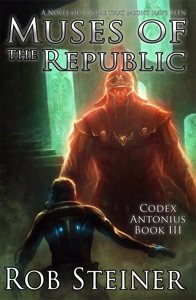
The ebook is out now. The paperback is scheduled to be released later this month. There's a compendium containing all three ebooks. You can get that here.
Rob hired Tom Edwards to create the cover. Edwards also created the covers for M. Terry Green's Chronicles of White World.
The ebook is out now. The paperback is scheduled to be released later this month. There's a compendium containing all three ebooks. You can get that here.
Subscribe to:
Posts (Atom)