Showing posts with label mystery. Show all posts

Sunday, June 12, 2022

The Theatre of Shadows by Christian Ellingsen

book cover for The Theatre of ShadowsSix months have passed since the events of The Silver Mask. Over the winter months, Vasini was plagued by Gareth Miller, the Winter Fayre Killer, who murdered 17 people before he was captured by Lieutenant David Locke. The city now waits for Miller to be hanged. But when Miller escapes gaol, ready to terrorise Vasini's streets once more, Locke must hunt the murderer again to stop him from claiming more lives.

As Miller flees into Vasini's streets, Joseph Bastin, ambassador to Vasini for the city-state of Laège, is assassinated in a brothel. With the threat of political repercussions for the death, it is up to Dr. Marcus Fox, newly appointed Commandant of Police, to find the ambassador's killer.

Fox's investigation soon leads to a suspect, someone who has been investigating links between the Laège embassy and the worship of the dead deities - his ally, Dr. Elizabeth Reid.

Now, Elizabeth and her friend, Catherine, must act quickly to clear her name before she is found by someone who doesn't believe her claims of innocence and she's forced to dance the hangman's jig.


This is the sequel to The Silver Mask, a terrific "flintlock and alchemy" novel. Unfortunately, The Theatre of Shadows wasn't as enjoyable for me due to the plot style and pacing. The story read more like a police procedural set in the 1700s, which isn't the sort of thing—regardless of time period—that I read. Investigating the ambassador's murder provided enough intrigue, but the serial killer plotline kept getting in the way, hogging the spotlight. Maybe the serial killer was fully developed in The Winter Fayre, a novella contained in The Divided River that preceded this novel, but here he's rather one-dimensional. He's always two steps ahead of the Inspectorate and the watchmen (police), rendering them seemingly incompetent as he murders people with impunity. It went on for far too long for me. It took roughly three-fifths of the novel before any sort of clue was given as to why the serial killer plotline even existed, and it wasn't resolved until much later.

The main characters from The Silver Mask—Fox, Locke, Elizabeth, and Catherine—are here. While fully developed before, they weren't neglected here. Fox and Locke are in pursuit of the ambassador's assassin and the serial killer. Elizabeth and Catherine spend their time searching for clues to clear Elizabeth's name of killing the ambassador. Ellingsen gives us each main character's POV—as well as those of a few key minor characters—as they investigate, thus enriching the depth of each one.

Ellingsen doesn't spend as much time world-building here as he did in The Silver Mask, but what he provides is top-notch. The city of Vasini feels authentic with Ellingsen's descriptions of the sights and scents of everyday life.

Ultimately, the protagonists' relentless pursuit of clues paid off. Ellingsen corraled the plot into a climax that resolved the current crises of random murder and calculated assassination. It was an effective ending, and so I feel better about the book as a whole. But for me, it was probably a hundred pages too long. However, I remain optimistic that the next installment in this series will have more intrigue and less procedure.

3 stars
Just to be clear: This book was not submitted to us. I went out and bought it on my own.

\_/
DED

Friday, June 12, 2020

The Liminal Zone by Richard Abbott

book cover for the Liminal ZoneNina Buraca, investigator of possible signs of alien life, has heard tales of mysterious events on Pluto's moon Charon, where a science outpost studies extrasolar planets. Facing opposition from her colleagues, she nevertheless travels from Earth to uncover the truth. Once there, she finds herself working with a team of people who have many secrets. To make progress, she has to take sides in an old dispute that she knows nothing about. Can she determine who – or what – is really behind the name "selkies" that the station's staff have given to this uncanny phenomenon?
The Liminal Zone is the third book in Abbott's Far From the Spaceports series, and like the others, it's a standalone. While the first two books (Far From the Spaceports and Timing) featured the same characters, this one introduces us to a whole new cast with a completely unrelated plot. It isn't necessary to read those first two to read this one, but if you like The Liminal Zone, you should check out the others.

For those unfamiliar with this series, humanity has colonized the solar system, and artificial intelligence (AI) has come to fruition. Space travel has improved, it still takes weeks, sometimes months, to travel from one celestial body to another. As such, there's a bit of self-governance each place enjoys, and adults are very much in charge. No dystopia here.

AI entities work alongside humans and have personalities that are barely distinguishable from them. Just as the gods of Mount Olympus suffered from the same emotional shortcomings as humans, so too do Abbott's AIs. As such, people and "personas" work together, live together, and form friendships. They're each other's besties. When Nina announces to her persona, Aquilegia, that she's headed to Charon to investigate the Selkie mystery, the latter balks at going. A fight ensues, and the two of them break-up. As theirs had been a six-year relationship, Nina is devastated and feels very much alone.

All the while that Nina investigates the mystery, her encounters with other people and personas and exploration of the Charon settlement and surface, she can't help but reflect on her feelings. She's the outsider trying to fit in among a group of people. Some are paired up; some work alone. Some are friendly; some stymie her every move to make progress on either the mystery or fitting in. The story is very much an introspective journey as well as an investigative one.

Having a character journey over 30 AUs to find herself may seem unusual, but is it really any different than someone traveling halfway round the world? You go where the path leads you. I confess that I was more interested in the secrets Nina strove to uncover than her personal journey, but I chalk that up to being in a healthy relationship for 26 years. One last thing I'd like to point out is that I haven't read this much about characters drinking tea since Ancillary Justice. I kid. All of this makes for a charming read. Having taken us to the asteroid belt, Mars's moons, and now distant Charon, I'm wondering where Abbott will travel to next.

4 stars
Just to be clear. This book was not submitted to us. I went out and bought it on my own. Now, back to hibernation!

\_/
DED

Wednesday, December 28, 2016

The Silver Mask (The Vasini Chronicles #1) by Christian Ellingsen

book cover for The Silver MaskThe gods are dead, killed two hundred years ago. With their destruction the moon split apart, the sun dwindled and the land was devastated. Civilisation has re-emerged from the carnage, but twisted creatures still prowl the savage Wildlands between the city-states. In the skies above the city of Vasini, a falling star, a fragment of the dead moon goddess Serindra, heads to earth.

In the Palace district, Dame Vittoria Emerson, darling of the city, has been found dead. As Captain Marcus Fox of the Inspectorate hunts the killer, Dr. Elizabeth Reid searches for the remnants of Serindra determined to make sure the poisonous quicksilver it contains is not used. With Vittoria's death threatening to draw the city's political elite into a war of assassins, Fox and Reid must rush to expose the secrets that lie within Vasini before they tear the city-state apart.


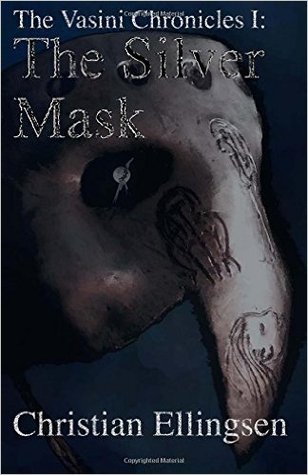
The cover looks like a photograph of a museum piece. While accurate, I don't believe it's enough of a draw to pull in a reader. If this was non-fiction about said mask, maybe it would be sufficient. But even so, the lighting is too dim. The color chosen for the title font is muddled. It should stand out more, like the byline actually does. The typeface is fine. Still, there's so much going on in this novel that the cover should have been a scene from the book rather than the mask, which plays such a minor role in the book that I'm thinking the title should've been something else: City of the Dead Gods? Alchemy of Resurrection?

The chapters are broken into scenes which are occurring simultaneously, rather than devoting a single chapter to a character and his/her POV. It was a little confusing and took a little bit to get used to it and the characters sorted out. However, the opening chapter gave me the impression that a lot was happening on several fronts and thus drew me in. After a while I was able to discern the personalities of the major characters and what roles they played in the city of Vasini.

Ellingsen has invested a great deal of effort in developing the world wherein this story lies, but he doesn't drown you in backstory. It starts out with the familiarity of a mirror Earth and then the differences are sprinkled into the story. The culture of Vasini draws heavily upon the French—many French words frequent the manuscript—but there's a dead pantheon of gods that is complete fiction. There are sub-humans that live among the Vasinians as servants to the wealthy and strange monsters in the woods. And it rains all the time, which might be attributable to the heavily damaged moon in orbit.

To help the reader become more familiar with the city of Vasini, its inhabitants, and surroundings, Ellingsen has placed images of random documents highlighting Vasini's religious, philosophical, and cultural history between chapters. When I could read them, they were a nice touch. Unfortunately, I don't know how to enlarge images embedded in books on my Kindle Fire (just the text) so some of them were illegible.

Captain Fox and his assistant, Sergeant Locke, are the detectives charged with solving Emerson's murder. But as the investigation plays out, they discover that there is much more going on underneath the surface. Not only is Vasini a city that is divided between rich and poor, but the wealthy are bitterly divided into factions (Fishers and Scarlets) that manipulate the masses. Emerson's murder is the spark that sets off retaliatory assassinations on either side of the political divide. Reid and her friend, Catherine, are conducting their own investigation in parallel to Fox and Locke, for their own reasons. They're clearly in over their heads, and it isn't until Reid joins forces with Fox that they're able to see enough pieces of the puzzle to figure out how to solve it.

Christian Ellingsen has created a rich world within The Silver Mask, and despite 400+ pages of exploration, I feel like he's just scratched the surface. He carefully juggles a large cast of characters with ease, and it shows when we're afforded time to read from so many unique points of view (some extensive, some just a pivotal moment). While the mystery seems so Byzantine that Fox and Reid always seem to be three steps behind the antagonists, it only makes the resolution that much more satisfying.

For more information about The Silver Mask, please visit the author's website.

Monday, August 8, 2016

Madam Tulip by David Ahern

“All the world’s a stage” would be an apt subtitle for David Ahern’s madcap thriller/mystery novel Madam Tulip. Several characters are struggling actors, but even the non-thespians engage in performances of varying degrees of desperation. They include a steely businessman trying to disguise shady dealings, undercover police posing as wealthy socialites, and a murderous international criminal who assumes a more mundane persona to avoid detection.

Into this unfolding intrigue inadvertently stumbles 27-year-old out-of-work Dublin actor Derry O’Donnell. Prompted by her chronically poor finances, she decides to capitalize on the psychic abilities that run in her family by setting herself up as a fortune teller under the moniker “Madam Tulip.” She lands a gig at a glamorous charity event hosted by supermodel Marlene Doyle, wife of Peter Doyle, the aforementioned shady businessman. As Derry plies her new trade amidst the beautiful, the famous, the wealthy, and the venal, a promising pop star in attendance dies suddenly. Derry, by dint of information gleaned during fortune-telling sessions, begins piecing together the tragedy’s antecedents.  The well-meaning Derry also fears for Marlene’s safety, and in trying to avert another tragedy, she becomes drawn into an increasingly dangerous mystery.

Madam Tulip sets off at a brisk pace that accelerates as the book progresses. In the early chapters, Ahern deftly sets to the stage for the mayhem to come by hinting at secrets and questionable motives. On meeting Marlene and Peter Doyle at a racetrack, Derry’s immediately detects that they are not what they seem.
Doyle is an actor, thought Derry. He’s playing the rich and successful host, a man in control. He’s having an off-day for some reason, but he doesn’t forget his lines, and he stays in character no matter what.
Very quickly, Derry’s relatively uneventful life is upended. Following the death of the pop star Mojo, Derry’s friend Bella is unjustly detained by the police, collateral damage from the plot that Derry is investigating. Derry herself becomes a target. With the help of her friend Bruce, a former U.S. Navy SEAL, she embarks on a series of maneuvers to unmask a deadly conspiracy. Like many characters who are suddenly catapulted into an adventure for which they are ill prepared, Derry faces strange and sometimes comical dilemmas, such trying to figure out how to dispose of planted drug money without leaving forensic traces.
…Derry hadn’t got a shredder.
How do you get rid of money? Never in her life had Derry imagined she’d be asking herself that question. “I know,” she said, jumping up and rooting in a kitchen cupboard. She pulled out a blender, plugged it into the socket and poured in a little water from the tap.
“I guess if it’ll turn cabbage into a smoothie it can do it to twenties.”
Derry proves to be a perceptive observer, and her impressions effectively draw the reader into the story.  She quickly spots incongruities in the behavior of the Doyles’ chauffeur Paulo.  On one occasion when Peter summons Paulo, his response to his employer is unusual.
The chauffeur of a rich man might have been expected to jump to attention and follow his master meekly across the lobby. To Derry’s surprise, Paulo did nothing of the kind. He put his hands in his pockets, walked backwards towards the door and, as he had done once before, blew Derry a kiss.
Her instincts are unerring. Several times in the book, she must decide whom to trust without having all the facts. Her training as an actor stands her in good stead in these situations, enabling her to identify subterfuge and sincerity. After the pop singer Mojo’s death, suspicion falls on his girlfriend Sonya, but Derry is confident that she is innocent.
She couldn’t even begin to imagine Sonya killing Mojo. Nobody, not even the best actress in the world, could fake the feelings Sonya had shown.
Madam Tulip’s overall tone is light-hearted, with comic relief provided by a feud between Derry’s divorced parents – her mother Vanessa, a flamboyant art dealer, and her father Jacko, a raffish painter perpetually one step ahead of trouble of his own making. Ahern’s wry observations like the following also contribute to the book’s wittiness.
The phalanx of policemen now fanned out around the offending car as though the driver inside were a terrorist or a wanted gangster. Meanwhile, the helmeted motorcyclists tried to disperse the watching crowd, shouting, “Nothing to see here, nothing to see! Move on!”
No crowd of Dubliners promised the delightful spectacle of raised voices, shouted obscenities and discommoded policemen will willingly accept an instruction to disperse, especially if accompanied by the ludicrous statement that there is nothing to see. Plainly, there was lots to see. The mood was turning ugly.
The novel has a couple of minor weaknesses. One subplot explores Derry’s potential rekindling of a past romance; however, the interactions between Derry and her former boyfriend lack any spark, and his character is woodenly unappealing. Another flaw, in light of the fact that this is the first in a planned series, is that Madam Tulip does not introduce any compelling character or story arcs that would span multiple installments. Because the novel is very competently written and succeeds on many levels, this is not strictly necessary. But to keep readers strongly engaged with a series, a novel should leave interesting questions and conflicts unresolved.

On the whole, though, Madam Tulip is pure entertainment, striking an ideal balance of comedy and suspense, with a cast of delightful eccentrics flailing their way through a gripping adventure that culminates in a satisfyingly cataclysmic conclusion.

For more information, please visit the author's website.


Thursday, June 16, 2016

Far from the Spaceports by Richard Abbott

Book cover for Far from the SpaceportsQuick wits and loyalty confront high-tech crime in space.

Welcome to the Scilly Isles, a handful of asteroids bunched together in space, well beyond the orbit of Mars. This remote and isolated habitat is home to a diverse group of human settlers, and a whole flock of parakeets. But earth-based financial regulator ECRB suspects that it’s also home to serious large scale fraud, and the reputation of the islands comes under threat.

Enter Mitnash Thakur and his virtual partner Slate, sent out from Earth to investigate. Their ECRB colleagues are several weeks away at their ship’s best speed, and even message signals take an hour for the round trip. Slate and Mitnash are on their own, until they can work out who on Scilly to trust. How will they cope when the threat gets personal?


While the story got off to a slow start, it certainly wasn't dull. Abbott introduces us to Mitnash and does just enough world-building to hook the reader with an intriguing future. Humanity has colonized a good chunk of the solar system, and artificial intelligence (AI) has come to fruition. It's something that the technorati would approve of. And while space travel has improved, it still takes weeks to travel from Earth to the asteroid belt. This remoteness allows for a bit of self-governance that libertarians could find comfort in—it isn't anarchy or the Wild West. It does mean that there will be no cavalry coming to Mitnash's rescue should he get into trouble with the locals. He is very much alone, surviving by his wits.

The AI entities work alongside humans and have personalities that are indistinguishable from them. In this age of never ending Terminator films and Kurzweilian singularity worship, it's actually refreshing. One drawback is that Mitnash relies heavily on Slate to do the heavy lifting. While that comes in handy for number crunching, "she" executes some of the best action, leaving Mitnash as spectator too often. The story is told from his point of view so the reader misses out on Slate's version of events. Mitnash does get in a bit of peril when he finds himself unable to rely on her, and this winds up being the most tense scene in the book. I think I would've liked a bit more of that. They're a team, for sure, but it seemed to me that Mitnash needed Slate more than she needed him.

There's a tremendous attention to detail, which threatens to be too much for the casual reader, but Abbott stops short of going too far. It plays into his world-building. While it isn't all essential to the story, it does help the reader get the feel of the place. I never got a proper understanding of the local gravity—one-fiftieth that of Earth—but I'll chalk that up to my being stuck on Earth my whole life.

Only found a handful of typos, so the editing gets a thumbs up from me.

Far from the Spaceports is a delightful read. Abbott's characters are very personable and make for good companions as he carries us to a promising future. There's no dystopia here; man and machine work together to fight crime through skill and wit rather than heavy-handed government oversight or firearms. David Brin would approve.

For more information, please visit the author's website.

Friday, October 17, 2014

Noise by Brett Garcia Rose

Noise by Brett Garcia RoseThe only person that Leon ever loved was his sister, Lily. But ten years ago, she left a suicide note and allegedly drowned. Allegedly, because her body was never found. Regardless, he was left alone.

But then a postcard in Lily's handwriting arrives one winter, drawing him to New York City. What he discovers unleashes a deadly rage that knows no bounds. A grisly trail of clues leads him to "The Bear", a sadistic Russian crime lord who traffics in human flesh. The police are of little help and don’t like Leon’s methods or the mess he leaves in his wake. He is single-minded in his purpose and will do anything to find Lily.

Now here's the kicker: Leon is deaf.

But being deaf isn't much of a handicap to Leon. He can read lips. He pays attention to his surroundings, aware of the change in shadows, the vibrations of someone walking across a floor. It's what kept him alive as a child in Nigeria and later through a stint in the army.

By and large this could simply have been the literary equivalent of one of those revenge flicks you curl up with on the couch, a bowl of popcorn and a beer (or two) close at hand. But no, we're given a story that's more than popcorn and violence (though there is plenty of the latter). When Rose isn't detailing Leon's choreography of investigation and execution, he offers Leon's reflections on his predicament and surroundings.

Our introduction to Leon:
The world is an ugly place, and I can tell you now, I fit in just fine.
We see New York through Leon's eyes, and it is a cold, heartless place where:
The sidewalks are narrow and crowded, the pedestrians impartial and unaware of one another in a way that even the simplest of animals are not. They never make eye contact; inches apart, they never touch. A New Yorker approaching another human being is indistinguishable from one approaching a utility pole or a tree.
And Leon makes no effort to hide what he thinks of the place:
It is not possible for me to be the first to say this, but I'll say it nonetheless: I hate the place. It is cold and ruthless. Humanity in constant battle, all its inhabitants rushing towards some invisible exit, never tiring of the trap. Cities are hell, and New York is the Grand Dame of them all.
I couldn't resist the noir-like atmosphere that Rose conjured. Now, I love New York—warts and all—but I know what he's talking about. It's the perspective of an outsider, and it's very easy to relate to it.

The story moves along predictably enough, with Leon punishing the guilty without mercy or remorse. There are no clean executions, no crises of conscience. His methods are as brutal as those he seeks out. He exists to make sure that those who live by the sword, die by the sword. Were it not for the fact that his cause was just, it would be difficult to root for him. In fact, some might pity the guilty.

One thing I found lacking was detail about Leon's past. There is scant little about his childhood in Nigeria, and his adoptive mother only receives a few sentences. There is Lily, but all we know of her is her suicide note, and that she was the one person in Leon's life that showed any kindness to him. Perhaps, it's intentional. Leon's single-minded determination leaves no room to dwell on the past.

Noise is a revenge flick dressed up as art house mystery. Rose juxtaposes brutality with spirited, yet acerbic, prose. Meticulous attention to detail evokes noirish cinematic imagery. Read the book before Hollywood figures out how to make the movie.

For more information visit the author's website.

Friday, May 24, 2013

Odd's Door by W. S. Lacey


Roger North and Lewis Spender, students and friends in the early Twentieth Century, are on a mission. In order to win acceptance into a club of rational thinkers, they must solve a seemingly paranormal mystery. Spender has chosen the case of the insane playwright, Adelard Odd. One person reading Odd's writings was struck blind, and three other people disappeared while in his room at the Quartersoake asylum. Once at the asylum grounds, the two men find out soon enough that Odd's door, a door ostensibly leading to nothing, is an axis mundi that involves those entering in a myriad of shifting universes. North and Spender are soon separated; Spender is held up as a king in the civilization he happens upon. North reappears with one eye colored silver; he is now able to see past and future and is also gifted with sight in the subjunctive mood.

They reunite and contend with multiple realities, described with a Douglas Adamsesque matter-of-factness. Trying to escape from a land run by paisley-clad Greeks, they briefly encounter Odd, who is a ruler, and who initiates a destructive impulse that lands them back on terra firma.

But the rational thinkers' club is a ruse. Spender is really on a mission to find out what happened to his mother, one of the three people to have disappeared through Odd's door on her own Odd-yssey. This Oedipal journey (we meet the Sphinx not once, but twice) subsequently leads to an island off Tunisia. They soon realize that dealing with doors such as these is dealing with Death, and they try to avoid killing or being killed as they search for Spender's dematerialized mother, aided by the sinister, scarred Dr. Holroyd.

This is very enjoyable reading. Lacey is a superb writer. The reader will encounter wonderful old words like “grimoire” and “catafalque.” The allusions to mythology (I probably missed some of them) are enticing. Do not fear Doors, but allow yourself to be immured in this story.

Monday, January 7, 2013

Strictly Analog by Richard Levesque

Strictly AnalogIn Strictly Analog, author Richard Levesque introduces us to a future where California has seceded from a dying America. A corporation has been elected governor (Romney's "Corporations are people, my friend" comment taken to its ultimate extension) and isn't letting go. While some freedoms have been curtailed in the name of national security, the secret police won't bust you for smoking marijuana. Fear of being expelled to the surrounding wasteland keeps the population in check.

Technological innovation is still alive. Everyone has a pair of iyz, eyeglasses that let you seamlessly connect to the internet (You could say that the initial versions are almost here), essential in a near total digital world. Every facet of people's lives can be recorded and shared with their phriends. If you thought Facebook and You Tube were omnipresent in society today, Levesque shows you the next level.

Our guide to this dystopian future is Ted Lomax, private detective. Ted is a veteran of California's war for independence, where he lost an eye. Having lost said eye, he is unable to use iyz, which require both eyes to bring data into focus. Not being connected 24/7 means that Ted is excluded from society's online interactions, persona non grata, but in his business that's a plus. Not being connected means his investigations remain discreet. In a society where almost nothing is private anymore, secrets are priceless.

Ted's daughter has been arrested for the murder of her boyfriend, a member of the secret police. Ted has only a few days to crack the case before she is deported (the death penalty having been abolished). But clearing her name will require him to figure out who her boyfriend was investigating, a state secret in its own right. Analog skills won't be enough to solve this case. Ted will have to get help from hackers and gear-head rebels, provided they don't sell him out to save their own skins.

Levesque, an English teacher in Southern California, has provided us with a well-crafted story with realistic characters we can root for in a hard-boiled landscape. Told in first person POV, Ted is the perfect guide for the reader. His handicap renders him an outsider, much like we are in his world. While Ted lacks the tough as nails, hard-drinking attitude of typical noir fiction from the 50's, his down on his luck demeanor (he doesn't have an office; he lives in a storage facility) and soft cynicism are a perfect match for cyberpunk.

It feels weird for me, a former tech guy who basically had to re-learn creative writing, to critique the work of an English teacher, but I can definitely say Levesque brings the goods. I really enjoyed reading Strictly Analog. It's a story that should appeal to fans of early Gibson or Sterling. And now that our world is much closer to the cyberpunk vision of tomorrow that was forecast decades ago, the story should appeal to contemporary detective fiction fans too. Strictly Analog is highly recommended.

Strictly Analog is available on the Kindle and in print from Amazon. Visit his website to learn more.

Monday, February 6, 2012

Superliminal by Andy Kaiser

Book cover for SuperliminalSuperliminal is the first book in a (hopefully successful) series of stories about Dev Manny, an Information Technology Private Investigator (ITPI).

Manny is called in by local law enforcement to help uncover an explanation for the trashing of some computer equipment. A VHS tape is discovered in a PO Box and reveals a psychotic manifesto from the missing owner of the computer gear. He rants about a virus whose release could lead to horrific consequence for humanity. The police need Manny to get to the bottom of this. Is the guy a crank or a terrorist?

Don't let the IT part throw you. While Kaiser is clearly credentialed to set a detective loose in the world of IT, he doesn't beat his reader over the head with it. If you don't know http from ftp or a router from a server, it won't impede your ability to enjoy the story. For IT geeks though, Kaiser offers them an access port into mystery fiction (much like Rob Steiner did with Aspect of Pale Night).

I wasn't sure what approach Kaiser was going to take here: satire or thriller. It turns out he does a bit of both. When the threat turns real, Kaiser dials up the tension. Despite going for a bit of Sam Spade, Manny's self-deprecating and wry sense of humor defuses the situation and his ego before either get too serious.

Kaiser really shines when Manny is "under duress" (I don't want to spoil the story). Manny is forced to complete a vital part of his investigation while suffering through the equivalent of a bad acid trip. The details of Manny's experience are exceptionally well-written and the poor guy lapses into a depression brought on by an existential crisis. It's as if he's living through a Descartes' philosophical proof. It was the highlight of the novel for me. After dropping a couple Lovecraft and Dalí references along the way, I was sold.

As for the technicals, the book is well-edited. The pacing is fast and Kaiser's writing is tight and efficient. Only a couple of typos and one formatting error got through. By the time you pick up the book, these may already be removed.

Andy Kaiser's Superliminal is a wonderful ITPI mystery. It is a fast-paced story driven by a protagonist whose IT knowledge is matched only by his wry sense of humor. The IT spin on detective fiction is akin to what Stross' Laundry series does for spy thrillers, though without the Lovecraftian horrors. Highly recommended.

To get more information about Superliminal, please visit the author's website.

Tuesday, March 9, 2010

Null_Pointer by Ken McConnell

Null_PointerNull_Pointer is a fresh take on the amateur sleuth mystery genre with a hacker turned detective at its center.  The action takes place in a world just enough removed from the ordinary to make the story interesting. The high concept at its core makes it surprisingly satisfying.

The book opens with the mysterious death of an unnamed programmer from what appears to be a new type of malware that transports the victim into a deadly virtual reality.  Who is behind this and what do they want? And how can anyone kill with sounds and with images on the screen?

Josh Jones suffers from insomnia, a psychologically induced condition that is the result of his tragic past. When he was sixteen, his parents were killed in a car accident that he blames himself for causing. Now in his early 20s, Jones makes a living as a coder at RegTech and does well, he drives a Porsche. But he is a target of an clever and deadly enemy who has been stalking him for years.

Because he can’t sleep, he makes his way to work at a very early hour and discovers that one of the other coders, Glenn, is dead, slumped over by his terminal. At first the death appears to be nothing more than a consequence of poor lifestyle choices finally catching up with Glenn. Still, when Jones gets back home from the police station, he finds that he is rattled by the death. But when his friend Dancia drops by, Jones learns that a hacker called Zemo was found dead by his parents. Zemo’s death was not accidental: a hidden message suggests that someone has killed Zemo and that others are on the target list. Could Glenn’s death and Zemo’s be connected?

As Jones investigates, he discovers that the apparently unassuming coder at RegTech who went by the name of Glenn was really Themis, a hacker with whom Jones worked over the Internet on a college project called MyMovies. Jones discovers a secret message in the computer code—someone is targeting the members of the MyMovies programming team and Jones and Dancia are next.

Null_Pointer does a great job imagining the life of young computer geniuses. McConnell’s characters talk the secret language of root kits, localhosts, virtual machines, C sharp, kernel level access, shells and on, giving the reader a taste of what real hackers living inside a secret hacking culture might talk like. It is a largely hidden world of mostly young men with exceptional skills who make their own rules.  It is a murky world, too. Many of these computer demigods are only known by their aliases, making distinguishing between friend and foe difficult: you never know who hides behind the alias. Communication is done through IRC chartrooms and bulletin boards forums. Rarely do the players actually meet in the offline world. But the death of Zemo occasions a rare meeting between Jones and a security expert known as Psycho in search of clues.

A good part of the detective work involves finding system logs and tracing Glenn’s computer activity. Because nearly all of Glenn’s life has left a digital trail, Jones soon comes across the “how” of the murder -- not only can the images and sounds steamed from the Internet kill, they can also make you do things that you would not normally do:  the story is based on a clever concept that is likely and frightening and just maybe not developed enough. But the “who” turns out to be much closer to Jones than he imagines and much more involved with his family past than he knows.

See http://jjmysteries.ning.com/ for more information about the book.

Author’s website is http://ken-mcconnell.com/

His newest book is Starstrikers.

Wednesday, April 18, 2007

Of Blood and Blackwater by T.C. Heffernan (C)

Cover for: Of Blood and BlackwaterCover: Interesting.
Available at Amazon.com

Someone waits concealed, near a jogging trail, for his next victim. Oblivious, Sherry Coltrane runs by, the run a part of her preparation for a marathon. Without warning, she's hit by something, then, slowly, begins to lose consciousness. When she falls, the killer takes her and carries her into the woods…

The suspense starts right away, and the opening is written in a clear, smooth style that grabs your attention. The kidnapping turns out to be one of a number of similar incidents in the Portland area: someone is taking young women and doing unspeakable things to them. This is a good setup that is well executed.

Of Blood and Blackwater is a very well-written, creative, novel that stumbles because of problems with the plot.

The first problem is that the storyline about the detective and the law enforcement search for the killer does not really work because there is no obvious relationship between the investigation storyline and the Gareth storyline. We are left wondering whether this is a story about the detective looking for a killer, or a story of the college professor, Gareth who is somehow involved with the killings. Most, if not all, thrillers use multiple story lines to create suspense and tension but they do so by making the multiple story lines collide, the collision will creating problems and complications for the characters. There is nothing wrong with the two storylines in this book, of course, but they must be related somehow, must collide, and this must happen in the first third of the book—sooner even, if possible. But 100 pages through the 400+ page novel, the link between the storylines remains unclear, and, as a result, the suspense that existed earlier slacks.

Another problem lies with the presentation of the killer. In his book Along Came a Spider, Patterson makes it clear right away who the kidnapper is and what his plans are. In Blood and Blackwater, we don’t know much about the killer, his identity, motives, or goals. Suspense is always increased, in thrillers, if we know who the antagonist is and what his plans are. When we know, for instance, that the killer becomes interested in the protagonist and then targets his wife, the tension arises out of the uncertainty as to what will happen. Suppose that the detective found the dart in the very first few pages, went to Gareth, and that this became known to the killer, who would then take an interest in Gareth, and his wife. Now there would be tension and suspense because Gareth would be in danger, and the story lines would be interwoven. If the identity, plans, and motives of the antagonist are unclear, then danger that threatens the protagonist becomes diluted, and suspense and tension slacken. Of course, a writer may keep the identity of the killer a secret, but then the story becomes a mystery, and the bulk of the problem the protagonist faces is in figuring out who the killer is. You can do many things when you write a thriller, but one thing that you can't do is to have suspense and tension slacken. Which brings me to the final problem—escalation.

In Blood and Blackwater, there is no escalation for the first 150 pages. The reason for this is that there is no complication in any of the storylines that impacts the flow of the other storyline. The killer just kills and does not make a mistake. The police catch no break. Gareth does not become involved with either the killer or the detective. The storylines proceed, essentially, in parallel. They can't. Not in a thriller. Although sometimes multiple story lines are called parallel, they are not; storylines always converge and the moment of their convergence creates turbulence, complications, and problems for the characters in the story.

A good book must certainly be well edited, and Blood and Blackwater is; but a good book also must have a great deal of plot editing, which Blood and Blackwater lacks. Plot is the engine of the thriller, and a weak plot is the hallmark of an under performing book.

Friday, April 13, 2007

A Dirty Business by Joe Humphrey (A-)

A Dirty BusinessFirst impression: Cover is good, but nothing special. It is, really, somewhat ambiguous.

Available through Amazon.com

The story opens with Kevin Bailey arriving in New York City. He has a few problems in his life--he's broke and has no place to stay. As we read, it is obvious that Kevin is looking for some traction in his life, that he's trying to get his feet on the ground, and that he is in need of change for the better. Through a good friend, he gets his foot in the door as a PI. As I read, I found myself wondering--Is he going to catch a break in his troubled life or begin the journey to his doom?

His first case involves a client who wants to find out about her son's girlfriend; it will be Bailey's training wheels case, but the question immediately arises--will the inexperienced Bailey get into trouble? After all, he has no PI license and no investigative skills. And yet the case seems harmless enough. These facts create uncertainty as to what will happen to Bailey, and what kind of a crime he will come into contact with; after all, there is going to be some Dirty Business involved.

After a somewhat slow opening, the plot engages as Bailey learns that the woman he's looking for is not the same that the client's son is going out with. This is the first complication, and the first indication that things aren't as they seem. The mystery grows, as does our suspicion of foul play, when Bailey learns that the woman that he's looking for disappeared. Questions such as--where is Norma Vidon; whether she was killed; and if so, then by whom, and why—swirl over the action. The mystery pulls us in as the investigation into the woman's disappearance turns up links and connections to the son, his mystery girlfriend, and their doctor; it develops, with unexpected twists and turns intensifying the suspense, and, like in a good mystery, nothing in the end turns out the way that it seemed it would.

The writing is smooth and easy and Humphrey is speaking to us with a powerful, assured voice of Bailey's first person. The book goes down quick, and before you know it, you find yourself wanting more. This is a good read that introduces an interesting character, leaving plenty of room for sequels.