Showing posts with label paranormal. Show all posts

Wednesday, November 6, 2024

Escalators to Hell: Shopping Mall Horrors

book cover for Escalators to HellThis anthology's theme is horror stories that have some connection to shopping malls, those dying bastions of consumerism. Not that consumerism is dead, mind you. It's that we're transitioning from roaming their vast corridors of myriad wares to surfing the digital versions on our phones and laptops. To wit, the editors thought that the demise of shopping malls would make for an excellent theme for a horror anthology. And I thought so too.

The stories cover a wide gamut of horror sub-genres, so it isn't all about gore. There's a "Content Warnings" section—something I've never seen in a horror anthology—which I thought was odd. I mean, it's horror. If your mental health is such that certain things will trigger a traumatic emotional reaction, maybe you shouldn't be reading horror. I know that there are certain aspects that I won't read because of my issues. So I guess a content warning is considerate of the authors, can one find it before purchasing it?

Author representation is quite diverse. While North American authors are present, there are stories from African and Asian authors. Also, there are many non-binary authors in this collection.

Ok, onto the stories. Of the 22 stories in this collection, I liked 15 of them. Of those that I didn't enjoy, a good deal of them were too focused on gender identity, with the mall serving as mere setting. A couple of the others were too esoteric or allegorical to connect with.

On with the good stuff! The opening story, "Hard to Be a Mall God," was excellent. It deals with a demonically possessed escalator. "The Intercessor" shows how retail associates deal with trollish customers. "Why I Won't Eat at the Food Court" is part of the Generation Dead series. It drags in some cosmic horror for teen mutant superheroes to deal with but doesn't forget to add a dash of humor. "A Plague Upon Both Our Houses" is Romeo and Juliet with Zombies in a mall. "A Quick Trip to Ryan's" delves into masochism on a whole another level. "Kim, Ray, Trey, and Morgan" delves into drugs as a mind expanding experience with a dash of cosmic horror.

Some stories confront serious matters. "You Must Drop Buy" tackles the subject of rampant materialism and false promises made by deceptive marketing. In "Poseurs," a teen girl deals with her father's suicide by re-enacting a drama with mannequins.

In case anyone feels I'm being unfair to non-binary character stories, there were good stories that had non-binary characters and authors. These stories didn't lose sight of the objective. For example, "The Basement of Crowley's Artefacts and Interests of the Occult" has some non-binary teens dealing with demonic invocation in the supply room of an odd store in the mall. "Cherry Cola Lips" features a woman reflecting on her first crush back in high school, a girl who wouldn't come out and later disappeared. Rumors are that she was murdered, but the truth is stranger.

My favorite story was the closer, "The Temple of All." Makoma is forced by ritual to take her dead husband's remains into the ancient ossuary. It's a post-apocalyptic story with a touch of Handmaid's Tale where the ultimate act of rebellion is to live.

Yes, I'm glad I read this anthology. While I wish some of the stories were better, the good stories made it worth the price and my time.
Full Disclosure: I backed this book on Kickstarter and received a digital copy as a reward.

\_/
DED

Tuesday, February 18, 2014

Windfall by Colin Dodds

WindfallSeth Tatton is a "middle-of-the-pack attorney" struggling to help his suburban family keep up with the Joneses. Through his firm, he becomes a fixer; he gets things done no matter what the job entails. He's clean, methodical, and a stickler for detail.

The opening of Windfall introduces us to Seth and his accomplice, William, while out on a job. Seth is clearly in charge and instructs William to wait in the car while he approaches a target that can help cover up a murder committed by a client. Posing as a police detective, Seth conducts the interview with aplomb. His knowledge of the law enables him to play the part, extracting all the information from the target for Seth to construct the perfect coverup.

Seth's boss is part of a cabal of the wealthy and political elite who are scheming to take control of several western states and secede from the Union. Culled from the political chatter that's out there now, I wouldn't be surprised if it went down like this. The cabal recruits governors, senators, CEOs, assorted VIPs and military figures with the promise of them becoming a cadre of new Founding Fathers. Unburdened by D.C. debt, this new country will be prosperous thanks to an unusual shale oil discovery. All they need to do is put the right people in positions of power and arm the militias. But secret organizations need skilled specialists on the ground to make things happen and that's where Seth comes in.

As Seth completes each assignment, he picks up bits and pieces of the cabal's plan. He's drawn deeper inside the organization and meets the key players and listens to their plans and dreams. Part of him is on board with the plan; part of him questions whether it will lead to a bloodbath.

While it might seem that Seth is a cold-blooded killer, he isn't. He buries his guilt deep down inside with the help of alcohol and something that dwells within him. It was this paranormal element that drew me in and makes this thriller stand out from every other political thriller out there. This entity is his steadfast companion. It suggests courses of action and prods him forward on an amoral path that will see Seth rise to greatness.

Seth is assigned to keep an eye on Sarah, the plaything of a powerful Senator in the cabal. She's a mess and Seth falls for her, much to the chagrin of the thing within him. She threatens to unravel the Gordian Knot that has kept his conscience in check. Dodds could've played the old devil on one shoulder, angel on the other bit but doesn't. Instead, Dodds sends Seth stumbling along a hazy path of morality with a malfunctioning compass that takes him through a maze of airports, hotel rooms and casinos in search of his identity.

While the novel's focus is on Seth and his mysterious companion, Dodds gives us an interesting bunch of characters. Even those that have a bit part to play are well-defined, leaving the reader to wonder if they'll be back for more. But the crux of the novel is the relationship dynamic between Seth and the thing that dwells within him. Through a series of flashbacks, we learn about Seth's companion from its point of view and how the two came together. Rather than relying on some cheap cardboard cutout of evil, Dodds crafts a unique being with an intriguing origin story.

Besides some comma issues, my only real complaint would be with the climax. There are three figures that Seth needs to deal with on his journey, but he only handles two of them. The third is taken care of by someone else. I would've liked to have seen him handle all three, but the way the story unfolds it would seem that the logistics weren't possible. While I would've liked to have seen how that went down, considering what that character shared with Seth, I still found the ending satisfying. I don't want to spoil it, but Mr. Dodds and readers of Windfall will know who I am talking about.

Windfall is not your typical political thriller. Dodds deftly weaves in a solid paranormal thread that explores ambition, myth and morality in an indifferent America without resorting to pulpit thumping or cardboard villains. His protagonist wanders through the amoral battleground of the American political class with a spirit guide whose theme song could very well be "Sympathy for the Devil".

For more information about Windfall, check out the author's website.

Saturday, January 18, 2014

Mondays With Mephistopheles: 9am-Rhys by Dan O'Brien

Mondays With Mephistopheles: 9am-RhysMondays With Mephistopheles: 9am-Rhys is a short story written by Dan O'Brien. It covers one session Dr. Abraham Rogers—he insists his patients call him Abe—has with one patient, Rhys.

You can probably guess from the title that Abe's patients aren't the regular human kind. However, through this session we learn that even supernatural beings have their hangups and need the help of a psychologist.

Abe and Rhys have a clever exchange. Abe tries his best to get Rhys to come out of his shell while Rhys resists. Rhys counters with his acerbic outlook on humanity and modern culture, particularly with its unhealthy obsession with his kind.

O'Brien's writing is solid. His characterization is splendid. But all that being said, this piece doesn't work for me as a standalone story. It reads like a chapter in a book. There is no resolution; the session ends and so does the story. I re-read the story twice just to make sure I didn't miss anything. While I liked the story, ultimately I was left unsatisfied. It needs to be in a book either about Abe's patients or one resolving Rhys's dilemma. But I would read either book.

Mondays With Mephistopheles: 9am-Rhys is available from Amazon. You can learn more about the author and his works through his website.

Monday, February 4, 2013

The Mighty Quinn by Paula R. Stiles

The Mighty QuinnQuinn Bolcan is a small-time ex-criminal who has the ability to drain energy from things, be they physical or magical. This talent proves to be beneficial (defusing bombs) and deadly (body heat loss can lead to frostbite). When the story opens, Quinn is unaware of his ability but, over the course of the novel, learns how to control it. Needing to get out of town (Vancouver) after a pot farm raid, he takes on the role of courier. His lawyer has a package that needs to be delivered to Montreal and it "isn't the kind you want to send by Fedex."
While the story could've been about Quinn's cross-country trip (Canada is big and interesting enough), Stiles only details two stops: a bar in the Rockies where Quinn has a run-in with a supernatural biker gang and the delivery of the package in Montreal. They do factor into the novel later on though. The real action happens across the border in Vermont where Quinn accidentally defuses a nuke. The rest of the novel covers Quinn's reluctant assistance to DHS agent Nan Carreira's investigation of the terrorists who set up the bomb in the first place.

Ok, so it's not the best cover. I've seen far worse since I came on board here at the New Podler. I believe that it's meant to convey the swarm of foes that Quinn faces, though a better cover might've been one of him draining the magic out of a zombie or holding a bomb in his hands as he's about to drain it. But I digress.

The story is told in multiple POV's, which enable Stiles to develop her characters. Stiles starts with Quinn's story, told in first person, and then switches to third person to relate Agent Carreira's encounters, along with those of the villains. Considering that a large chunk of the action takes place away from Quinn, this is essential as we'd miss the scheming of the villains, who would otherwise be two-dimensional. Quinn is the strongest, and most likable. We're privy to his thoughts and his wry sense of humor. It's through him that Stiles conveys her mastery of imagery (smells too!).

Stiles could be accused of going overboard with the supernatural stuff. There are lycanthropes, vampires, ghouls, sorcerers, zombies, demons, fairies, and more. There are some naturally occurring events too which, for me, were a bit over the top. These are explained as being a side effect of Quinn's energy draining powers, but I felt this avenue was left unresolved, particularly how he deals with these events.

As for the technicals, the manuscript is fairly well-edited, but it definitely could've used an extra pair of eyes as a few passages fell through the cracks. For example, refer back to the first paragraph of this review. I quoted a passage from the story where Quinn is talking to his lawyer about the package. It says "Fedex" but the proper name for the company is "FedEx".

The Mighty Quinn is an entertaining read. Its titular character carries the story through a gauntlet of supernatural entities and is almost as surprised as we are that he came out the other side. While Stiles is adept at her use of imagery and developing her protagonist, some unresolved elements lead me to think she may have bit off more than she could chew by cramming too much into one novel.

The Mighty Quinn is available in print and on the Kindle. For more information, check out the author's website.

Tuesday, December 27, 2011

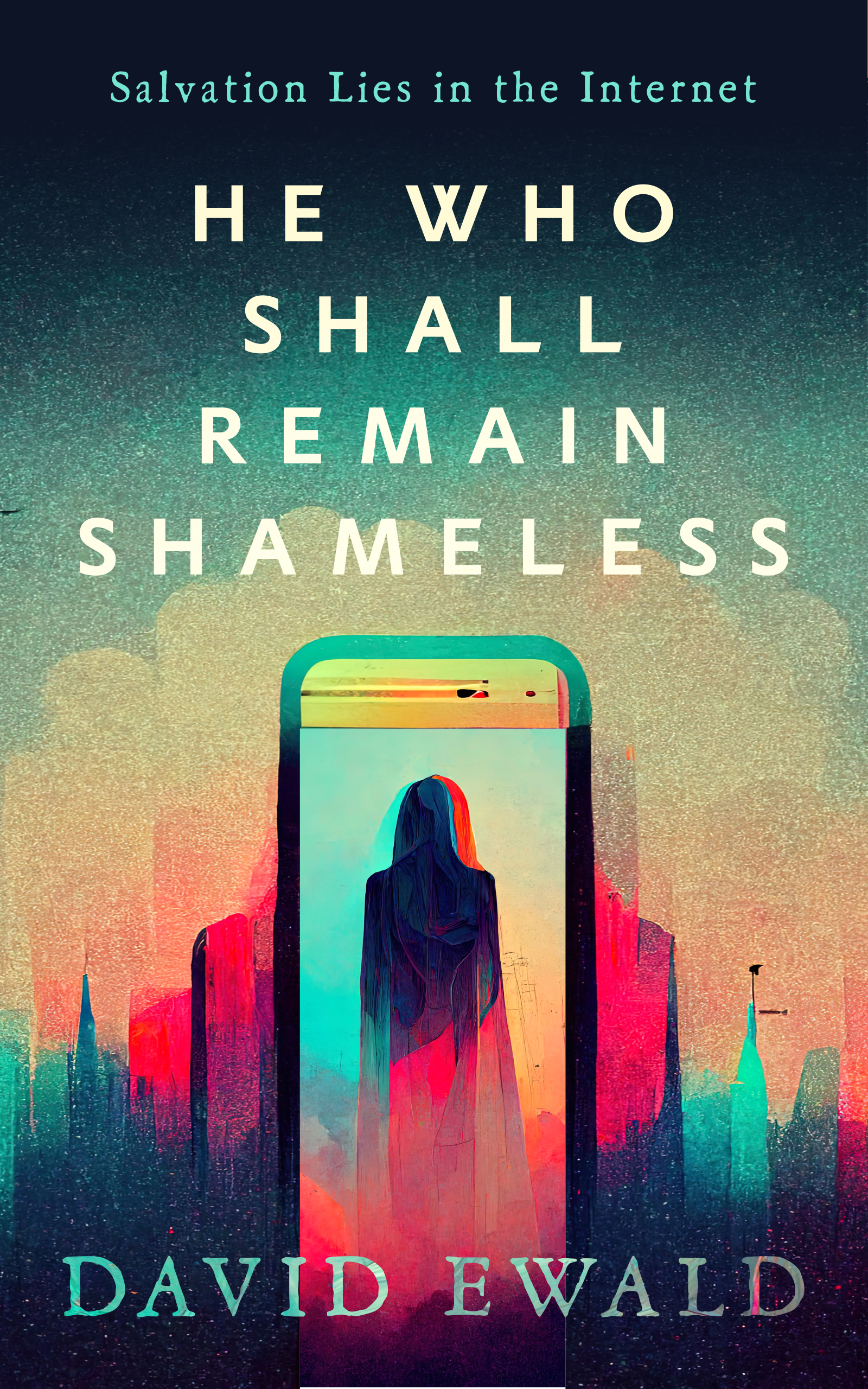
He Who Shall Remain Shameless by David Michael Ewald

He Who Shall Remain ShamelessIn He Who Shall Remain Shameless, the protagonist roams the world with his electronic companion on a mission to rescue ghosts from obscurity (personified by the Meritocrat). Most of these are no ordinary ghosts, but rather those who enjoyed some celebrity or notoriety in life and have become largely forgotten in death. Our protagonist, who shares the same name as the author of this book but definitely isn't him (and that's explained in the book), believes that the internet can keep the memory of people alive forever. All he needs to do is convince them to embrace it.

Sometimes he succeeds. Sometimes he doesn't.

That kind of describes Ewald's story too. Each chapter is about a ghost the protagonist encounters and some were better than others. In some chapters, Ewald successfully builds suspense; particularly with those who died a violent death. These are his better chapters. Other chapters fall short when Ewald abandons suspense in favor of a satirical approach, as when the protagonist encounters King Aegeus of Greek legend. It's as if Ewald isn't certain what type of novel he's trying to write.

Ewald deserves credit for his research. As each ghost was introduced, I couldn't help but see what I could learn of them from a couple of quick searches (I discovered Mr. Ewald's fingerprints on multiple occasions). While I knew of a couple of these figures, most of them were unknown to me. Ewald deftly collects fragments and scraps of these lost souls and builds believable characters out of them. Again, those in the suspenseful chapters proved to be the most memorable.

The strength of the protagonist varies too. His cause is noble, but his various methods waver on their propriety. At times, he seems genuinely concerned about the dead and consoles them as they wrestle with their fate. Other times, he resorts to trickery or mockery to boost his chances of success (the end justifies the means). The latter behavior casts a shadow over the former. Perhaps if there had been more transition, the shifts in the protagonist's behavior would've been easier to understand.

Despite these quibbles, I found He Who Shall Remain Shameless to be an entertaining read. Ewald is at his best when he plays the suspense card. His historical ghosts are well researched and have believable personalities. But the story's strongest element is its exploration of death and obscurity. As we ponder his assertion that the Internet can (and should) be used to remember everyone, celebrity and average person alike, he reminds us that we're mortal. And death is a lesson we should all remember as we conduct our lives.

Friday, October 29, 2010

Fixing Mr. Styx by Geoffrey Thorne

Fixing Mr. StyxLooking for a quick read this Halloween? Say, about 30 pages? Then, might I suggest Fixing Mr. Styx by Geoffrey Thorne. It's a paranormal urban fantasy where demons and magic are real and a high priced gopher, I mean "procurement specialist," finally gets the one job that will make or break… the world as we know it.

Mr. Styx, an alias for our protagonist, Sherman, finds "things" for his clients. Typically they're magic items, but sometimes he solves missing persons cases. Unfortunately, these are people who would prefer to stay missing. While he won't get his hands bloody, his conscience looks the other way if his clients make a mess of the mark. When we meet Sherman, he's in his favorite diner (not so much for the food as it is for the plethora of exits) being offered a job he's not allowed to refuse by a couple of lineman-sized thugs who are far more sinister than they appear to be.

Despite all of Sherman's flaws, Thorne makes him out to be a likable character. He's aware of his moral shortcomings, but acknowledges they're necessary for survival in the line of work he's in. Thorne spends a good deal of time exploring Sherman's character and reveals how he came to be the man he is. While on the surface, he resembles a Gen X version of the hard-nosed detective of many a pulp fiction story, underneath there's a vulnerability that belies that exterior.

Thorne's writing style makes for an entertaining read. To add to the almost noir-like atmosphere, he pours on the similes and metaphors like syrup over a steaming fresh stack of blueberry pancakes. Mmmmmm. It fits in well with establishing Sherman's character, his clients and the grim city he lives in.

As for the technicals, there are several typos. They were easy enough to find and could easily have been eliminated if a second set of eyes had gone over the manuscript before publishing. However, none of them were bad enough to detract from the story. Small bumps in the road as it were.

I understand that this is the third story in Thorne's "Grim Arcana" series. I'm not sure what the other titles are but you don't need to have read them to enjoy this story, though I suspect you'll want to. With Fixing Mr. Styx, I feel like we've come in at the end of a story, and I'm left wanting to know how we got here. Only in Resident Evil can you have a sequel to "Apocalypse." Thorne throws us enough bones to want to read more about Sherman's past exploits that led up to this encounter. A novel, or a collection of novellas, highlighting his misadventures in expanded form is what I'd like to see.

All-in-all, Fixing Mr. Styx is a highly enjoyable excursion into a dangerous world that exists just outside the corner of our eyes.

Fixing Mr. Styx is available for FREE from Smashwords as part of a Halloween promotion. Once the Day of the Dead rolls in, all bets are off.

Update 11/1/10: Got word from Mr. Thorne's editor that the typos were his fault, not Mr. Thorne's, and that they've been corrected.

Sunday, June 6, 2010

Review Roundup by Libby Cone

by Libby Cone

I have been on another Smashwords adventure, catching book samples on my hard drive as they drop from the conveyor belt of the literary fiction genre. Using this method, I hope to save readers time, energy, and money by reporting on books worth reading, worth sampling, and worth letting fall into oblivion.

Brakenstroom by Jacob SingerThe latest offering is Brakenstroom by Jacob Singer, a book of short stories about Jewish emigrants to South Africa. When I noted that only the first ten percent of the book was offered as a free sample, I was concerned that I might not appreciate its essence by reading such a small excerpt. I need not have worried, though. I invite experts on the complicated and tragic history of South Africa to comment on the accuracy of the author's account in the introduction. No expert is needed, however, to find “it's” being used as a possessive pronoun, or an implement for blade sharpening being described as a “wet-stone.” I began to have serious doubts when I read this sentence: “He worked hard, the hours spent pouring over accounting books giving him the stooped scolitic back and chronic myopia that on his tall thin frame, offered a portrait of the Scrooge circumstances had made him.” Then I read this sentence and gave up: “As a boy he was always a head and shoulders taller than others his own age, as thin as a stick, with two large ears on either side of a very Jewish nose.”


To Come Back So Far From Nowhere in ParticularNext is “To Come Back So Far From Nowhere in Particular” by Jon Thorpe. This is a free short story. Unlike the previous work, which dealt with a skinny, four-eared Jewish kid, this story describes the challenges facing suburban Christian youth devoid of bizarre physical deformities. I stopped reading after Page 6, which contains this sentence: “One young woman, Virginia Talbot, someone who would proclaim that Lubeck had seduced and corrupted her and led her astray from her good Christian values, had come forward and admitted Lubeck had arranged meetings with her in seedy hotel room where the two would smoke crack and Lubeck would masturbate as she pleasured herself with a crystal dildo.”

The next book in line is “The Sister City Initiative,” also penned by Mr. Thorpe. Forgive me, readers, for skipping his other ouevre, and the next book in line, which is written in Japanese.


The AlbumThe next book is “The Album” by Sandra White. It is actually published by “The Fiction Works.” POD purists may skip the rest of this paragraph. Ms. White gets brownie points from me for correct usage and spelling of the words “pored” and “its.” However, after wading through onslaughts of telling-and-not-showing, I was finally defeated by this bit of dialogue: “'It's beautiful out here, Jack. Blakefield's city fathers have done a superb job expanding and building without totally demolishing the wonder of Mother Nature.'”


Never, Ever, Bring This Up AgainEveryone knows the conflicting urges to look, and not to look, at something ghastly. I decided to give in to the desire to look at another short story of Mr. Thorpe, the next story in line, called “Never, Ever, Bring This Up Again.” I am happy that I did, because this cold-war-era story of a failing oil platform (sound familiar?) while somewhat difficult to follow, is actually an attempt at satire. It led me to return to the previous story by Mr. Thorpe, about the crystal dildo, and indeed, satirical narrative followed. My bad. While I did not think either satire was very clever, far be it from me, hoodwinked as I was, to reject Mr. Thorpe's pieces out-of-hand. You may wish to sample them yourself.

As that wasn't much of a ringing endorsement, I proceeded to the next book, “Chips & Gravey,” only to find that it does not seem to be self-published, having already garnered advance comments from the likes of E. Annie Proulx and Atom Egoyan.


book cover for Wherever You May be SearchingNext in line is Wes Patterson's Wherever You May be Searching. A weird book. A motormouth know-it-all boy has a creepy, borderline-incestuous relationship with his sister, who is just a couple of years younger than he. I think he's supposed to be a "bend-the-rules", "different drummer" sort, but he comes off as controlling and manipulative. Sample it if you wish.


107 Degrees Fahrenheit“107 Degrees Fahrenheit” is another short story by Barry Rachin, whose “Just Like Dostoyevsky” I have reviewed previously. Barry, Barry, Barry, what's with the weird commas? What's with the snappy dialogue like: “'Marauding insects and harsh weather often destroy the eggs. Raising them in captivity helps even the odds they’ll survive to adulthood and reproduce.'”?


Beyond Redemption - The ForbiddenBeyond Redemption – The Forbidden by Jax Alexander. Adjective-noun, adjective-noun, adjective noun, ad nauseam: “Gagging down bile mashed up by the crushing grip, Mike was assaulted by the stench of decaying carrion as he oozed through the clashing colors into the center of the stinking swirl. Toxic thoughts filled with ancient anger forced their way into his head and fouled his mind with an oily presence.” Need I say more?


Embrace The RainFinally (my eyes are crossing), Embrace the Rain by Michael Holloway Perronne. I only read the first thirty pages or so, but it looks good. Technically, it's published by Chances Press, which seems to specialize in gay erotica, but I don't see any encomiums by Edmund White or Sarah Waters, so I'll include it in the self-pub category. A bunch of couples and families, gay and straight, are affected by the devastation of Hurricane Katrina, some in a completely negative way, some in an opportunistic way. The writing is good. Take a look at it.

Saturday, April 28, 2007

The Communion of the Saint by Alan David Justice (C)

The Communion of the SaintAvailable at Lulu.com

Cover: Is a bit vague. I think a picture of a congregation perhaps would be more effective.

As I read the Communion of the Saint, I couldn’t help but wonder-when will the protagonist come into conflict with the Communion of the Saint, her employer, or someone else, as a result of her visions? A hundred pages into the 320 page book, there is no conflict stemming from the revelations, that is, the protagonist is not in trouble—say threatened with losing her job—as a result of her visions, and the opportunity to create tension and suspense is lost.

It is best to establish suspense early because suspense creates interest. For example, suppose that we start this story right away, dispensing with the slow beginning: suppose that we start with a scene in the hospital. Clio’s there because of her visions, and her job, freedom, and sanity are in trouble. Such a beginning establishes the stakes—what Clio stands to lose (job, sanity, freedom) as a result of her visions. It does not show us the experience of the visions, but it establishes the threats that Clio faces should the visions return. With such danger hanging over her, we would be worried and uncertain as to what will happen to Clio, and this would create suspense. There would be anticipation of problems and conflict should the visions return. Without such a mechanism to create suspense and anticipation early, the story is a bit boring. The beginning, in order to be effective, must establish an expectation or anticipation of conflict where something important will be in danger and the outcome will be uncertain.

Another thing that the book would benefit from would be a more clearly defined antagonist. Who stands in the way of Clio and Alban? The psychiatrists? The minister? Who threatens and embodies the threats that she faces on her quest with Alban? Who, in other words, has the power to stop her in her tracks? Although this story is about the struggle of an intellectual with the revelations of the divine, someone, a specific character, has to embody her doubts, fears, and the other forces that oppose her experiences.

In good conflict, two forces are in opposition; two forces that represent two opposing beliefs and value systems, and these forces fight with all the available means at their disposal to win over the other. So the question is—who is threatened by Clio and her visions? Whose values, lifestyle, or beliefs are threatened by the visions? Who is seething with jealously because she has them? What is the person willing to do? What can he/she do to prevent Clio from having her visions? For example, who can have her committed and forced to undergo treatment that cuts Clio off from Alban? Of course, the vital importance of the visions to Clio must be set up. Perhaps her soul is at stake and she must complete what Alban is trying to teach her? Without such a clear locus of opposing forces, there is no conflict and no plot.

It is only after about 100 pages, that the story becomes more engaging once Clio ends up in the hospital because of the vision; she’s in trouble, and this is good news for a story. The problem, aside from the fact that there is no clear antagonist, is that there is no direction to the revelations. What is Alban, in other words, trying to do? Perhaps Clio’s soul is in danger and he’s trying to teach her something to save her? But this must be made clear very early on in the story. Why is he doing what he does? What’s his goal? Without clear answers to such questions, presented through action early in the story, there really is no story because there is no one who can threaten Alban’s plans. If it’s Clio’s disbelief that’s the antagonist, then this needs to be reinforced through another, skeptical, character, perhaps her lover.

Suppose that Clio’s lover is an atheist, and Clio’s faced with the choice—leave him and follow Alban’s prompts or refuse Alban. If Clio had an atheist lover, Alban’s revelations would then become a threat to the relationship. How would her atheist lover respond? Try have her committed? The key struggle in this novel, the intellectual vs. divine, is not developed well because it is not developed through conflict between Clio and other characters. Internal conflict and struggle must always be made external through the struggle of the protagonist, who represents a particular belief system or set of ideas, and the other opposing characters, who represent the opposite ideas, agendas, or beliefs.

The Communion of the Saint
, like many average print on demand books suffers from weak plot construction. Good plots are always a result of well developed characters who then interact with one another, because of their needs and desires, in surprising and threatening ways.