Showing posts with label Reviewed by Libby. Show all posts

Monday, July 15, 2013

Celebrate the Sinner by Steven Merle Scott

Celebrate the Sinner takes place against the backdrop of the lumber trade in Oregon during the Great Depression. The family featured doesn't put the “fun” in dysfunctional: Marie, the mother, is a lonely alcoholic with serious boundary issues; Merle, the father, is an entrepreneurial sort whom the reader never gets to know; Teddy, their son, copes. They move to a house that gives real meaning to the word “ramshackle” when Merle acquires a sawmill. The descriptive writing here is mostly very good; the reader is introduced to the cacophony and grit of living on an industrial site, the constant fear of fire, the broken men who work there. There are intermittent reminiscences by the now-elderly narrator, whose only pride is in his undiminished sexual prowess. He casts off wives and girlfriends when they become ill and just looks for the next hot encounter. These asides are jarring, because the reader is left trying to figure out how he got from here to there. We are witnesses to Teddy's difficult, but not friendless, childhood; his problems in school overcome by Miss Cherry, a kind teacher; his relationships with the various characters who work at the mill; his inquisitive mind.

A novel full of flashbacks and asides requires a lot of heavy lifting on the part of the author. The long passages about his father entering the business are interesting, but his use of the first person (“The question had to have caught Dad off guard”), and his references to minutiae that he, a young child, would have no way of knowing (“Dad's heart was pounding in his ears. Sweat tracked cold along his ribs.”) don't ring true. If his Dad was so standoffish, how did Teddy ever get to know these things about him? One cannot imagine his brusque, businesslike father offloading these stories to his young son. Teddy is sensitive and has a moral compass; in a book full of bridge metaphors the bridge between his youthful self and his narcissistic dotage is not at all discernible. The book may have been a better read if the author had chosen to make Teddy an unreliable narrator, though that is also a huge challenge.

Then there is the issue of editing. It always raises its ugly head: “'Mills burn,' Dad said, settling into a tone that Moses likely used when he spoke to the apostles from the mount, 'either through bad luck or bad judgment.'” I don't remember Moses having any apostles. There are misspellings of names, such as Buster Keaton's, and other little dents and nicks. There is not enough variety in the vocabularies of vastly different people.

My quibbles should not detract too much from the book's good qualities. The depictions of the lumber business, the bad deals, betrayals, and bootlegging, are excellent. The reader gets a window on a little-known part of life during the Great Depression.

Friday, May 24, 2013

Odd's Door by W. S. Lacey


Roger North and Lewis Spender, students and friends in the early Twentieth Century, are on a mission. In order to win acceptance into a club of rational thinkers, they must solve a seemingly paranormal mystery. Spender has chosen the case of the insane playwright, Adelard Odd. One person reading Odd's writings was struck blind, and three other people disappeared while in his room at the Quartersoake asylum. Once at the asylum grounds, the two men find out soon enough that Odd's door, a door ostensibly leading to nothing, is an axis mundi that involves those entering in a myriad of shifting universes. North and Spender are soon separated; Spender is held up as a king in the civilization he happens upon. North reappears with one eye colored silver; he is now able to see past and future and is also gifted with sight in the subjunctive mood.

They reunite and contend with multiple realities, described with a Douglas Adamsesque matter-of-factness. Trying to escape from a land run by paisley-clad Greeks, they briefly encounter Odd, who is a ruler, and who initiates a destructive impulse that lands them back on terra firma.

But the rational thinkers' club is a ruse. Spender is really on a mission to find out what happened to his mother, one of the three people to have disappeared through Odd's door on her own Odd-yssey. This Oedipal journey (we meet the Sphinx not once, but twice) subsequently leads to an island off Tunisia. They soon realize that dealing with doors such as these is dealing with Death, and they try to avoid killing or being killed as they search for Spender's dematerialized mother, aided by the sinister, scarred Dr. Holroyd.

This is very enjoyable reading. Lacey is a superb writer. The reader will encounter wonderful old words like “grimoire” and “catafalque.” The allusions to mythology (I probably missed some of them) are enticing. Do not fear Doors, but allow yourself to be immured in this story.

Thursday, April 18, 2013

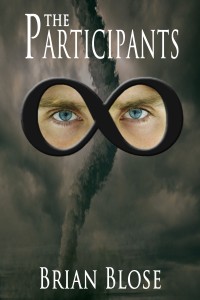
The Participants by Brian Blose

The Participants
Amazon link

Meet Hess and Elza. Like Nick and Nora, Harry and Sally, Pat and Tiffany, they're a memorable couple, trading wisecracks and getting out of difficult situations. The difference with Hess and Elza is that they're linked eternally, through countless Iterations of worlds. They are Observers, a handful of humanoids sent by a Creator to observe His/Her/Its world (though, if this Creator is so omnipotent, why does “He/She/It” need anybody to do the observing for “Him/Her/It”?). Other Observers go through their Iterations as different genders, but Hess and Elza are always a man and a woman. They constantly snipe at each other, each accusing the other of “participating” in the world too much. They seem to be the only Observers with empathy. Like other Observers, they can die, but are dead only temporarily. Every time one pops up in a different Iteration, they seek the other. It is much more difficult in preliterate and even pre-Internet worlds. Other Observers, who do much more shape-shifting, seem jealous of them, and some who see themselves as having more executive privileges seek out opportunities to submit them to torture (imagine torturing someone who never dies). The worst-case scenario? “Dying” and being buried, left to lie quietly underground, perhaps for centuries. This is why Zack, Hess' alter ego, a convenience-store clerk, is afraid of the dark.

This book pulls the reader in; it has been written with a lot of imagination. Who are the best Observers? The ones who watch passively, or the ones who participate out of an overwhelming empathy? What would a blind Creator desire?

Tuesday, January 29, 2013

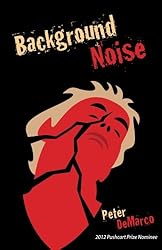
Background Noise by Peter DeMarco

Background NoiseHenry is a background kind of guy. He keeps his life simple, eschewing any kind of a career, observing the working-class lives around him. These stories, written in the first or third person, show Henry dealing with his problems, often by trying out roles. His parents both died young; he has them on his mind a great deal. He keeps meeting nasty priests; one comes on to him, and another is observed wearing Henry's late father's shirt, stolen from the donation box. He closely observes some gay men, but does not feel any temptation. Henry's acute sense of color irritates some folks; the grown-up former bully in his neighborhood is incensed by Henry's painting his house in an unusual color scheme, and exacts revenge over and over. The reader begins to feel claustrophobic, but cannot stop reading, having become all too enmeshed in the protagonist's passive-aggressive inner world, where thought equals deed. Finally, Henry lashes out violently at an easy target. Or does he? He seems to understand that he cannot replay his childhood in ways other than how it has transpired. He still plays roles, though; the reader is left hoping for more of these acutely-written stories to see if this shadowy "virgin man" will ever break through the fourth wall.

Wednesday, November 14, 2012

This Jealous Earth by Scott Dominic Carpenter

This Jealous Earth by Scott Dominic Carpenter. Midwestern Gothic Press.

It is interesting that one of these sharply written short stories, “The Spirit of the Dog,” takes place in a uranium mine. Instead of looking for sparkly bits of gold, the miners run around with Geiger counters after a preliminary blast, looking for little bursts of radiation. Most of these stories involve connections: their breaking, their forming, their resilience, their failure. Just as the forces binding particles in the atomic nucleus are enormously strong, many of the characters in these pieces are drawn, despite themselves, to their imperfect families, to their treasured pets. The opposite occurs in “The Spirit of the Dog”; the various miners pit themselves against the new, pretty engineer. Their individual stubborn egos form a sort of misogynist hive mind whose evil ideas drive everyone apart.

The egos of squabbling or drunk parents get in the way, but their kids band together for mischief or otherwise store up memories that refuse to die, and, when probed, yield little bursts of love. In “Inheritance,” a computer programmer is reminded of the illogical kindnesses of his alcoholic father as he cleans out the latter's home after his death, and has to confront some of his darker ideas of the family romance as he sees himself through the eyes of his son. In “The Death Button,” a young college student sells his plasma to make rent; he is caught up in the drudgery of survival until, as the subject of a psychology experiment, he is compelled to note each instance he thinks of death. His inadvertent running over of a squirrel starts him obsessing about death, spurring him to behave more decisively towards someone he loves.

The title story concerns a family in the last throes of preparation for the rapture. The son doesn't buy into it. As his parents scurry around doing useless things like housecleaning and clothes packing, he thinks about practical, Earthly concerns like money and food. Slowly, the rest of the family, starting with his sister, realize the strength of their own connections. What girl would choose the uncertain amusements of Heaven when she has a brother who calls her “Kitty Cat,” and who tries to arrange future care for her hamster?

Saturday, August 11, 2012

Ghosts of the Multiverse by Harald Hansen

Poor Jeremy Fade. He lives in Goom, suburb of San Francisco, with his second wife and three kids. He worries. About his wife, about his ex-wife, about his kids, about his job. An engineer-turned-salesperson, his career and peace of mind depend upon the closing of his first sale, that of a huge software package to an unnamed university. But first he has to negotiate all the postmodern everything-is-a-social-construct politics and then kiss up to the Bursar, who decides everything. And he keeps seeing a ghost.

The beginning of the book deals with the various characters and their feelings of deserving things: Fade, his sale; the Bursar, deferential behavior; Fade's drug-counselor-wife's patients, her time. All are pursuing their agendas with varying degrees of success.

The University faculty is distracted from their usual concerns by the impending visit of a delegation, headed by an Imam Walid, from the Islamic Institute of Wyrigistan. Pakistan has been defeated by India. Its remnant joins with Baluchistan, Waziristan, Afghanistan, Tajikistan, and Uzbekistan to form Wyrigistan, “balanced in power between the Pashtuns and the northern tribes.” It also is capable of relatively large-scale nuclear war. The delegation's secret purpose is to decide if San Francisco is too corrupt to go on, and is deserving (that word again) of nuclear wrath.

Enter Invention, Jeremy's brown-hooded ghost. Ghosts are the product of unlimited human possibilities, of at least three humans thinking outside the box simultaneously, reifying multiple universes. Invention, who has access to multiple universes (called “cosmi” in this case) believes that Jeremy's sales success is tied to his helping to prevent the Waziris from destroying San Francisco.

We wind up with a rather cartoonish team of bunglers from the various parts of Wyrigistan (plus a couple of American converts) sent out to plumb the most depraved depths (as they see it) of homosexuality to decide if San Fran can live or not. Their adversaries: Jeremy; Phil, a gay African-American ex-linebacker who works as a drug counselor; Homer, a Chinese-American accountant; and Ricard, a Filipino sportswriter-turned-mystery-author. The FBI and CIA are in on it, too. I was a bit disappointed in Ricard's quick synopsis of the Golden Age of Spain, when it was run by Caliphs after the Arabs (he calls them “Islamists”) conquered the not-too-swift Visigoths and held sway over a burgeoning of literature, philosophy, mathematics, music, and architecture that brightened the otherwise Dark Ages. He then cites 1492 as the “real” emergence of Spain as a superpower, while many readers will recognize the year as the one of the Expulsion of the Jews and Arabs and the rise of the Spanish Inquisition. While I don't relish the idea of living under a Caliphate nowadays, in 1000 C.E I would have preferred it over being tortured by Visigoths. Every civilization has its ups and downs.

Things get more interesting when the Norse Pantheon enters the fray. It all is very complicated, but many characters we have already met turn out to have both human and divine identities. There is violence and death and some destruction. Harald Hansen handles it all deftly; the writing is superb and holds your attention through all the wild events. He also includes some wonderful quotes from Neal Stephenson, Virgil and other august characters. A very satisfying book.

Friday, August 3, 2012

The Miracle Inspector by Helen Smith

Book cover for The Miracle Inspector
England experienced a civil war and a Revolution, both in the seventeenth century. Each profoundly affected the English way of life: the civil war through violence, and the Revolution through a change in the power of the monarchy and modification of its succession formula to keep it out of Catholic hands, a change that was in effect until 2011. We do not like to think about it, but most of us with a knowledge of 20th century and early 21st century history have an understanding of the fragility of democracy and the strange, cultish, and often violent movements that threaten to replace it. In Helen Smith's dark book, parliamentary democracy has been replaced by an ideology of victimization that has turned strangely upon itself. A rise in global terrorism has resulted in the borders being sealed, and secret police lurking everywhere. Children are kept from unrelated adults (such as teachers) out of fear of pedophilia, and, in a bizarre sort of Stockholm syndrome, women are veiled and similarly restricted out of fear of rape. It seems to be the nationwide implementation of the signs you see outside of theatres: "Strobe lights, haze, cigarette smoke (herbal or tobacco) will be used during this performance,” and then some. Perhaps to tell themselves that they are indeed enlightened, people avoid meat (the author takes pains to mention that this includes human flesh) and stick to fish and vegetables. I did wonder why home schooling wasn't a big cottage industry, and how men were educated without using books. Anyway, lucky are the folks who can make it into their thirties or forties before getting whisked off by “the authorities,” never to be seen again.

A large bureaucracy includes various ministries and Inspectors, including Inspector of Cats, Inspector of Hedgerows & Grass Verges, and Inspector of Miracles. Lucas, a man in his twenties, is said Miracle Inspector. He keeps busy driving around London in his government car examining pieces of toast that are alleged to bear the likeness of Jesus, etc. His wife Angela is stuck in the house with just a few scrounged encyclopedia volumes to peruse. They share a lot of unspoken frustrations, but actually give voice to the idea of escaping to Cornwall, outside of the borders that have been set up. They befriend a woman, Maureen, who used to be a newscaster, and her special-needs child, Christina, whose miraculousness is hidden behind an enigmatic smile. After a friend of the family, Jesmond, is murdered by Nihilists following a poetry performance and Lucas is taken into custody when someone gets wind of a trip to Cornwall, Angela, Maureen, and Christina are left to hoof it out of authoritarian England. To their horror, all the places they seek refuge are just as bad: in the town of Clough they are expected to become sex workers, and at a back-to-the-land feminist commune of sorts they are exposed to magical thinking and a bloody ritual that does nothing to protect them from marauding men and escaped zoo animals. They learn to avoid the big trucks full of UN and other NGO personnel who make a big show of doing nothing. When Maureen disappears, Angela learns to assume the worst about everybody, and is left crossing the moors with Christina.

Could England, or America, become like Syria? England, while having no written Constitution, does have the Magna Carta and a Bill of Rights. The US obviously has both. The book seems to oscillate between blaming the heightened fear of terrorism and its usual anodyne, the attenuation of individual liberties, and blaming the victimhood felt by those who see every bright light, every peanut, every hug by a friend as a threat. The writing is beautiful, as Smith has shown in Alison Wonderland and Being Light. Other reviewers have characterized this book as a comedy, but I see no way out of its pessimism. Fear is our worst enemy. How do we wage war upon it without waging war upon ourselves?

Author's Website.

Wednesday, April 25, 2012

The Hairdresser of Harare by Tendai Huchu

The Hairdresser of Harare

Meet Vimbai. She is a young single mother working as a hairdresser. That's a book right there. Add to it that The Hairdresser of Harare takes place in Zimbabwe, a culture turned upside-down and anarchic. Inflation is so bad, cash is a nuisance; it takes a brick of notes to buy a loaf of bread. Sugar is available through shady black marketers. Armed gangs roam the streets with impunity. People who don't like the government lie low. Caucasians are fair game. Most people find solace in religion. The culture's attitudes towards gay people is pretty much pre-Stonewall. Vimbai is one of the star hairdressers in Mrs. Khumalo's shop, and inherited a house from a relative (which leaves her on bad terms with much of her family), so for the moment she is not destitute. She is able to feed herself and her daughter, Chiwoniso, and can send the child to school. Then Dumi, hairdresser extraordinaire, walks in. He outshines even Vimbai in hairdressing skills, and is soon catering to government ministers and their spouses. He befriends Vimbai, who soon falls in love with him. His family dotes on her. But what does it mean when someone says at a family dinner that Vimbai has “cured” Dumi? Why does he disappear some nights? The answer is obvious to an American reader, but not to someone in a culture made so different by the swing from colony to dictatorship that its situations could pass for science fiction.

The beauty shop thrives and expands. Vimbai allows herself a little happiness. The denouement is as expected; she is mutely uncomprehending, and behaves as any spurned woman might, but also with a tinge of resignation that is heartbreaking. She is not bereft of empathy, and like the poorest of the poor in her country, is still able to show generosity of spirit in the end. The prose is great. The metaphors provided by Zimbabwe are there to be plucked, and Huchu is a deft harvester.

Sunday, February 19, 2012

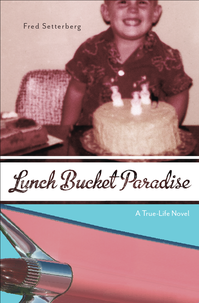
Lunch Bucket Paradise by Fred Setterberg

Lunch Bucket ParadiseIf, like me, you're a Baby Boomer, the suburbs probably played a role in your early life, either as the culmination of your parents' postwar material dreams, or as a green-lawned magical oasis that you could only visit. Cheap suburban real estate was a boon to the working class of the 50's and early 60's, though, as with any new enthusiasm, personal problems did not disappear, and an increasingly unstable economy gave the lie to the concept of easy modern living.

But many books have been written about life in the suburbs (Michael Cunningham's Flesh and Blood comes to mind), and many go unread. Fred Setterberg's sparkling prose and ear for dialog power this autobiographical novel like a vintage T-bird. Setterberg's book has brief, serious (they must be serious; they're in sans-serif) intros to the chapters, which then unleash crackling dialog between the protagonist's autodidact father and his war-hero brother, Win, as well as between the aforementioned older man and the protagonist, called “Little Slick.” The Dad is quite a character: “Too often on Sunday mornings, my mother and I would return home from Mass to find Dad cooking breakfast for the Jehovah's Witnesses, fattening them up for debate.” The Dad and uncle have no illusions and take no prisoners. The Mom is also quite independent, working for political candidates of her own choosing and putting campaign signs up on the lawn over her husband's objections. These are people who know they work for the man and are determined to express their disdain and their heretical ideas when out of the workplace. Of course, some express better than others; another father, a pompous Scoutmaster, gets his comeuppance, but his son pays the price.

The younger generation, playing rock 'n roll and Motown while residing in all-white neighborhoods, of course grow up confused, admiring their parents' resourcefulness but desiring more individuality, living under the shadow of the Vietnam war (which, if you were a teen and time passed slowly, seemed infinitely longer than our longest conflict in Afghanistan seems now), arguing its appropriateness, thinking about going on to college, wondering about their place in what is slowly becoming a service economy. There are dates with girls, hiding extra people in the trunk at drive-in movies, moments of homoeroticism. At the end, our protagonist quits the job his uncle obtained for him (in a ketchup factory) and sets out on a quest for something more. Of course, like the rest of us Boomers, there will be revelations and disappointments, and white-collar work will turn out to be the same as blue-collar toiling for management. The flower beds and barbecue grills will cease to be bourgeois trappings and become for a new generation small avenues for self-expression as the country lurches from one conflict to the next and the economy swings wildly up and down. Though settling down into middle age, the children of the working-class suburbs remember their quarrelsome roots.

For more information, check out the author's website.

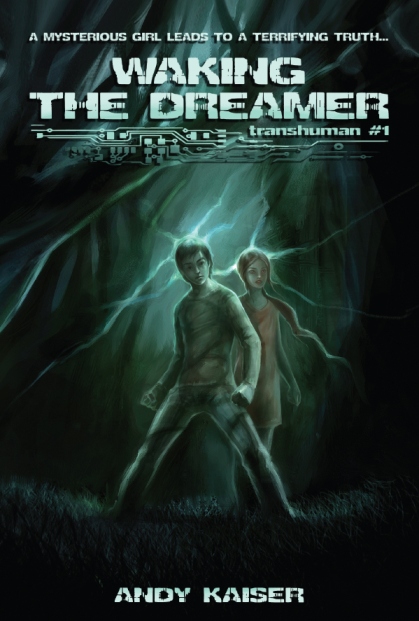
Waking the Dreamer by Andy Kaiser

Waking the DreamerTyler and Zack are thirteen- and fifteen-year-old brothers. Tyler sees himself as an out-of-shape video gamer, while looking up to Zack as a natural athlete and ladies' man. There are moments of tension between them, but their brotherly solidarity, and Tyler's own inner strengths, are affirmed when they go to a rustic lakeside resort with their parents for vacation and Tyler is attracted to a mysterious girl named Eena. The brothers are quickly swept up in a plot involving programmed human subjects, transferable supernatural powers, and a mysterious metal box. Their aloof survivalist father and hysterical ADD-afflicted mother are well fleshed-out, though they mostly stay out of the way of the two boys. Kaiser is good at character development and dialog; we see Tyler tap both his native and his newly conferred powers without jealousy on the part of Zack, who is less concerned with being #1 than Tyler realizes.

Much of the action takes place in darkness, adding to the spookiness of the narrative (though I kept having trouble figuring out the levels of darkness when sometimes two characters made “eye contact” but other times couldn't see in front of their faces). This is book one in a series, so there are plenty of loose ends dangling at the end of the story, but enough of them are tied up so as not to leave the reader feeling manipulated.

This book is for Young Adults. Perhaps they will not mind the editing problems that cropped up from time to time: “seaweed” and “waves” being used to describe things in a lake, the use of “lead” instead of “led.” Fairly minor stuff, all in all.

The book is currently available on the Kindle. See the author's website for further details.

Sunday, November 27, 2011

The Spectacular Simon Burchwood

The Spectacular Simon BurchwoodSimon Burchwood raises his balding pate again in another picaresque tale by Scott Semegran. This time, he is unemployed and newly divorced. After landing a job as a help-desk guy in a government office, he finds out that his ex-wife has abruptly moved with the kids from Austin, where Simon lives, to Dallas, several hundred miles away. Our hero is devastated; he truly loves his kids, and will do anything to get them back so that he can at least see them according to the custody schedule. As in Semegran's previous book,The Meteoric Rise of Simon Burchwood, he cannot do this alone. Rather, he accepts the help of a guy he barely knows from his brand new job, a guy with horrible teeth and questionable personal hygiene, whom Simon calls Snaggle. They set off in a rented Caddy. Snaggle wants to play Slug Bug as they drive, while Simon wants to do MadLibs, so they agree on silence.

Is it my imagination, or am I detecting tiny infrequent bursts of empathy on Simon's part, feeling sorry for the socially inept Snaggle, being a bit more understanding of the various transportation and lodging personnel they encounter? Although Simon's pretensions to being a writer are relatively ludicrous, his pretensions toward being a better communicator and accepting quirks in others, which on the surface may just seem part of the writerly image to him, are actually becoming part of him in a deeper way.

He and his aromatic acquaintance barrel along the highway, soon picking up more assistance in the guise of Gina, a multi-pierced Goth student from Oklahoma, looking for a lift to Norman. Of course, Simon had given his new boss, as well as Snaggle and Gina, the explanation that his grandmother had just died, and they are going to her funeral. He ruminates from time to time about this fib. Complications ensue, and they eventually go through Dallas and on to Oklahoma, where more complications ensue. But Simon is starting to understand something, and his luck literally changes. Semegran handles this quite deftly; even though Simon keeps warbling his “It's true!” declarations at a great rate, the reader does not tire of them, because, well, some of them ARE true, and we see the progress he is making in getting a grasp of what life is about, albeit in his own hamfisted way.

Visit his website. Buy the book!

Sunday, October 2, 2011

The End of the World by Andrew Biss

The End of the WorldThe writing in this novella keeps your interest; after reading the sample I immediately went to Amazon and got the rest. I have read other submissions about young people thrust into other worlds, but the narratives often run out of gas and the author tries to string multiple situations together without much of a unifying theme, leaving the reader puzzled. Biss celebrates the ordinary and alludes to the horror (again, mostly offstage, as in ZombieStop Parade by Richard Buzzell) that makes up millions of unfortunate peoples' lives. There is a lot of Buddhist sensibility here, and those who can let the attachments fall away without too much trouble have an easier time at The End of the World, portrayed as a run-down boarding house distractedly attended to by a Mrs. Anna. Valentine, the protagonist, is raised by a strange couple who seem to embody the false sense of safety of the First World. They abruptly send him away with some money, the panacea of the West. He is too attached to the money to give it up to a mugger, only to be relieved of it by a denizen of the boarding house soon after his arrival. “My name is Luka. I live on the second floor,” says another housemate in an homage to Suzanne Vega and, perhaps, Arthur Phillips' book of homages, The Song is You. Mrs. Anna plays midwife in the end, plying Valentine with Proustian wisdom and guiding him towards modest expectations as he enters his next womb, an old washing machine. We are left hoping that he will be better prepared for the life he will lead if the womb is Sudanese or Syrian.

Visit the author's website for more information.

Thursday, July 21, 2011

Scimitar by Robin Raybould

Scimitar

This is exciting reading. We're in 15th century Europe at the end of the Byzantine era. All the rival city-states in Italy, Greece, and elsewhere are fielding networks of spies (some of them blackmailed), who move from place to place in disguise, trying to find out one another's designs on a moribund Constantinople, We follow the studly Eduardo Ferrucci, an orphan trying to make his way as a bookseller, as he is drawn into the Florentine network and begins his escapades. The background is Renaissance deluxe with lots of boastful merchants, dishonest servants, adulterous wives, and dramatic reversals of fortune.

A sociopathic and jealous spymaster working for the Bargello in Florentine security blackmails our hero into serving long years working for these baddies, who have their fingers on the pulse of Florentine society by way of access to the records of all the banks, plus the usual team of informants. Over in Constantinople there are lots of battles, skirmishes, swords flying, and blood spattering, while, back in Florence, the Security people exact their own kind of bloodless vengeance, bankrupting those they mistrust or see as obstacles to their own enrichment. When Eduardo isn't involve in battles, he is seeking out valuable books to send back to his bookseller boss. Some of the books he discovers trace back to ancient Greece, and were actual discoveries that influenced Renaissance thinking. There is a lot of bibliophilia throughout the book, as well as a lot of escapades of a more fleshly nature, as Eduardo can't seem to keep it in his tights.

I don't want to spoil the plot, so I won't tell you how the book ends, but it is fairly predictable.

The only problem I had with the work was with the omniscient narrator: using words like “life-style” and “rationalize” tends to spoil the suspension of disbelief in a novel set in the Renaissance. The author, a Renaissance scholar, also cannot refrain from using footnotes, further breaking the spell. Maybe some notes at the end, with suggestions for further reading, would be appropriate, but swashbuckling and footnotes don't mix. Also, the long sentences at the beginning of the book skate dangerously close to run-on territory. Raybould would do well to consult the masters of the long sentence, Yaacov Shabtai and Todd Hasak-Lowy.

Wednesday, June 29, 2011

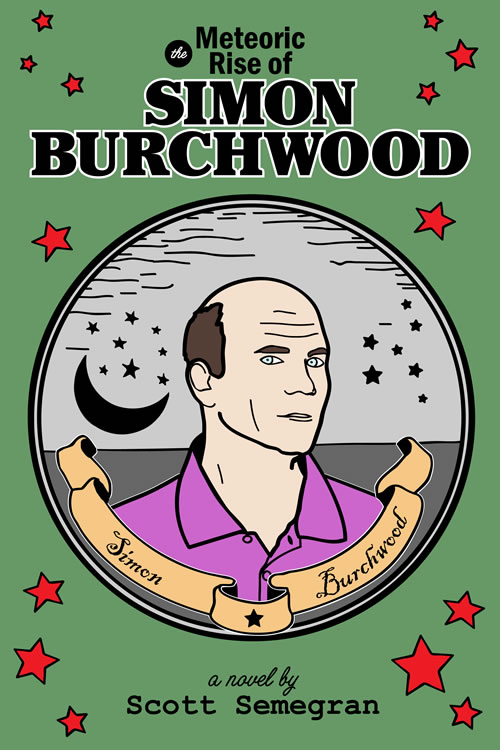
The Meteoric Rise of Simon Burchwood by Scott Semegran

The Meteoric Rise of Simon BirchwoodThis funny picaresque novel features the insight-challenged Simon Burchwood, off on a quest for fame and fortune as a great writer, making his journey from Texas to a reading of his début novel at the flagship Barnes and Noble store in New York City by way of Montgomery AL, where his boyhood friend Jason signs on as his Sancho Panza. Simon is a fine example of a “you spot it, you got it” personality type, exceedingly critical of everyone he meets, tilting at windmills that have his own name painted on them. Semegran manages a first-person narrative that is simultaneously derogatory, clueless, and energetic. Simon is constantly launching into little asides, some of which make one want to scream “TMI!” His meanderings will remind birders of the song of the house finch, which emits a long trail of descending, insistent-sounding notes, finishing with a querulous, whiny three-note ascending and descending phrase at the end; Simon's songs always end with the assertion “It's true!” He's a stingy tipper to boot; this is tolerated somewhat better in Montgomery than in NYC.

The action picks up substantially during his time in Montgomery, where he runs into old acquaintances and revives his assorted petty grudges against them that had been dormant for years, refreshing his relationships with people as what I think folks nowadays call their “frenemy.” He disparages Jason's slovenly lifestyle and makes fun of his old car, calling it a “turd-on-wheels.” The reader will tightly grip an imaginary steering wheel while Simon, often half in the bag, rides around the dark Alabama streets in Jason's other car, his father's lovingly restored 1967 Mustang.

As Simon readies for the New York leg of his trip, the cracks in Jason's marriage become visible to him, and, at Simon's insistence, Jason comes along for the ride, even though he has declared to Simon that “Everything was fine until you came into town. That's when everything started to fall apart.”

The New York segment is played for slightly more broad comedy, a two-hicks-in-the-big-city farce. The two men arrange with a sleazy bellman to stage a “practice” reading of Simon's book (always referred to in caps: “THE RISE AND FALL OF A TITAN,” based on the illegal shenanigans of Simon's detested boss), inviting off-duty hotel employees and sending up a keg. Simon clutches and manages to read the first paragraph only; then the drinking and partying begin. Our hero does manage a few moments of empathy, both in dealing with Jason and with a menacing breakfast chef. Does this suggest that, all other evidence aside, his book may be good? Is he capable of change, or will he remain a legend in his own mind?

The writing is very clever. The only problem I had was with Semegran's usage of “low and behold,” instead of “lo and behold,” and a few typos. Read this book, and feel yourself clutching the wheel of the Mustang as Simon careens through the streets and reaching for your wallet as he prepares to dole out another miserly tip.


Visit his website. Buy the book!

Friday, May 20, 2011

"Editorial" by Arthur Graham and "Lief" by Ryan Tressel

I have just finished reading Arthur Graham's Editorial and Ryan Tressel's Lief. They offer an interesting contrast in authorial voices. On the surface, the books are remarkably similar. Each follows a main character over a disjointed timespan: in Editorial we follow mostly one character over thousands of years (he is apparently immune to the nuclear catastrophes that kill off most of the world's population, and in one guise clutches a black leatherette notebook that serves as the tale's Maguffin) and in the other book, we follow the title character, Lief, at four-year intervals (she is a Leap Year baby) that go back and forth through her life.

EditorialAlthough Editorial switches between the first and third person (and between human and snake species as it indulges in a little shape-shifting), this reader was at a loss to identify any emotional investment in the characters by the author. If someone spends time as either a human or a snake, I want to know more about what it is like to, pardon the expression, experience humanity through snake eyes, and vice versa. I want to know what the kid being raised by an “aunt” and “uncle” really ate for his meals, why he exulted in their frequent fights, how he learned to read and write when being raised on dirty magazines (almost as an afterthought, deep into the story, we learn that he also attended school). The protagonist talks about using sex for currency in the world economy (I imagine it would make it very complicated to go to a movie) and generally displays a misanthropic Weltanschauung (“And this was what the people of the world, if they learned anything in their short, ignorant lives, learned on that day.” … “An ugly man and woman and their doubly ugly children [what happens when ugly multiplies] sat continuously yammering … ”) that, in itself, could still make for interesting reading if it weren't for the overall impression that Graham doesn't underpin the complicated narrative with much in the way of character development. There are scattered illustrations (one of which my Kindle couldn't handle), but they don't really add much.

LiefLief is a woman whom we glimpse every four yeas on February 29, from age four to forty, but out of order. We are invited to read the chapters in any order, but this reader chose to read them in the order written, which is still non-chronological. One is given a vague sense that she, too travels in time in an unusual manner. She is a rather ordinary person, a bashful child and a slightly anxious adult who goes to college and tries to sort out her complicated familial and social relationships. But the level of emotional investment by Tressel in his characters is what transforms the story. Leif is shy. Her mother is a left-wing radical who occasionally ignores the children when she is caught up in her political campaigns. The father is quite affable, and gives everyone nicknames (he reminded me, for some reason, of the father in the movie Juno). The mother dies offstage, as it were, and when we notice the name of the brother changes and he is not an older brother but a younger one we fear that he, too (the older brother), may be dead, and are relieved when we learn he was estranged from Lief and later takes steps to get back together. These are the things that draw the reader into a story, any story. Lief often refuses to wear her glasses; she has an occasional problem with excess saliva that leads to apologies and self-deprecatory remarks. If she existed as a snake for part of the narrative she would be self-conscious over a patch of dull scales and would worry about where she was going to lay her eggs. She is always cold, because it is always February 29.

Both books need editing. Both use the term “alright,” which to me is like fingernails on a blackboard. One is not squeezed in a vice but squeezed in a vise. On the plus side, I learned a new spelling for “jissom.”

Wednesday, April 13, 2011

March 2011 Smashwords Conveyor Belt


I picked out these pieces in the first week of March and only now am able to review them, not only due to being involved in a move but also due to the sweetness of some of the candies coming down the belt. I think the caliber of Smashwords submissions is improving.
Here TodayHere Today by Simon Groth is a novel about a woman doing a short-term gig as an occupational therapist in a palliative ward. It takes place in Australia. The protagonist, Astrid, is bunking with a friend, Leith, who herself has become paralyzed from the waist down, and who deals with it by dressing and behaving like Lindsay Lohan. Astrid has self-esteem issues, but does some good work with the mostly elderly clientele, and with a famous writer who has suddenly become locked in by a stroke. The theme of the book is communication; sometimes this is expressed with slightly heavy-handed metaphors, as when Astrid bites her tongue seriously enough to require medical attention, but overall the interplay between her, her patients, and her friend is handled very well. The narrative explores the lies we tell to ourselves and to others, and the struggle to communicate truthfully that some never win. It was an enjoyable book overall.
The Empress RoseThe Empress Rose by Chris Eastvedt held my attention for many pages, until the constant info-dump of material about the superiority of hydroponic farming wore me down. At my new digs, a front and back yard with scruffy grass are challenging me to revitalize them organically, but I doubt you want to hear much about the three-bin method of composting or the pros and cons of corn gluten meal. But Rose doesn't stop. At a farmers' market, after she has explained to other farmers in excruciating detail how her methods are superior, she starts all over again preaching to a restaurateur. I have been accused of doing the same thing over topics I am passionate about; I have learned that it is a quick way to bore people conversationally, and it sure is a good way to bore the reader if one is not careful.
Siding The HouseSiding the House by Michael Jasper is a short vignette about a poor African-American family living down South who try to preserve a little joie de vivre in the face of threatening monotony and casual racism. The story is narrated by turns by Kanita, the little daughter, all brightness and speed; her depressed mother; her toothless grandmother, who tries to keep up morale by constantly making candy (an imaginative example of self-defeating behavior); and Bobby Ray, the developmentally delayed brother. Their house is being covered with siding by two young white men who seem to illustrate the downside of attempts at upward mobility in a racist system. Kanita disowns the siding, calling it “ugly,” and manages to hold onto her self-esteem. Beautifully written.
Tim the Tale Teller by Timothy Conerson: "By 2010 President Obama was constantly looking for terrorist in every corner of the globe. While cities and towns in the United States crumbled, Chinese computer programmers began to create a virus that paralyzed the weapon systems in the U.S. All combat took place hand to hand, gun to gun. The people of the United States were not particularly patriotic during that time so it was easy for the Chinese military to occupy the U.S."

This is from “The Peoples [sic] Republic,” the first of several short stories. I think he means “terrorists.” This would have worked so much better if set in the distant future, with names changed (and text edited; there are many typos and grammatical errors). The year 2010 has come and gone, and I see no dearth of people who consider themselves patriotic, from the Tea Partiers to the strikers in Wisconsin. The author really liked his own book; he gave it five stars on Amazon.

Chewing on Pen Caps by Cloud Buchholz. I think this is. A type of experimental fiction. Because when the narrative is. In the POV of. Or about the protagonist. Lemon Anderson. The structure reverts. To sentence fragments. But it's difficult to read. And no substitute for character development. Which may happen eventually. But not soon enough for me.


If you find explicit sexual content unpleasant, read no further.

This is Butte. You Have Ten Minutes by Craig Lancaster This Is Butte. You Have Ten Minutes and Gunshot Stigmata by Scott C. Rogers, if I had them in paperback, would probably smell of stale cigarette smoke and dried beer, with covers splotched with dried secretions whose origin I might not want to know. The Lancaster book looks at the trajectories of the lives of several people in Montana, down on their luck, and in one case, in prison. There is a lot of riding of Greyhound buses, furtive and fast screwing in a bus station restroom, and the exchange of a blow job for a lift with a trucker. The prose is intense but smooth, like good black coffee. The characters are honed by experience, mostly bad. Any residual loyalty or vulnerability is tested or betrayed. The whole narrative is bathed in yellowish sodium streetlight.

Gunshot StigmataRogers' book is different, in that its unreliable narrator is usually stoned and always insane. A damaged product of the foster care system, he plays guitar until his incapacity to bear life leads him to shoot himself in the hand, hence the title. He does try to find love; an uninhibited male view of sex runs rampant here and is refreshing. Rogers writes about sex and the ever-present undertone of aggression, like Charles Bukowski on steroids: “The mole that hid just on the inside of her right thigh. Whenever I ate her out I always kissed it goodbye afterwards, pulling up with a chin wet like a lion fresh from a kill.” The novella is in many short, disjointed chapters that jump around like the disordered thoughts of a severely shattered soul. Very well done.

Wednesday, January 19, 2011

Being Light by Helen Smith

Being Light

This is a very entertaining book. Readers familiar with Smith's prior work, “Alison Wonderland,” will become reacquainted with several chracters, including Mrs. Fitzgerald, a private eye; Alison and her daughter Phoebe, who assist Mrs. Fitzgerald; and Alison's friend Taron. It is not necessary to have read “Alison Wonderland,” nor is it necessary to keep notes on the myriad characters, because Smith is able to make them memorable with very deft description, so that when they pop up unexpectedly in the narrative, we recognize each individual's Leitmotif immediately.

The book begins with Roy, an affable middle-class man, and his more edgy friend Brian, inflating a “bouncy castle” for children attending a charity fair. Roy's whole relationship with gravity, tenuous at best, is completely transmogrified by a gust of wind that lifts him up with the castle and deposits him in what he thinks is (and there is no reason to think otherwise) Paradise, complete with an adoring angel named Sylvia, plus chickens, ducks, a cow, a dog, and an elephant. Roy's disappearance is a complete disaster to his devoted wife Sheila. When the police are no help and Mrs. Fitzgerald can find no leads at the outset, Sheila casts her lot in with a clairvoyant and other mediums, eventually going all over England with little aluminum foil earlaps to try to tune in Roy.

More twists and turns evolve as we meet Jeremy, a cross-dressing eco-activist; Venetia, Sylvia's former boss (she wants the elephant back); and Jane, a trendspotter-cum-journalist, who has to find a story in everything.

The characters all sound “light,” but some have agendas that are very weighty. There is a hint of criminal activity afoot, and one character buys too heavily into the idea of lightness and meets a ghastly end. Some don't “get” it, and are simply barmy or shallow, but interesting nevertheless.

This book, besides being very entertaining, is a good book for self-publishing authors to look to as an example. It is free of typos, avoids the two-adjective-noun, two-adjective-noun death march to boredom, and manages to tell a lot of story without a lot of words.

Sunday, December 19, 2010

Pairs by D. W. Richards

PairsThis book is about two (predominantly straight) couples. The men are cousins with little in common save blood; the women are from very disparate backgrounds. They are all (except maybe Adam, who seems to have his life together already but is conveniently unattached) relatively nice people who have had setbacks in their pasts. They are ready to pick up and move on to better things. Both couples meet cute, take ages to have sex, then go at it with enthusiasm. There is a lot of humor here, especially the character Kayley's grandmother, whom we never meet, but whose deftly sprinkled stream-of-consciousness phone calls are expertly crafted, and reminded me of the razor-sharp prologues to both parts of Angels in America.

The ongoing story is quite entertaining. Occasionally one realizes that the author is trying to run a subplot underneath all the conversations, flirting, sex, personal growth, and confessions. This arises awkwardly; Chapter 16 concludes “A cathartic sorrow overwhelmed Kayley, and she wept quietly.” The very next chapter ends with “A cathartic sorrow overwhelmed Alexandra, and she wept softly.” Am I missing something? I mean, I get the part about renovating the house.

There is something else about Kayley's departed ex-boyfriend and a poem they wrote together, but it gets so little emphasis that its infrequent mentions, and a recovered letter from the deceased, read at the end of the book, are somewhat anticlimactic.

Mr. Richards' prose can be awfully good: “A weak grin slid onto Kayley's face and led into a quiet pop of breath that Adam interpreted to be a distant and shattered cousin of laughter.” Some same-sex attractions, mostly fleeting, flow easily with the narrative. Inexplicably, besides the slightly-more-than-tolerable number of typos are some other quirks. One character owns a “Berber umbrella.” I have searched Google, thinking that there may be more drizzle in North Africa than I have been led to believe. All I could come up with was “...unless one is prepared to disagree with the whole concept of closely related Afrasan 'languages' brought under the 'Berber' umbrella...” Does he mean Barbour? Burberry?

The author pays the bills by being an accountant but I would have guessed he is an architect. I counted the word “foyer” ten times in the text. If I weren't so cheap I could have bought the Kindle version and found a few more with the search function. I checked the poem that is so infrequently mentioned yet so fraught with a meaning that escapes me: no “foyer.” Is it a metaphor for the birth canal? A critique of urban Canadian residential architecture? Wait; do Berber dwellings have foyers? A friend suggested that perhaps Richards is very fond of the author Jonathan Safran Foer and betrays this unconsciously in his writing; it's a reasonable theory.

Quibbles aside, I enjoyed the story and recommend it to those who are looking for well-rounded characters and overall good writing.

Wednesday, October 13, 2010

ZombieStop Parade by Richard Buzzell (aka ZombieStopperUno)

book cover for Zombie Stop ParadeThis book is entertaining, not so much for its plot as for its style. There are truckloads of books telling tales of young progressives working to enlighten the masses about corrupt systems, but few told in such a fresh and economical way.

The whole story unfolds in the form of a diary kept by the unnamed best friend of a late-teens/early-twenties college dropout named Corky. Both guys are unhappy with the way large corporations seem to break the rules and expect the population to buy their twisted rationalizations as expressed by the corporate-owned mainstream media. There is much mention of a recent "financial fiasco," which everyone is dealing with, and which is being spun as usual to make the corporations look blameless. Corky and his friend run a progressive blog called ZombieStop, which they founded when twelve years of age. It includes a forum and, as the book progresses, a satirical comic strip. Corky is also a DJ at an invitation-only club. The two guys are very good at what they do, and very careful about letting things go to their heads. They just want people to stop being zombies.

The plot has a few twists and turns, but what held me from beginning to end was the spare and elegant prose style. This is the diary of a young man with a close friend whom he admires. They share a common goal, and are willing to put in hours, years, really, in front of computer screens to achieve it. His trust of Corky is tested from time to time by others; he doesn't go crazy or confront Corky at knife-point or anything; he just reflects upon his feelings in the diary. It is a real treat to read someone's thoughts about friendship, loyalty, truth, and doubt when they are presented so honestly, and in a very clever deadpan style.

The book reads like a Jane Austen novel; any really intense action occurs offstage (in this case, a house and a yacht are blown up after some embarrassing personal finance information is uploaded to the blog by someone calling himself the Jackal; this brings the blog under suspicion but also boosts its following). What the reader is treated to is the inner thoughts of the number two guy as he handles the blog's newfound fame, the rekindling of a relationship he has had with a lover who criticizes him constantly, and the intrusive and leading questions of an FBI agent assigned to sniff out conspiracies. The friend discusses at length Corky's common-sense progressive ideology and his quietly subversive style without ever sounding didactic or fawning; he is able to show doubt, modesty, and humor in a way that is rare in literature of this type.

Downside? The prose, while very good, could do with a comma-ectomy. Buzzell also needs to decide upon English (“neighbourhood”) vs American (“labor”) spelling. But these are easily fixed, and do not detract from this little gem of a novel.

Author's Blog

Wednesday, September 15, 2010

The Smashwords Conveyor Belt


It has been a while since I have sampled the treasures of Smashwords as they arrive hot off the server. Once again, I am looking at the book-length literary fiction offerings available today, September 15. I mainly read the samples, which are often generous, but if I really love a book, I buy it. I am skipping thrillers and any other genres I feel would be better judged by another member of the staff.

First up is G. K. Ingersoll's The Atheist Vignettes. This is a mostly well-written pastiche of pieces about people, mostly former members of a group called Chris†eens, who are confronting their doubts about faith as they enter middle age. We are treated to sections of a play interspersed with vignettes (naturally) of characters in various states of dogmatic compliance/anxiety interacting with one another. The dialog seems very sharp and realistic; the only problem is with the play excerpt at the beginning, featuring a dialog between God and Satan. The name of the speaker does not begin every line, so the reader is constantly referring back to the top of the page and counting downward “God, Satan, God, Satan...” to the line in question. There are also a few syntactical errors, but overall it looks like an interesting read.


Next, we have three offerings from the mysterious “Dorian Taylor.” Is he real? Is he alive? Is he dead? The preface of each work only hints.

I will start with Modern Problems. We are told of an author using the pseudonym “Dorian Taylor,” an artist plagued by anomie who just cannot get it together to find a market for his writing. The book is a pastiche of narratives, beginning with a poem. I think Taylor has a story to tell, but first he has to fix the errors and the derivative style. I'm sure he can come up with a more interesting description of a dancer than comparing her to Terpsichore:

“From all that he could conger up in his mind in later years, all that really presented itself to his memory were Jamie's legs…”

“Standing still she was a homely little girl from Nebraska, in motion she was Terpsichore, the Goddess of the dance, and she came from Mount Olympus.

“There is or maybe was, a bar off of Washington Square, situated in the basement. It had chess boards painted on it's tables, and the chief reason for going there was to discuss philosophy, or literature, or maybe play a game of chess, while sipping the French liquid fire called Pernod” (italics mine)…


Top 40 is a book that uses old (and I mean OLD) pop tunes as chapter headings in stories about the author as a “man out of time.” Being old myself, I can relate. I didn't get through enough of the sample to see if he actually used Joni Mitchell's “Urge for Going,” but it's what comes to mind. The image of the rambling man who “marches to a different drummer” or “hears the call of the road,” or (if I ever write my own song) “is too narcissistic to commit to anyone” is very prominent. I'm hoping it was a satirical treatment, but when he misspelled “Iliad” I couldn't go on.


Billed as “Georgette Heyer meets the Marquis De Sade,” Taylor's Volatile Elements makes for more interesting reading. It is about a very wealthy man who owns vineyards and other revenue-producing ventures, a man who came by his money in a very unfortunate way that I wish Taylor had elaborated much more upon. He meets up with a long-lost girlfriend, and we are treated to multiple points of view, as well as lots of steamy sex. I think Taylor's characters become much more interesting when they are making love rather than soliloquizing. This seems to be the most mature of the works.

UPDATE: We think this has been republished as The Gaze of the Abyss.


Elder Wonder Comes of AgeElder Wonder Comes of Age is a book about horny Mormons. It's very funny. It's Mormon practice to send their young eighteen-year-old men to do two years of missionary work. They can have only limited contact with family and friends while on a mission. The protagonist, Jerry Wonder, already has one strike against him: he's a vegetarian. Also, as most eighteen-year-old humans, he's constantly thinking about sex. He is sent to New Zealand, where, under the very watchful eye of a senior elder, he goes out proselytizing with other horny teens. It is the early 1960's, and everybody is worried about what direction the Cold War will take. They get a mixed reception in New Zealand; their hard-sell tactics anger many people. As a Jew (Jews don't seek converts), I found it unnerving to read about Jerry's partner lying to an elderly Jewish woman, telling her they were sent by her Rabbi to visit her. Jerry refuses to back up the other missionary's faith statements. Meanwhile, his girlfriend has taken a job as a stewardess so she can see him in New Zealand. I may have to buy this one…