 Forensic psychologist Dr. Jack Carter wakes from a semi-catatonic state in a mental hospital with no memory of the previous year. His wife, Sarah, has disappeared, and as the last human being to see her alive, Jack is the prime suspect in her disappearance. Without a body and with no physical evidence to prove foul play, the lead investigator and Jack's friend, Bill West, must continue to search for the truth even if it means fingering Jack for the crime. When a serial killer in West Virginia's coal country claims to have killed Sarah Carter, Bill and Jack rush to the crime scene. What they find is a deeply disturbed man with no memory of his crimes or of taking credit for Sarah's death. As Jack tries to decipher the mysterious series of runic symbols the killer carved into his slaughter house, he unlocks a deeper cosmic mystery that goes beyond anything he could imagine.
First Stone is the first novella in Gary Ballard's Stepping Stone Cycle, a "modern interpretation of H.P. Lovecraft's Cthulhu Mythos." Naturally, I'm curious about all things Lovecraft, including new tales by authors playing in the Master's non-Euclidean sandbox. Of course, should anyone defile that sandbox, I would feel compelled to warn everyone to stay away. Fortunately, that isn't the case here.
The novella opens with Carter waking from his semi-catatonic state. As a nice touch, Ballard has Carter re-discovering his senses and the world around him. He questions the words we attach to objects, the length of time, and his own body. There are elements of knowledge still functioning within his brain, but we don't know if these are all a priori nuggets or the undisturbed bedrock of memory. Either way, slipping back into one's body isn't as simple as getting back on a bike after years away.
A good chunk of Lovecraft's work involved the protagonist setting off on an investigation to uncover the truth to a bizarre circumstance. In this regard, Ballard follows a similar path. His protagonist is a forensic psychologist, a solid choice for going out to crime scenes and dealing with those whose minds may have been damaged by things that dwell in the dark.
Ballard invests a good deal of time developing his characters, and it pays off. You really get to know Carter and root for him to find the answers to Sarah's disappearance. His friendship with Bill plays easy. And Ballard develops the small town West Virginia characters, too. It would've been easy to let them be two-dimensional stereotypes, but Ballard invests in their backgrounds to make their personal stories real.
While Ballard is playing in Lovecraft's sandbox, he doesn't play with his toys in quite the same way. Ballard sticks with his own writing style. Yes, he teases you with a survivor's testimony, has you listen to some preaching about the unfathomable darkness, and flaunts mysterious objects. The obligatory fhtagn and R'lyeh utterances are thrown in, too, but the story flows like a crime drama rather than cosmic horror. It's an interesting twist on presenting Cthulhu Mythos fiction and might serve as a bridge for psychological thriller fans to get a glimpse of the Old Ones.
Like quest fantasies and space opera epics, this isn't a tale that will be wrapped up right away. Patience is the key here. Ballard explains that he's writing the novellas like episodes in a TV series. Short-term mysteries are solved in each novella and clues to the overarching plot (What happened to Sarah Carter?) will be provided as the mystery deepens, but to get it all you'll have to read all of season one (Episode Two was recently released).
All in all, it's an entertaining and quick read. I'm left wondering just how far Ballard intends to go with this series and if he'll deliver the goods at the end of the season. I got the feeling that he was holding back, not wanting to give too much away so soon. But like many a good writer, he dangles the line out far enough to hook you in.


 A young woman is haunted by a past she can't remember. She feels threatened by her father and his lascivious friend. In her efforts to elude the pair and track down her brother, a third man hunts her for his own depredations.
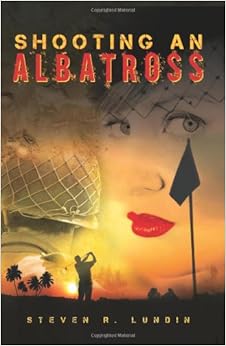 Revenge takes a generation to come to fruition in Shooting an Albatross, Lundin's above average first horror thriller. One day the lonely life of a ninety-something Floyd Akerly is interrupted when he receives a stranger into his home, thinking that the man is there to keep him company and listen to his stories. But the uninvited visitor with an unusual interest in events that took place over six decades in the past has a different agenda. Only Floyd's careful recollection of the past prevents the stranger from carrying out his plan right away.