Showing posts with label contemporary. Show all posts

Monday, September 2, 2024

The Forgotten Sons of Wyoming by Brady Koch

book cover for The Forgotten Sons of WyomingIn the frozen heart of Wyoming, the Trinity Meat Processors stands as a beacon of rehabilitation. Here, men with no pasts and blank slates find purpose under the watchful eye of Pastor Isiah. Asher, unsettled by the sudden disappearance of his friend after a confrontation with a mysterious intruder, races against time, battling forgotten truths and moral dilemmas.

This is the second book in Koch's All Our Forgotten Futures series. And it's probably my favorite.

Asher is one of several men who work at the Trinity Meat Processors slaughterhouse. Koch pulls no punches when he describes the brutal work that the men do. There's a cold detachment from the process, stripping away each layer of the animal until there's nothing left. It's unsettling. It parallels the counseling sessions and church sermons that the men are required to attend as part of their therapy. They strip away the layers, trying to find the man underneath, but it's the same result: an empty shell.

Each man suffers from memory loss, unable to remember what happened before they came to work at the slaughterhouse. The "mysterious intruder," referred to in the blurb, knows. His presence disturbs the men. He accuses them of things they have no memory of. But Sonny, Asher's friend and the lead on the kill floor, has some idea, but he'll be damned if he's going to let this guy get to them. Of all the men, he's the least docile, which is unacceptable.

Asher desperately wants to remember his past and what his counselor won't tell him. It has to be something terrible, right? It seems that Sonny has the answers, which might explain why he's the most boisterous of the bunch. Events build to a head, and Asher comes to realize that things are terribly wrong. A character shows up from The Negotiated Death of Sara Glen which will cinch it for the reader. At this point, Asher and the men at the slaughterhouse are in mortal peril.

As I mentioned earlier, this story was my favorite in the series. Between Koch's descriptions of the men's lives, their work environment, and the surroundings, plus the way he builds dramatic tension, The Forgotten Sons of Wyoming makes for a solid thriller. But there's a scene towards the end of the book that really did it for me. Asher is standing in the middle of a road with the snow coming down. He needs to make an important decision. The imagery of the scene, coupled with how he comes to make that decision, is the cherry on top of a thrilling sundae.
Full Disclosure: I was hired by the author to proofread/edit this book. While you might think I'm biased, I suggest heading over to Goodreads for other opinions.

\_/
DED

Monday, August 26, 2024

The Negotiated Death of Sara Glen by Brady Koch

book cover for The Negotiated Death of Sara GlenSara makes a startling discovery through an at-home ancestry kit: She possesses a unique immunity to the elusive Jessica Kitner Syndrome. This revelation doesn't go unnoticed. OriginPoints, the DNA test company, approaches her with a proposition that might demand the ultimate sacrifice.

Caught in the maelstrom of genetic intrigue and moral dilemmas, Sara stands torn. With a profound sense of duty on one hand and the weight of her own life on the other, she grapples with choices where clarity is elusive.


This is the first book in Koch's All Our Forgotten Futures series.

As stated in the blurb, Sara learns that she carries a cure for a disease that reverses the cognitive development of children. The problem is that in order to extract it, she must undergo a procedure that will kill her. She leans this at an engagement party for her sister. Over the course of the book, she goes back and forth between sacrificing her life to choosing to live.

While Sara attempts to keep the news of this to herself, the CEO at OriginPoints is eager to promote the technology that led to the discovery. It could lead to billions, which would make stockholders very happy and he'd wind up rich and famous. The pressure is on him to deliver.

So what's in it for Sara? Well OriginPoints will fully take care of her, pay for her to travel and see the world, memorialize her legacy, basically anything to make her out to be a hero.

The rest of the story, told completely from Sara's POV, has her debating her choice with herself. She volunteers to work at a daycare specializing in the care of kids with JKS to get the parents' perspective. She helps plan her sister's wedding; she even starts dating a guy. Sara goes back and forth until Koch throws in a couple of plot twists that change the stakes.

While Koch does a great job at developing Sara, he also does a solid job of developing all of the other characters that Sara interacts with as she tries to make her decision.

All-in-all, this story is a solid start to a great series. In the hands of a lesser author this could've been treated as a maudlin morality tale. Instead, Koch has crafted a fine dramatic thriller.
Full Disclosure: I was hired by the author to proofread/edit this book. While you might think I'm biased, I suggest heading over to Goodreads for other opinions.

\_/
DED

Friday, October 28, 2016

A Sickness in Time by MF Thomas and Nicholas Thurkettle

Cover: A Sickness in Time
THE MOST DANGEROUS OPERATION

In 2038, the human race is in a death spiral, and most people do not even know it yet. Technology that was supposed to make us better and stronger instead is birthing a strange and terrible plague we may not be able to stop. When the young daughter of Josh Scribner, a wealthy tech entrepreneur, starts to succumb to the illness, he dedicates his fortune in a desperate effort to save her life. Working with a friend & celebrated physicist, Josh develops the ability to send objects back through time. Their goal to recruit an agent in the past who might change our fatal path.

In our present day, a broken and traumatized Air Force veteran finds a strange message in the woods, drawing her into an adventure spanning decades. All humanity is at stake, as she and her small group of friends become the unlikely heroes taking up the secret fight against our future doom.

MF Thomas and Nicholas Thurkettle, authors of the acclaimed sci-fi thriller,
Seeing by Moonlight, are back with this time-twisting adventure that asks if our own destiny can be healed.

A Sickness in Time, by MF Thomas and Nicholas Thurkettle, is set in two time periods: one in the present day and one in 2039. It is a time travel plot with carefully defined limitations around what can be sent and how far back. The constraints are, of course, what makes the plot interesting. There can be no free-for-all in which the timeline gets increasingly muddied, but the various characters have to plan out very precisely what they intend to do. And the nearness of the two time periods—under twenty years—is very intriguing. There is no grandfather paradox here: the overlaps are much more immediate.

But before you reach the time travel elements of this story, and running along in parallel with it, is a plot dealing with the crossover between human and artificial intelligence. In this case, the artificial part takes the form of augments to human capability, rather than alternatives. The book's title refers to the discovery that the augments have a shadow side, the extent of which is largely unknown. They are not the unequivocal benefit first assumed, though puzzling out what the problems are takes a lot of time.

This story really worked for me. I liked the interplay between the different periods and the gradual alteration of the future line in response to successive changes. It's hard to tie up all the loose ends once you invoke time travel, but the authors do a convincing job. Inevitably, well before the halfway mark, you find yourself wondering how the tangle is going to resolve. Without giving anything away, the resolution had a clever twist. Every reader will—like me—wonder if that was the best choice to make, but it has certainly been done creatively.

There are two pairs of main characters, one pair in each of the two periods. But the pairs are contrasting in several ways rather than parallel. The authors do a good job of exploiting these contrasts. I found all four of the protagonists very credible, and quite individual.

In short, A Sickness in Time is well thought out, well planned, and well executed. If you like science fiction which doesn't just tell a story, but probes the difficult interface between scientific, social and ethical areas, this could be the book for you. I certainly really enjoyed it.

The book's website can be found here.

Wednesday, October 19, 2016

Kingdom's End by Charles D. Blanchard

book cover for Kingdom's EndIndio, a wise blind mole rat, has led a prosperous colony of sighted rats in the ruins of an old, abandoned movie theater for most of his thirty years. But the head of colony security, an ambitious Norway rat named Matthias, thinks he can do a better job and schemes to make a power grab. Meanwhile, the city recognizes that it has a rat infestation problem and decides to wage war on them, ultimately setting its sights on the theater.

Blanchard dedicates this novel to Richard Adams for writing Watership Down. While that book got people to look at cuddly rabbits in a new light, Kingdom's End attempts to take an animal often looked upon as vile and detestable and shine a more favorable light upon it. He makes no attempt to gloss over the rats' culinary preferences or nesting habits, but through anthropomorphization he imbues some of them with more admirable qualities of honor and service to community.

The story starts off with a group of rats out on a foraging mission. We start with one rat, then segue over to another rat, who then meets up with another rat, and so on. The focus of the story shifts from one rat to the next as Blanchard introduces us to parts of their world. Some rats that appear early in the story don't re-appear until much later. It's a bit dizzying as I wasn't sure which rats were important to the overall story and which weren't.

The story is told from a universal omniscient POV, which goes above and beyond third-person omniscient. Not only do we know what all of the rats are up to, but the nameless humans they encounter as well. Blanchard tells us everything, relevant or not to the adventures of the rats. I found it odd that we would be told a human character's backstory but not their name. And there's a lot of telling that goes on with this form of narration. The foreshadowing comes in the form of prophesies from an old rat that lives near the river. We know what's going to happen, it's just a question of when. I realize that this is a more traditional form of storytelling, but I find that it goes too far and leaves less for the reader to discover on their own.

I don't know if many people will get past the ick factor to follow Blanchard down into the grimy world that the rats live in. When I described the book as "Watership Down for rats" to my wife, that's how she replied. We like rabbits; they're soft, cuddly, and cute. It isn't hard to make your reader care about their fate. That's far from an easy thing to do with rats. Blanchard succeeds to some extent; I felt pity for the rats that were cruelly struck down by the hazards of urban living, and I rooted for the good and honorable rats. But too often a misapplied narrative focus and the deafening foreshadowing cut into my entertainment of the story.

To learn more about Kingdom's End, please visit the book's website.

Monday, September 28, 2015

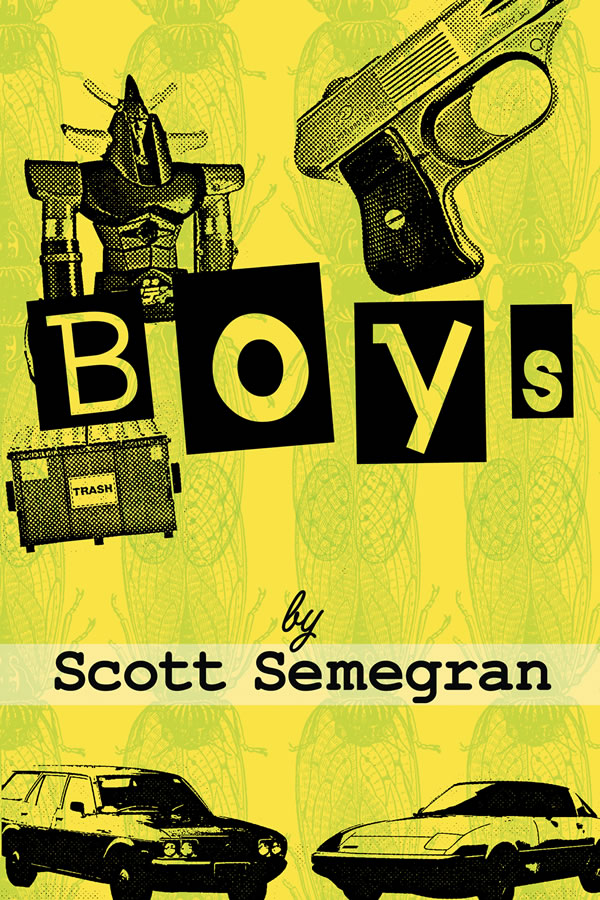
Boys by Scott Semegran

book cover for BoysThese are the stories of three boys living in Texas: one growing up, one dreaming, and one fighting to stay alive in the face of destitution and adversity. There's second-grader William, a shy yet imaginative boy who schemes about how to get back at his school-yard bully, Randy. Then there's Sam, a 15-year-old boy who dreams of getting a 1980 Mazda RX-7 for his sixteenth birthday but has to work at a Greek restaurant to fund his dream. Finally, there's Seff, a 21-year-old on the brink of manhood, trying to survive along with his roommate, working as waiters and barely making ends meet. These three stories are told with heart, humor, and an uncompromising look at what it meant to grow up in Texas during the 1980s and 1990s.
The collection opens with Wiliam's story, "The Great and Powerful, Brave Raideen". It's a short story with a predictable plot element, but it's nicely done. The characters are honestly portrayed; the dialogue genuine. It demonstrates the dual fickle-forgiving nature of children and the power of play.

Sam's story, "Good Night, Jerk Face", comes next. It's a novelette that ends rather abruptly. Semegran builds up the tension between Sam and his parents over Sam's desire to buy the car of his dreams, but it just fizzles out. There's also the potential for conflict between Sam and his boss over the restaurant's delivery van, but that too gets shrugged off. The title of this story implies some kind of confrontation. While Semegran explains who says it, we never find out why. To his credit, Semegran does a good job at capturing adolescent anxiety—learning how to drive, talking to girls, working menial jobs.

The remainder and bulk of the book is "The Discarded Feast". Seff and his roommate, Alfonso, work at a chain restaurant barely getting by on their meager earnings. The story covers their adventures at work and outside of it. A good deal of their free time is spent smoking cigarettes, drinking cheap beer, and wondering if they'll be able to come up with the money for next month's rent. If it were a movie, it could serve in a double feature with Waiting, but the characters are far more realistic.

This isn't so much a story you get wrapped up in for plot; the events pertaining to the story's title make up a fraction of the content. Rather, you tune in for the characters. Everyone has a story, and the people that Seff meets tell him their stories. Some are more interesting than others. I get the feeling that these are people that Semegran met when he was Seff's age, and he felt compelled to honor them by relating their stories here.

Boys is a collection of stories that reads more like a fictionalized memoir. It would've benefited from a run through by an editor to draw a bit more focus in content and to clean up the grammatical mistakes (mostly comma usage). Semegran gets points for realistic characters even if the book falls short on the storytelling.

Scott Semegran is also the author of The Meteoric Rise of Simon Burchwood and The Spectacular Simon Burchwood. For more information about these works, check out the author's website.

Tuesday, February 18, 2014

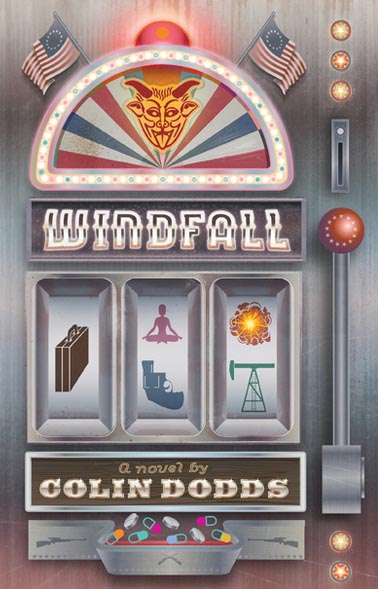
Windfall by Colin Dodds

WindfallSeth Tatton is a "middle-of-the-pack attorney" struggling to help his suburban family keep up with the Joneses. Through his firm, he becomes a fixer; he gets things done no matter what the job entails. He's clean, methodical, and a stickler for detail.

The opening of Windfall introduces us to Seth and his accomplice, William, while out on a job. Seth is clearly in charge and instructs William to wait in the car while he approaches a target that can help cover up a murder committed by a client. Posing as a police detective, Seth conducts the interview with aplomb. His knowledge of the law enables him to play the part, extracting all the information from the target for Seth to construct the perfect coverup.

Seth's boss is part of a cabal of the wealthy and political elite who are scheming to take control of several western states and secede from the Union. Culled from the political chatter that's out there now, I wouldn't be surprised if it went down like this. The cabal recruits governors, senators, CEOs, assorted VIPs and military figures with the promise of them becoming a cadre of new Founding Fathers. Unburdened by D.C. debt, this new country will be prosperous thanks to an unusual shale oil discovery. All they need to do is put the right people in positions of power and arm the militias. But secret organizations need skilled specialists on the ground to make things happen and that's where Seth comes in.

As Seth completes each assignment, he picks up bits and pieces of the cabal's plan. He's drawn deeper inside the organization and meets the key players and listens to their plans and dreams. Part of him is on board with the plan; part of him questions whether it will lead to a bloodbath.

While it might seem that Seth is a cold-blooded killer, he isn't. He buries his guilt deep down inside with the help of alcohol and something that dwells within him. It was this paranormal element that drew me in and makes this thriller stand out from every other political thriller out there. This entity is his steadfast companion. It suggests courses of action and prods him forward on an amoral path that will see Seth rise to greatness.

Seth is assigned to keep an eye on Sarah, the plaything of a powerful Senator in the cabal. She's a mess and Seth falls for her, much to the chagrin of the thing within him. She threatens to unravel the Gordian Knot that has kept his conscience in check. Dodds could've played the old devil on one shoulder, angel on the other bit but doesn't. Instead, Dodds sends Seth stumbling along a hazy path of morality with a malfunctioning compass that takes him through a maze of airports, hotel rooms and casinos in search of his identity.

While the novel's focus is on Seth and his mysterious companion, Dodds gives us an interesting bunch of characters. Even those that have a bit part to play are well-defined, leaving the reader to wonder if they'll be back for more. But the crux of the novel is the relationship dynamic between Seth and the thing that dwells within him. Through a series of flashbacks, we learn about Seth's companion from its point of view and how the two came together. Rather than relying on some cheap cardboard cutout of evil, Dodds crafts a unique being with an intriguing origin story.

Besides some comma issues, my only real complaint would be with the climax. There are three figures that Seth needs to deal with on his journey, but he only handles two of them. The third is taken care of by someone else. I would've liked to have seen him handle all three, but the way the story unfolds it would seem that the logistics weren't possible. While I would've liked to have seen how that went down, considering what that character shared with Seth, I still found the ending satisfying. I don't want to spoil it, but Mr. Dodds and readers of Windfall will know who I am talking about.

Windfall is not your typical political thriller. Dodds deftly weaves in a solid paranormal thread that explores ambition, myth and morality in an indifferent America without resorting to pulpit thumping or cardboard villains. His protagonist wanders through the amoral battleground of the American political class with a spirit guide whose theme song could very well be "Sympathy for the Devil".

For more information about Windfall, check out the author's website.

Wednesday, November 14, 2012

This Jealous Earth by Scott Dominic Carpenter

This Jealous Earth by Scott Dominic Carpenter. Midwestern Gothic Press.

It is interesting that one of these sharply written short stories, “The Spirit of the Dog,” takes place in a uranium mine. Instead of looking for sparkly bits of gold, the miners run around with Geiger counters after a preliminary blast, looking for little bursts of radiation. Most of these stories involve connections: their breaking, their forming, their resilience, their failure. Just as the forces binding particles in the atomic nucleus are enormously strong, many of the characters in these pieces are drawn, despite themselves, to their imperfect families, to their treasured pets. The opposite occurs in “The Spirit of the Dog”; the various miners pit themselves against the new, pretty engineer. Their individual stubborn egos form a sort of misogynist hive mind whose evil ideas drive everyone apart.

The egos of squabbling or drunk parents get in the way, but their kids band together for mischief or otherwise store up memories that refuse to die, and, when probed, yield little bursts of love. In “Inheritance,” a computer programmer is reminded of the illogical kindnesses of his alcoholic father as he cleans out the latter's home after his death, and has to confront some of his darker ideas of the family romance as he sees himself through the eyes of his son. In “The Death Button,” a young college student sells his plasma to make rent; he is caught up in the drudgery of survival until, as the subject of a psychology experiment, he is compelled to note each instance he thinks of death. His inadvertent running over of a squirrel starts him obsessing about death, spurring him to behave more decisively towards someone he loves.

The title story concerns a family in the last throes of preparation for the rapture. The son doesn't buy into it. As his parents scurry around doing useless things like housecleaning and clothes packing, he thinks about practical, Earthly concerns like money and food. Slowly, the rest of the family, starting with his sister, realize the strength of their own connections. What girl would choose the uncertain amusements of Heaven when she has a brother who calls her “Kitty Cat,” and who tries to arrange future care for her hamster?

Friday, August 3, 2012

The Miracle Inspector by Helen Smith

Book cover for The Miracle Inspector
England experienced a civil war and a Revolution, both in the seventeenth century. Each profoundly affected the English way of life: the civil war through violence, and the Revolution through a change in the power of the monarchy and modification of its succession formula to keep it out of Catholic hands, a change that was in effect until 2011. We do not like to think about it, but most of us with a knowledge of 20th century and early 21st century history have an understanding of the fragility of democracy and the strange, cultish, and often violent movements that threaten to replace it. In Helen Smith's dark book, parliamentary democracy has been replaced by an ideology of victimization that has turned strangely upon itself. A rise in global terrorism has resulted in the borders being sealed, and secret police lurking everywhere. Children are kept from unrelated adults (such as teachers) out of fear of pedophilia, and, in a bizarre sort of Stockholm syndrome, women are veiled and similarly restricted out of fear of rape. It seems to be the nationwide implementation of the signs you see outside of theatres: "Strobe lights, haze, cigarette smoke (herbal or tobacco) will be used during this performance,” and then some. Perhaps to tell themselves that they are indeed enlightened, people avoid meat (the author takes pains to mention that this includes human flesh) and stick to fish and vegetables. I did wonder why home schooling wasn't a big cottage industry, and how men were educated without using books. Anyway, lucky are the folks who can make it into their thirties or forties before getting whisked off by “the authorities,” never to be seen again.

A large bureaucracy includes various ministries and Inspectors, including Inspector of Cats, Inspector of Hedgerows & Grass Verges, and Inspector of Miracles. Lucas, a man in his twenties, is said Miracle Inspector. He keeps busy driving around London in his government car examining pieces of toast that are alleged to bear the likeness of Jesus, etc. His wife Angela is stuck in the house with just a few scrounged encyclopedia volumes to peruse. They share a lot of unspoken frustrations, but actually give voice to the idea of escaping to Cornwall, outside of the borders that have been set up. They befriend a woman, Maureen, who used to be a newscaster, and her special-needs child, Christina, whose miraculousness is hidden behind an enigmatic smile. After a friend of the family, Jesmond, is murdered by Nihilists following a poetry performance and Lucas is taken into custody when someone gets wind of a trip to Cornwall, Angela, Maureen, and Christina are left to hoof it out of authoritarian England. To their horror, all the places they seek refuge are just as bad: in the town of Clough they are expected to become sex workers, and at a back-to-the-land feminist commune of sorts they are exposed to magical thinking and a bloody ritual that does nothing to protect them from marauding men and escaped zoo animals. They learn to avoid the big trucks full of UN and other NGO personnel who make a big show of doing nothing. When Maureen disappears, Angela learns to assume the worst about everybody, and is left crossing the moors with Christina.

Could England, or America, become like Syria? England, while having no written Constitution, does have the Magna Carta and a Bill of Rights. The US obviously has both. The book seems to oscillate between blaming the heightened fear of terrorism and its usual anodyne, the attenuation of individual liberties, and blaming the victimhood felt by those who see every bright light, every peanut, every hug by a friend as a threat. The writing is beautiful, as Smith has shown in Alison Wonderland and Being Light. Other reviewers have characterized this book as a comedy, but I see no way out of its pessimism. Fear is our worst enemy. How do we wage war upon it without waging war upon ourselves?

Author's Website.

Monday, August 29, 2011

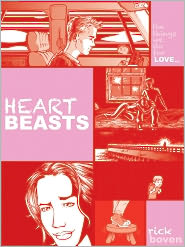
Heartbeasts by Rick Boven

HeartbeastsHeartbeasts is a collection of three stories about matters of the heart. What makes this collection stand out is that it is an eComic. Boven utilizes both the written word and stark black and white illustrations to convey his tales of wounded hearts.
In the first story, "Pruned", a young man confronts a friend who chooses religion over friendship and ditches the protagonist when he needed her friendship the most. Although the protagonist delivers a powerful and moving case against the friend, we're deprived of the friend's response. The story ends up just being a rant. While there's always satisfaction in telling someone off, I think the story would've been better served if we could've seen how (or even if) the friend reacted to being told what a heel she'd been.

"The Price Is Wrong" shows us how a man, Jamie, can appear to have everything going for him yet still feel empty inside. This one was the strongest of the three. Boven brings us in to the picture with Jamie seemingly happy at his girlfriend's house eating dinner with her parents. But on the drive home, Boven shows us how a song on the radio can dig up memories that can cloud our judgement and lead us to ruin.

The last story, "Before It Snows", has no dialogue at all. Boven's skill with his drawings render words irrelevant. He skillfully captures the loneliness of a boy desperate for attention that anything he can get, no matter how negative, is something to build on, even if that foundation is weak.

While it has been said that a picture is worth a thousand words, in reality these stories are more like flash fiction. I find this form limiting as the word count forces writers to cut so much that the proper story often remains unfinished. It's a bit like trying to construct a dinosaur skeleton from just a femur. But having the artwork accompanying the stories enables Boven to tell us much more than words alone. And, in that way, it works.

Heartbeasts is available from Nan bu Nan Publishing.

Wednesday, April 13, 2011

March 2011 Smashwords Conveyor Belt


I picked out these pieces in the first week of March and only now am able to review them, not only due to being involved in a move but also due to the sweetness of some of the candies coming down the belt. I think the caliber of Smashwords submissions is improving.

Here TodayHere Today by Simon Groth is a novel about a woman doing a short-term gig as an occupational therapist in a palliative ward. It takes place in Australia. The protagonist, Astrid, is bunking with a friend, Leith, who herself has become paralyzed from the waist down, and who deals with it by dressing and behaving like Lindsay Lohan. Astrid has self-esteem issues, but does some good work with the mostly elderly clientele, and with a famous writer who has suddenly become locked in by a stroke. The theme of the book is communication; sometimes this is expressed with slightly heavy-handed metaphors, as when Astrid bites her tongue seriously enough to require medical attention, but overall the interplay between her, her patients, and her friend is handled very well. The narrative explores the lies we tell to ourselves and to others, and the struggle to communicate truthfully that some never win. It was an enjoyable book overall.
The Empress RoseThe Empress Rose by Chris Eastvedt held my attention for many pages, until the constant info-dump of material about the superiority of hydroponic farming wore me down. At my new digs, a front and back yard with scruffy grass are challenging me to revitalize them organically, but I doubt you want to hear much about the three-bin method of composting or the pros and cons of corn gluten meal. But Rose doesn't stop. At a farmers' market, after she has explained to other farmers in excruciating detail how her methods are superior, she starts all over again preaching to a restaurateur. I have been accused of doing the same thing over topics I am passionate about; I have learned that it is a quick way to bore people conversationally, and it sure is a good way to bore the reader if one is not careful.
Siding The HouseSiding the House by Michael Jasper is a short vignette about a poor African-American family living down South who try to preserve a little joie de vivre in the face of threatening monotony and casual racism. The story is narrated by turns by Kanita, the little daughter, all brightness and speed; her depressed mother; her toothless grandmother, who tries to keep up morale by constantly making candy (an imaginative example of self-defeating behavior); and Bobby Ray, the developmentally delayed brother. Their house is being covered with siding by two young white men who seem to illustrate the downside of attempts at upward mobility in a racist system. Kanita disowns the siding, calling it “ugly,” and manages to hold onto her self-esteem. Beautifully written.
Tim the Tale Teller by Timothy Conerson: "By 2010 President Obama was constantly looking for terrorist in every corner of the globe. While cities and towns in the United States crumbled, Chinese computer programmers began to create a virus that paralyzed the weapon systems in the U.S. All combat took place hand to hand, gun to gun. The people of the United States were not particularly patriotic during that time so it was easy for the Chinese military to occupy the U.S."

This is from “The Peoples [sic] Republic,” the first of several short stories. I think he means “terrorists.” This would have worked so much better if set in the distant future, with names changed (and text edited; there are many typos and grammatical errors). The year 2010 has come and gone, and I see no dearth of people who consider themselves patriotic, from the Tea Partiers to the strikers in Wisconsin. The author really liked his own book; he gave it five stars on Amazon.

Chewing on Pen Caps by Cloud Buchholz. I think this is. A type of experimental fiction. Because when the narrative is. In the POV of. Or about the protagonist. Lemon Anderson. The structure reverts. To sentence fragments. But it's difficult to read. And no substitute for character development. Which may happen eventually. But not soon enough for me.


If you find explicit sexual content unpleasant, read no further.

This is Butte. You Have Ten Minutes by Craig Lancaster This Is Butte. You Have Ten Minutes and Gunshot Stigmata by Scott C. Rogers, if I had them in paperback, would probably smell of stale cigarette smoke and dried beer, with covers splotched with dried secretions whose origin I might not want to know. The Lancaster book looks at the trajectories of the lives of several people in Montana, down on their luck, and in one case, in prison. There is a lot of riding of Greyhound buses, furtive and fast screwing in a bus station restroom, and the exchange of a blow job for a lift with a trucker. The prose is intense but smooth, like good black coffee. The characters are honed by experience, mostly bad. Any residual loyalty or vulnerability is tested or betrayed. The whole narrative is bathed in yellowish sodium streetlight.

Gunshot StigmataRogers' book is different, in that its unreliable narrator is usually stoned and always insane. A damaged product of the foster care system, he plays guitar until his incapacity to bear life leads him to shoot himself in the hand, hence the title. He does try to find love; an uninhibited male view of sex runs rampant here and is refreshing. Rogers writes about sex and the ever-present undertone of aggression, like Charles Bukowski on steroids: “The mole that hid just on the inside of her right thigh. Whenever I ate her out I always kissed it goodbye afterwards, pulling up with a chin wet like a lion fresh from a kill.” The novella is in many short, disjointed chapters that jump around like the disordered thoughts of a severely shattered soul. Very well done.

Wednesday, March 2, 2011

The Wrinkly by Paul Collis

The WrinklyMike Lewis is closing in on 40 and has been selling commercial space for TV shows for most of his adult life. Although he's done well in his chosen profession, he's coming into a mid-life crisis. His job no longer satisfies, the women he dates are shallow and materialistic, and he can no longer identify with twenty somethings. He views the way they dress and their new-fangled iPods as alien. Meanwhile his passion for Brubeck and a 57 Chevy Nomad station wagon gives him more in common with older generations rather than his current one.

While on a business trip, he stumbles across Goldenville, a retirement community. He's immediately caught up in the idea of moving in and playing golf for the rest of his life. But there's one problem, you have to be at least 60 to live there. With the help of a makeup artist, Mike endeavors to act the part. But how long can Mike go before someone figures out his secret?

We follow Mike through a series of humorous encounters that could easily play out on a sitcom. The author confesses on his website that the story started out as a screenplay. And it shows. Each scene is fully blocked and the characters' actions choreographed so well they are easy to visualize. I would think a network exec would pick this up for potential cross-generational appeal.

Collis certainly nailed Mike's disconnect and discontent, but it was hard for me at first to be sympathetic with someone so shallow. Fortunately, Mike evolves as the story progresses and, once removed from his employer, is free to see that there's more to life than selling ad space on TV.

As for the other characters, they're certainly a colorful bunch. While Collis avoids stereotypes, I found that development was a bit short. Then again, the book is only 151 pages long. With a couple of exceptions, I would've liked to have seen Collis explore Mike's interactions with his co-workers and new neighbors a bit more.

All in all, The Wrinkly is a cute story with colorful characters who get into humorous situations. It's a quick read with a message that is content to ride in the back with the top down, making for light-hearted fare and a pleasant read.

The book is available in print and various eBook formats. Check out the author's website for all the links.

Wednesday, January 19, 2011

Being Light by Helen Smith

Being Light

This is a very entertaining book. Readers familiar with Smith's prior work, “Alison Wonderland,” will become reacquainted with several chracters, including Mrs. Fitzgerald, a private eye; Alison and her daughter Phoebe, who assist Mrs. Fitzgerald; and Alison's friend Taron. It is not necessary to have read “Alison Wonderland,” nor is it necessary to keep notes on the myriad characters, because Smith is able to make them memorable with very deft description, so that when they pop up unexpectedly in the narrative, we recognize each individual's Leitmotif immediately.

The book begins with Roy, an affable middle-class man, and his more edgy friend Brian, inflating a “bouncy castle” for children attending a charity fair. Roy's whole relationship with gravity, tenuous at best, is completely transmogrified by a gust of wind that lifts him up with the castle and deposits him in what he thinks is (and there is no reason to think otherwise) Paradise, complete with an adoring angel named Sylvia, plus chickens, ducks, a cow, a dog, and an elephant. Roy's disappearance is a complete disaster to his devoted wife Sheila. When the police are no help and Mrs. Fitzgerald can find no leads at the outset, Sheila casts her lot in with a clairvoyant and other mediums, eventually going all over England with little aluminum foil earlaps to try to tune in Roy.

More twists and turns evolve as we meet Jeremy, a cross-dressing eco-activist; Venetia, Sylvia's former boss (she wants the elephant back); and Jane, a trendspotter-cum-journalist, who has to find a story in everything.

The characters all sound “light,” but some have agendas that are very weighty. There is a hint of criminal activity afoot, and one character buys too heavily into the idea of lightness and meets a ghastly end. Some don't “get” it, and are simply barmy or shallow, but interesting nevertheless.

This book, besides being very entertaining, is a good book for self-publishing authors to look to as an example. It is free of typos, avoids the two-adjective-noun, two-adjective-noun death march to boredom, and manages to tell a lot of story without a lot of words.

Wednesday, September 15, 2010

The Smashwords Conveyor Belt


It has been a while since I have sampled the treasures of Smashwords as they arrive hot off the server. Once again, I am looking at the book-length literary fiction offerings available today, September 15. I mainly read the samples, which are often generous, but if I really love a book, I buy it. I am skipping thrillers and any other genres I feel would be better judged by another member of the staff.

First up is G. K. Ingersoll's The Atheist Vignettes. This is a mostly well-written pastiche of pieces about people, mostly former members of a group called Chris†eens, who are confronting their doubts about faith as they enter middle age. We are treated to sections of a play interspersed with vignettes (naturally) of characters in various states of dogmatic compliance/anxiety interacting with one another. The dialog seems very sharp and realistic; the only problem is with the play excerpt at the beginning, featuring a dialog between God and Satan. The name of the speaker does not begin every line, so the reader is constantly referring back to the top of the page and counting downward “God, Satan, God, Satan...” to the line in question. There are also a few syntactical errors, but overall it looks like an interesting read.


Next, we have three offerings from the mysterious “Dorian Taylor.” Is he real? Is he alive? Is he dead? The preface of each work only hints.

I will start with Modern Problems. We are told of an author using the pseudonym “Dorian Taylor,” an artist plagued by anomie who just cannot get it together to find a market for his writing. The book is a pastiche of narratives, beginning with a poem. I think Taylor has a story to tell, but first he has to fix the errors and the derivative style. I'm sure he can come up with a more interesting description of a dancer than comparing her to Terpsichore:

“From all that he could conger up in his mind in later years, all that really presented itself to his memory were Jamie's legs…”

“Standing still she was a homely little girl from Nebraska, in motion she was Terpsichore, the Goddess of the dance, and she came from Mount Olympus.

“There is or maybe was, a bar off of Washington Square, situated in the basement. It had chess boards painted on it's tables, and the chief reason for going there was to discuss philosophy, or literature, or maybe play a game of chess, while sipping the French liquid fire called Pernod” (italics mine)…


Top 40 is a book that uses old (and I mean OLD) pop tunes as chapter headings in stories about the author as a “man out of time.” Being old myself, I can relate. I didn't get through enough of the sample to see if he actually used Joni Mitchell's “Urge for Going,” but it's what comes to mind. The image of the rambling man who “marches to a different drummer” or “hears the call of the road,” or (if I ever write my own song) “is too narcissistic to commit to anyone” is very prominent. I'm hoping it was a satirical treatment, but when he misspelled “Iliad” I couldn't go on.


Billed as “Georgette Heyer meets the Marquis De Sade,” Taylor's Volatile Elements makes for more interesting reading. It is about a very wealthy man who owns vineyards and other revenue-producing ventures, a man who came by his money in a very unfortunate way that I wish Taylor had elaborated much more upon. He meets up with a long-lost girlfriend, and we are treated to multiple points of view, as well as lots of steamy sex. I think Taylor's characters become much more interesting when they are making love rather than soliloquizing. This seems to be the most mature of the works.

UPDATE: We think this has been republished as The Gaze of the Abyss.


Elder Wonder Comes of AgeElder Wonder Comes of Age is a book about horny Mormons. It's very funny. It's Mormon practice to send their young eighteen-year-old men to do two years of missionary work. They can have only limited contact with family and friends while on a mission. The protagonist, Jerry Wonder, already has one strike against him: he's a vegetarian. Also, as most eighteen-year-old humans, he's constantly thinking about sex. He is sent to New Zealand, where, under the very watchful eye of a senior elder, he goes out proselytizing with other horny teens. It is the early 1960's, and everybody is worried about what direction the Cold War will take. They get a mixed reception in New Zealand; their hard-sell tactics anger many people. As a Jew (Jews don't seek converts), I found it unnerving to read about Jerry's partner lying to an elderly Jewish woman, telling her they were sent by her Rabbi to visit her. Jerry refuses to back up the other missionary's faith statements. Meanwhile, his girlfriend has taken a job as a stewardess so she can see him in New Zealand. I may have to buy this one…

Sunday, June 6, 2010

Review Roundup by Libby Cone

by Libby Cone

I have been on another Smashwords adventure, catching book samples on my hard drive as they drop from the conveyor belt of the literary fiction genre. Using this method, I hope to save readers time, energy, and money by reporting on books worth reading, worth sampling, and worth letting fall into oblivion.

Brakenstroom by Jacob SingerThe latest offering is Brakenstroom by Jacob Singer, a book of short stories about Jewish emigrants to South Africa. When I noted that only the first ten percent of the book was offered as a free sample, I was concerned that I might not appreciate its essence by reading such a small excerpt. I need not have worried, though. I invite experts on the complicated and tragic history of South Africa to comment on the accuracy of the author's account in the introduction. No expert is needed, however, to find “it's” being used as a possessive pronoun, or an implement for blade sharpening being described as a “wet-stone.” I began to have serious doubts when I read this sentence: “He worked hard, the hours spent pouring over accounting books giving him the stooped scolitic back and chronic myopia that on his tall thin frame, offered a portrait of the Scrooge circumstances had made him.” Then I read this sentence and gave up: “As a boy he was always a head and shoulders taller than others his own age, as thin as a stick, with two large ears on either side of a very Jewish nose.”


To Come Back So Far From Nowhere in ParticularNext is “To Come Back So Far From Nowhere in Particular” by Jon Thorpe. This is a free short story. Unlike the previous work, which dealt with a skinny, four-eared Jewish kid, this story describes the challenges facing suburban Christian youth devoid of bizarre physical deformities. I stopped reading after Page 6, which contains this sentence: “One young woman, Virginia Talbot, someone who would proclaim that Lubeck had seduced and corrupted her and led her astray from her good Christian values, had come forward and admitted Lubeck had arranged meetings with her in seedy hotel room where the two would smoke crack and Lubeck would masturbate as she pleasured herself with a crystal dildo.”

The next book in line is “The Sister City Initiative,” also penned by Mr. Thorpe. Forgive me, readers, for skipping his other ouevre, and the next book in line, which is written in Japanese.


The AlbumThe next book is “The Album” by Sandra White. It is actually published by “The Fiction Works.” POD purists may skip the rest of this paragraph. Ms. White gets brownie points from me for correct usage and spelling of the words “pored” and “its.” However, after wading through onslaughts of telling-and-not-showing, I was finally defeated by this bit of dialogue: “'It's beautiful out here, Jack. Blakefield's city fathers have done a superb job expanding and building without totally demolishing the wonder of Mother Nature.'”


Never, Ever, Bring This Up AgainEveryone knows the conflicting urges to look, and not to look, at something ghastly. I decided to give in to the desire to look at another short story of Mr. Thorpe, the next story in line, called “Never, Ever, Bring This Up Again.” I am happy that I did, because this cold-war-era story of a failing oil platform (sound familiar?) while somewhat difficult to follow, is actually an attempt at satire. It led me to return to the previous story by Mr. Thorpe, about the crystal dildo, and indeed, satirical narrative followed. My bad. While I did not think either satire was very clever, far be it from me, hoodwinked as I was, to reject Mr. Thorpe's pieces out-of-hand. You may wish to sample them yourself.

As that wasn't much of a ringing endorsement, I proceeded to the next book, “Chips & Gravey,” only to find that it does not seem to be self-published, having already garnered advance comments from the likes of E. Annie Proulx and Atom Egoyan.


book cover for Wherever You May be SearchingNext in line is Wes Patterson's Wherever You May be Searching. A weird book. A motormouth know-it-all boy has a creepy, borderline-incestuous relationship with his sister, who is just a couple of years younger than he. I think he's supposed to be a "bend-the-rules", "different drummer" sort, but he comes off as controlling and manipulative. Sample it if you wish.


107 Degrees Fahrenheit“107 Degrees Fahrenheit” is another short story by Barry Rachin, whose “Just Like Dostoyevsky” I have reviewed previously. Barry, Barry, Barry, what's with the weird commas? What's with the snappy dialogue like: “'Marauding insects and harsh weather often destroy the eggs. Raising them in captivity helps even the odds they’ll survive to adulthood and reproduce.'”?


Beyond Redemption - The ForbiddenBeyond Redemption – The Forbidden by Jax Alexander. Adjective-noun, adjective-noun, adjective noun, ad nauseam: “Gagging down bile mashed up by the crushing grip, Mike was assaulted by the stench of decaying carrion as he oozed through the clashing colors into the center of the stinking swirl. Toxic thoughts filled with ancient anger forced their way into his head and fouled his mind with an oily presence.” Need I say more?


Embrace The RainFinally (my eyes are crossing), Embrace the Rain by Michael Holloway Perronne. I only read the first thirty pages or so, but it looks good. Technically, it's published by Chances Press, which seems to specialize in gay erotica, but I don't see any encomiums by Edmund White or Sarah Waters, so I'll include it in the self-pub category. A bunch of couples and families, gay and straight, are affected by the devastation of Hurricane Katrina, some in a completely negative way, some in an opportunistic way. The writing is good. Take a look at it.

Thursday, May 20, 2010

Book Review: This Unhappy Planet by Marc Horne

Reviewed for The New Podler Review of Books by Libby Cone.

This Unhappy PlanetAn elementary schoolteacher, a ravenous entrepreneur, and a New Age drifter form a company in Southern California to offer one-stop shopping for any kind of spirituality their well-off clientèle might wish. This sounds like the beginning of a joke, as well it should, but this book is awfully unfunny. Instead of jokes about messed-up kids really being “Indigo” and the language of beemers, we get odd metaphors and similes like “A bad vibe was bubbling up in the lava of the day” and “Her lips moved a little, like bananas full of maggots.” Most of the characters are not very likable, which is no sin; although I wasn't crazy about “The Kindly Ones,” you can bet I read it through to the end to see what its sick-pup protagonist would do next. But this isn't the Southern California of Didion or DeLillo; the characters and the plot are pretty predictable. The men are snarky and misogynist, the women neurotic and needy. We feel the economy tiptoeing towards the cliff, and see the unsurprising panic when it crashes. I'd love to see more character variety and depth, or at least more humor. The topic has the potential to be extremely humorous.

Gotta go adjust my aura!

The book is available at Smashwords.

Tuesday, December 9, 2008

Waiting for Spring * * * *

Waiting For SpringWaiting For Spring
by R.J. Keller
Available from Amazon

Waiting for Spring opens with an image of a path on which nothing will grow. The earth is just too hard, having been long trodden, to admit new life. Such is the heart of Tess Dyer, the protagonist, who lives in a world marked by emotional abuse and the absence of love. Tess yearns for spring.

The place was hidden from the road by thick, bushy pines and naked maples. The driveway was a little rough but already plowed, which was a good sign. The house itself was white. Two story. Small and very old. Old enough to explain the low rent. Enclosed porch with lots of windows. There was no garage or barn, but there was a decent sized shed beside the house. It was white, too, but looked much newer than the house. And beside that stood a little orchard; five bare, snowy apple trees.

There were no other vehicles in the driveway. I parked facing the orchard, kept the car running. Stared out the window at the trees. The heater was running at full blast. I still shivered. I’d been shivering for five months. No. I’d been shivering longer than that.

My heart was Titanium White. Arctic Wasteland. Hard, trampled soil covered with ice. The frozen orchard seemed to say that it always would be and the tears came. Finally. Stinging and bitter, but quiet like always, and I looked away from the trees, looked down at the dashboard. Oil light flashing, neon red. I stared at it, tried to imagine my engine; tired, hot, low on precious blood. The neon light liquefied, blurred, floated as my eyes filled past the point of choking it all back. I glanced up to let them spill over, hoping I’d be able to dam up what would want to follow. Squinted my eyes against the tears.

And that’s when I saw it.

Bare, icy trees; eerie and still. They almost looked dead, but they were really only sleeping. Waiting for spring. The red light caught in the pool of tears; refracted, projected, and I could see it. I could see what the orchard would look like covered with blossoms. In the spring. Alizarin Crimson, Dusty Pink--starry, superimposed on the wintry scene. Like covering a photo with a clear sheet of plastic then drawing on it with dried out marker; shadowy and transparent. But real. So real.

When her marriage to the small town sports hero ends in a divorce, Tess, an unsuccessful artist making a living as a cleaning lady, moves to a small rural Maine town of New Mills, where the beloved local cleaning lady had been murdered by rampaging teens, to start a new life. Conveniently, her new neighbor, Brian LaChance, happens to be an available attractive male with whom she can start something new. Despite a wound of a broken marriage, Tess finds herself attracted by the small-time charm of the younger man as she tries to fill her life with something. Will she be able to find love or will spring never come? What can break through the hardness of heart?

There are many impressive things about Spring that I want to mention. What impresses me about Waiting for Spring the most is the writing. R.J. Keller is a good writer, as you can tell from the excerpt above, and there are some good lines in the book that are worthy of a good independent film.

But Ashley had a suggestion.
“You can come, Brian. If you want. That way you can keep an eye on her.”
He didn’t even miss a beat. “Nope. We already have plans.”
She looked at me and I gave her an eyebrow.
That’s right, honey. While you’re getting drunk and stoned with your little friends he’ll be in my bed. Fucking me. Stuff that in your training bra.

Another impressive aspect of Spring is the humanity of its characters—Tess and Brian seem human for two reasons. They have personal struggles resulting from understandable yearnings and conflicting emotions. But the two are not the only characters who seem real. All of the characters in the book are trying to make love grow but fail miserably in their attempts, generating only enmity and conflict. All are deeply flawed. Brian's sister, Rachel, struggles with a drug problem that boils over into violence. All are deeply needy, but they are unable to give one another what they need. All have become hardened of heart as a result of being in one another's lives. And all are yearning for rebirth. Perhaps the most awesome moment in terms of character comes at Thanksgiving, when Tess and Cass have a conversation. The contrast between what Tess had been told and what she herself tells Cass reveals how she had evolved as a person in a moving and poignant way. Not only are the characters real, they inhabit a realistically portrayed world populated by secondary characters who seem alive. Someone once said that you should write about that which you know, and R.J. Keller certainly knows the world that she chose to portray in her novel. I think that there are more books to be written about the characters in these two towns.

Waiting for Spring deals with a perennial theme in popular American literature—the yearning for rebirth and the desire for a second chance—in an honest and human way. But there is a way to be too honest, and Spring is not what it could be because it does not stray from reality much. Part of the tragedy of the characters in Spring is their inability or unwillingness to express themselves or to understand others. Tess's tragedy is that she has no actionable goal, and therefore no hope of achieving it. Wanting a new life is not a goal; it is a desire that is dramatically irrelevant until a character particularizes it in terms of a specific goal. She lives a real life, and failures and pain are a part of that life. But we don't want to read about how characters fail or about how life really is. We want to read about the potential for hope expressed through struggle for something that stands for that hope. Characters who hope for something are deliberate in their action. They are always moving toward some goal. Tess isn't acting toward a goal. When Rachel dies, there is nothing she can do to keep Brian in her life. But Tess should have something, some lifeline, that she can use to stay with Brian. She must be able to do something.

Waiting for Spring is a story of lives in the small world of rural Maine, filled with ordinary humanity of flawed men and women as they hope, pray, and suffer their way toward rebirth of spring and new life.

Wednesday, October 24, 2007

Undercover White Trash by David Kilpatrick (A)

Undercover White TrashComedy is hard to pull off, but David L. Kilpatrick does just that in Undercover White Trash. The novel begins when Big Billy Barnes, owner of a chain of BillyMart stores, questions the advertising campaign put together by the Dickey advertising agency.
“A typical American family?” Barnes repeated as he lifted up the ad with one hand and pointed at it with the other. “What’s this man wearing, son?” he asked as he pointed to the father figure.

“A...suit. A suit and tie. And a white shirt,” I observed.

Barnes replied softly, “A suit and tie. And a white shirt, right?” I nodded.

Barnes’ face suddenly flushed and he shouted at me so loudly, I could smell his cigar breath all the way across the conference table. “Son, the only people who come into my stores wearing ties are cops looking for one of my employees for a parole violation! And the broad; she looks like she just stepped out of the Neiman goddamn Marcus catalog, pearls and all.” Barnes took a deep breath and continued. “You ever been in one of my stores?” he asked. I thought for a minute and shook my head. He then looked at the other executives. “Any of you shitbirds ever been in a BillyMart?”

And so begins the quest of Edward Prescott III to discover the ins and outs of the white trash culture. Undercover White Trash is a good piece of writing. The first thing that impresses me is the simplicity of the concept—a guy enters an alien culture incognito in search of its secrets. Kilpatrick spins the spy trope in a fresh way and shows what creativity is at it’s best—taking what is already familiar to the reader and spinning it in a new way. The author also moves directly into the protagonist’s problem—living in a different culture than that which he comes from, creating tension by juxtaposing a privileged young man with a subculture that is as alien to him as something in the pages of National Geographic, then plunging him into it, “like Jane Goodall with the monkeys”

As we witness Prescott pack for his three month adventure, we can’t help but wonder how he will be altered after contact with the world he’s about to visit. How will the people and events that are about to happen to him change him? There are many dangers that he flirts with: being swallowed up by the world into which he ventures, his lines of communication and safety cut off and him becoming a stranger to his old friends; or becoming entangled to his detriment in relationships with the member of this subculture.

The book shows differences between the world of privilege and want in America as the protagonist goes in search of the BillyMart consumer, a missing link between rural poor and suburbanites. Prescott inserts himself into a trailer park community, then uses a bait in order to start a relationship with Conley, the father of the family that Prescott decides to study. As he enters the lives of the people he studies, he learns that they are pretty much okay, and learns that his old environment is filled with backstabbers.

Undercover White Trash steers clear of pastoralizing the underclass or taking the well-worn road of cheap humor at their expense. There is in this story a lot of humanity with which Kilpatrick treats his subject and characters, making the book one of those rare independent novels that are worth a read. I wouldn’t be at all surprised if this one was optioned by a movie producer because it has cinematic potential.

I had a bit of a gripe with this ending—too hopeful for my taste—and I would have liked to see more comedic tension milked out of the near encounters that the protagonist has with his privileged pals—more dramatic irony, please--but despite my pet peeves, the book is, still, very good, and Kilpatrick is a totally talented writer whose work will most likely end up on the big screen.

(This review is not based on a submission but a reaction to reading a free ebook on the Author's Site)

Update 3/16/11: Mr. Kilpatrick's website is gone.

Thursday, June 14, 2007

Futureproof by N. Frank Daniels (A)

FutureproofAvailable from Amazon.com

A fight ensues and the troubled protagonist leaves his home for good. Futureproof is the story of a troubled teen from a troubled family in a troubled world. There is no hope here, no place that offers refuge and no oasis offering sanctuary. There is only desolation, emptiness, and despair which the desperate characters attempt to fill with endless sex in meaningless encounters that devalue the participants and drugs that wash away the tinge of guilt of it all.

One can’t help but feel sorry for Luke. Reader sympathy is evoked, in part, by the way that the author controls the first person point of view. There is a danger when using the first person: the narrator can come across as self-pitying. But here the narrator does not indulge in excessive pity for himself but tells it like it is. And what he tells us is a story of a person trying to fit, to find a place, a role and a purpose in life. But this is not easy when all that one’s life offers is not what one wants.

I’ll never get used to this shit. I’ll never be satisfied doing this work. I can still nail faster than Hank, I can pull up a wall almost as efficiently. But I can’t imagine being thirty, forty years old, and still on my knees, sweating, back aching, one forearm bigger than the other because the right arm is constantly swinging a mallet, right calf muscle gigantic because that leg is used to kick the boards into place just right so that we can fly through another upper-middle class home before heading directly to the next one. I’m making only slightly more money doing this shit than I was pulling in at Andersonville, and every time I think about that it burns me to the core and I want to grab my mallet and hurl it through every fucking window in every fucking house in this artificially contrived “community.”

Luke is a member of an entire subculture of lost souls. His meanderings through life end, temporarily, when he manages to get a job as a floor installer. There he meets a man, Hank, who used to work in the mines. In a scene where Luke attempts to engage Hank in a bit of class consciousness raising conversation, Hank is revealed as a completely downtrodden man, a member of the working class who is incapable of thinking about anything except his own immediate situation and survival. Unlike the sex and drug addicted contemporaries of Luke who are trying to dull out their pain, Hank seems to have disintegrated as a human being, becoming instead a kind of robot whose life is defined by his role as a bottom rung worker. This is what Luke does not want to become but it is the only option that life seems to have for him and his friends. Surely, there is more, somewhere. College and the hopes and aspirations that go with it are not an option here, all that is left is some soul-deadening job, usually manual labor, which offers nothing beyond a meager paycheck. He is not alone in his desire to escape the ravages of the pointlessness of existence. Many members of the X Generation want to rebel against the deadening of the soul, but end up getting medicated.

Those of us that do make it back from the storied institutions tell tales of our parents ruining our lives by sending us to “Peach Ridge” and “Windswept Meadows.” They could be the names of apartment complexes if you didn’t know better. But we know all about them. These places are revolving doors. They drain our parents’ health insurance and then turn us loose more fucked up than we were before. I am an anomaly among most of the kids I meet, though, who count days spent in treatment like tours of duty. Institutionalization is our Viet Nam. And in some way I’m ashamed of never having been shipped anywhere, a draft dodger shirking his duty, squatting in Canadian parks and bus stations until the shit blows over.

The book deals with the tension between idealism and the brutal realities of existence; between faith and the need to believe and the presence of death and decay. Out of this tension comes Luke’s struggle with himself and others like him. In earlier times, this tension would have given rise, perhaps, to some movement, as it did in the 60s. Unfortunately this struggle is no longer seen as legitimate by the society. In the 90s, Salinger’s protagonist would have been forced to take Prozac. Luke’s friends are committed by their parents. The search for meaning of existence has been declared, by the unholy union of big pharma and psychiatry, to be a sign of mental illness. The Woodstock generation has been aborted by Prozac.

Futureproof is a powerful story about the struggle for meaning and hope in a dead world, tracing expertly the course of progress of a man traversing the desolation of poverty and the impact of the journey on himself. Not to be missed.

Saturday, April 21, 2007

The Mad Days of Me: Escaping Barcelona by Henry Martin (C)

Mad Days of MeCover: interesting.
Available: Amazon.com

The story opens with the arrival of the protagonist in Barcelona. He turns out to be a runaway who has spent some time wandering about Europe. In Barcelona, his life takes a marked turn for the worse when he's attacked, robbed, and raped, leaving him homeless and wandering in the streets. This story has some potential that is not fully realized because of poor plot construction and some editing problems.

The first problem lies with the fact that we don't know who the protagonist is. The story gains nothing by keeping this unclear. Details are the lifeblood of good fiction, and they are a bit hazy in this novel. For example, is the protagonist European or an American? This has some consequence on the plot, as you don't need a passport to travel between EU nations if you are from one of the EU member states. The whole consulate scene, as a result of lack of details, is somewhat unbelievable.

Details are also essential because they evoke mood, tone, and theme; the very first page, the character arriving at the Barcelona train station, should therefore be much more detailed: we should experience this place, but we don't, as there are only hints of the place and the people who go through it. This was a great opportunity for a detailed description since the protagonist is new to this place, and so the author can legitimately insert a bit of exposition and description. There are other detail issues, as when, for instance, the protagonist files a police report despite not being able to speak the language. The lack of details really undermines the suspension of disbelief.

More serious problems, however, involve the plot. The story suggests that the protagonist will be trying to leave Barcelona. Great. Yet where will he go? He has run away from home, so what's his next stop? The destination is unclear, and this lack of clarity makes the plot weak and directionless. In any good story, literary or otherwise, the protagonist must have some goal, some task that he must accomplish in order to get what he wants. The goal and the task must be clearly defined and all action must somehow relate to this goal/task. What is the task here—to get the passport? (But why does he need the passport, if he has no specific destination anyway? I mean, why not just stay in Barcelona?) For the sake of argument, let's say his goal is to get the passport, but then the question becomes—how does he go about it? What's his plan, his strategy, to get the passport back? Without such clarity of tasks, goals and strategies, there is no tension or suspense because complications that come do not threaten any plan, goal, or strategy. Complications only work if they become treats to the achievement of something of vital importance to the protagonist.

Another plot issue is the lack of genuine conflict. For example, the protagonist goes to the police after his ordeal, and… nothing happens. Well, what should happen—something unexpected, something that creates a problem in his quest to get his passport, if that's his goal. In Code to Zero, by Ken Follett, we have a very similar situation, and we can look to that novel to see how obstacles create conflict and action. The protagonist in Follett's book wakes up in a public bathroom, apparently having lost all memory of who he is. His goal, naturally, is to find out who he is. Where does he go? The police. So what will happen? The police will help him out, right? Wrong. This is a story, and in a story complications and problems happen—characters almost never get what they want or expect. Instead of helping him, the police officer beats him up because he's wearing bum's clothes. How's that for a twist? As a result of this, the protagonist goes on a quest to steal suitable clothes before trying to resume his search for his identity.

In Mad Days of Me, the protagonist does not encounter any trouble with the police. It would be more dramatic if he did. It would certainly create conflict. There is no trouble again latter on when a good Samaritan offers some help. But what if this good Samaritan wanted to use the protagonist somehow? Maybe he would make him an offer of some kind—do something dangerous and or illegal and I will give you ten thousand euros, something along those lines. Of course, I realize that the author's intention was to write a more literary novel focused on the psychological aspects of the protagonist's predicament. But I think, and this is only my opinion, that literary writing requires more, not less, attention to plot, character goals, motivations, and other aspects of craft and story construction.

Another problem is that the book is not written in clear scenes. Scenes are dramatic exchanges between characters, each of which wants something out of the other. The scenes in this novel are not very clear, and this creates a very diffuse story. When you look at, for example, House of Sand and Fog, by Andre Dubus, which is a literary thriller, you see, in the very first page, great scene writing: we are in a specific place, the characters doing specific things. Each scene in that book evolves into another, advancing the movement of the plot. Such clear scenes are lacking in this novel. The turning point of the story, the robbery and rape scene, is not written as a scene, so its impact is lessened.

Finally, there is no real character development. The protagonist hangs out with all these homeless characters, but he doesn't develop a relationship with any of them. He doesn’t really change either, and this is because he doesn't develop any relationships. You can argue that a literary novel does not need plot; this is a valid point; what you can't argue for is that a literary novel does not need character development. And, the bottom line is, when you create character development, you find yourself creating plot and suspense and tension, which arise out of the character interactions.