Showing posts with label war. Show all posts

Saturday, July 7, 2007

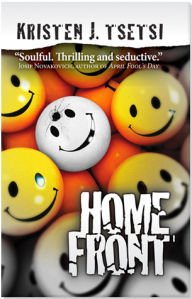
Homefront by Kristen Tsetsi (A)

HomefrontHomefront deals with the emptiness in Mia’s life after her boyfriend, Jake, is deployed to Iraq. A literary novel, it shies away from lurid plot in favor of the use of language to evoke the protagonist’s inner struggle. Kristen Tsetsi is certainly in great command of language and craft, which should not be surprising—her fiction has been published in Storyglossia and other respectable venues.

Mia’s struggle with herself, manifested in loneliness and confusion, is a common one, affecting many women whose men are deployed abroad. But Mia’s struggle is made harder not by the potential temptations to her fidelity to Jake but by the breadcrumbs left here and there that lead Mia to question just how well she really knows Jake. Consequently, a sense of foreboding weaves through the story, revealing that the relationship between Mia and Jake is troubled, uncertain, and perhaps ultimately fatally flawed. Certainly it seems to be missing in action in the end of the story.

There is a kind of apathy, too, in Mia’s character. She seems to wax and wane, developing a relationship with Donny “Doc” Donaldson, a Vietnam era alcoholic vet, yet this relationship does not go anywhere. Mia seems stuck, unsure of where she stands with Jake, and unwilling to outright betray him.

Like the war front, Homefront is a place of struggle, this one taking place in the hearts and minds of those left behind, and like in real combat, feelings and relationships can become missing in action. This is a thoughtful and elegant book; the writing immersive, evocative, and polished; the structure reflecting the sense of dislocation and of something missing in Mia’s life.

She is one of them, one of the others. The man she cares about is here, safe with her. She can’t understand about dusk, the sun’s evil teasing. The time of evening too far from sleep and an ‘x’ across another day, but too close to darkness and the hollow air of no conversation that amplifies the TV sounds of over-acted dialogue and rehearsed applause. Denise doesn’t know the taunting, subtle fade that cues the lighting of yellow windows, the drawing of curtains to hide people living normal lives, eating dinner, yelling top floor to bottom about who wants milk and where are the scissors. She would have little to say about time spent staring out the window at shapeless clouds and cracked sidewalks and meticulously trimmed shrubs, all of it so cheerful and commonplace while over the rooftops and trees and a plane-ride away, “everyday” is mission-planning and mortar fire and grass is something they might find tucked in the fold of a letter.

Sunday, May 6, 2007

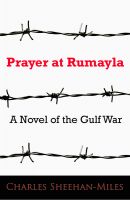
Prayer at Rumayla by Charles Sheehan-Miles (A+)

Prayer at RumaylaAvailable at Amazon.com

Profoundly moving, raw, exceptionally well-executed vision into one man's troubled heart as he deals with betrayal and the complexities of life after returning from the 1991 tour in Iraq.

In Prayer at Rumayla you will find an expertly written psychological thriller charting the slowly building resentment and psychological degradation of the protagonist, Private Brown. The story begins with betrayal and disappointment, this theme informing nearly every relationship that the protagonist has: that with his lover, with the Army life in the States, personified by a new and overly harsh sergeant, and finally with his remaining family. Brown is looking for a place of rest, for open arms after being wearied by combat, but finds no safe harbor-everyone, seemingly, is living for themselves, their lives too full to allow Brown even a slightest foothold:

In my room, I get another shock. Everything is gone. My clothes, books, my photo album. Chris, what about my diaries! What the hell did she do with them! I yank open the closet door - empty. The other one down the hall is filled with towels and blankets. I throw it all out on the floor, searching for my things. I don't believe this. Seven years of journals gone - what kind of monster is she? I sink to the floor and put my head in my hands. I wish I could cry.

What happens to such a man—a man who can find no rest in those who should give him peace? Indeed, having been altered by the experiences of war, can Brown ever find peace again? These questions permeate Prayer, with hints of violence presented as dangling causes, bits of dialogue, about killing the sergeant. But the violence is not something that Brown wants, it erupts of its own volition, an ugly monster created by his past, leaving Brown powerless to stop it.

Staring at the road ahead of me, I wonder what will happen. Jesus, I think I really hurt him. I couldn't stop myself; I just got so angry. I don't want to hurt anybody. I don't want to hurt anybody. I don't know what I'm going to do.

Unlike in many novels dealing with violence, violence in Prayer is well earned, evolving from the broken hearts and shattered dreams of the characters, being their desperate cry for help, a last stab back at the world that turns a cold shoulder to them. We understand why Brown is the way he is, and we even, if possible, feel a bit of sympathy with him: Brown is lost; having survived the close knit lifestyle of combat soldier, he returns home to find a void. And he's not himself anymore, but a different man, one that he no longer understands.

Will he be able to find a foothold into a new life or will his life spin out of control and he end up crashing into the ground? Just when you think that Prayer is about to offer a cheap resolution, something by-the-numbers, you find that the ending is much more nuanced and thought out, evolving out of the story and the characters in it.

Prayer is easily one of the most impressive books reviewed in this blog. The writing is spectacular, the kind you'd expect to find in a mainstream novel, and this is somewhat disappointing because it demonstrates that mainstream publishing does not always publish books that deserve to be published.