A few weeks ago,
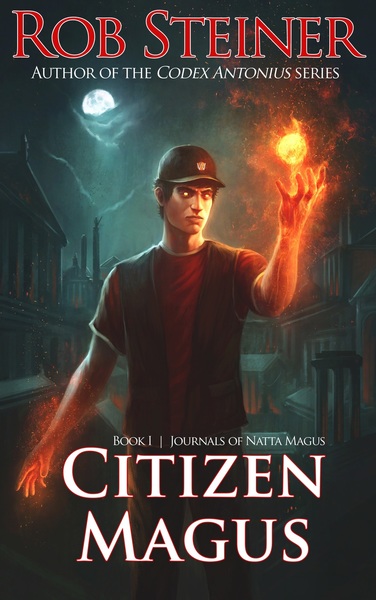
we revealed the cover for
Citizen Magus, the first book in a new series by Rob Steiner. Today, Steiner has granted us permission to reveal the first chapter of the story. Enjoy!
 CITIZEN MAGUS
by Rob SteinerCHAPTER ONE
My name is Remington Blakes, but people in 6 B.C. Rome call me Natta Magus.
Why?
For starters, I
am a fully trained, licensed, and insured magus from twenty-first century Detroit in the American Union. Second, I needed to feed myself somehow after I got stranded in ancient Rome, so I set up my own magus shop on the Aventine Hill. What Roman would hire
Remington when they could hire (cue epic echo)
Natta Magus. It means something like "artisanal wizard" in Latin, so I guess you could call it a marketing decision.
But there were times like now, running through Rome's crowded streets on my way to stop a magical murder, that I wondered if there were safer ways to earn money. Like joining the legions.
Gaius Aurelius Vitulus, my Praetorian friend—perhaps my
only friend in Rome—stopped ahead and gave me an impatient frown. I once saw him make a corrupt
quaestor spill his guts with just that frown. He was a few inches shorter than my six-foot two-inch frame, but he had the intimidating build of a twenty-something man who spent the last ten years in the legions. When I caught up to him, he said, "The sun is setting, and we're still a mile from the temple."
"I'm going as fast as I can," I growled. "These damned sandals are killing me." Eighteen months in Rome and I still longed for the rubber-soled sneakers I wore back home.
"Your
dawdling will kill Celsus Maximus," Vitulus grunted, and began weaving his way again through the crowds and labyrinthine Roman alleys.
Vitulus was dressed like any other citizen of the equestrian social rank—a white woolen tunica with two narrow, vertical red stripes down the sides—but his bearing and the well-used, pearl-handled gladius on his belt made the crowds part for him. The gladius was a gift from his father upon his ascension to manhood on his fourteenth birthday. I once asked Vitulus why he didn't brush the stains off the pearl handle, and he said that the stains remind him the gladius was a tool and not a bauble. I tried not to think of how many men he'd killed with it during his days in the legions.
I'd known Vitulus for about a year, and all I can tell you is that by contemporary Roman standards, he's a huge Boy Scout. He values honor above all other virtues, always keeps his promises, will fight to protect the innocent, but won't hesitate to kill his enemies. A year ago I had helped Vitulus and his boss, Praetorian Prefect Salvius Aper, with a "delicate matter" involving supernatural forces. They'd come to me ever since with more "delicate matters" that gods-fearing Romans didn't
want to believe in.
Take the case of Celsus Maximus, the famous gladiator whose murder we were racing to prevent. Now I abhor slavery like anyone from my time, so when Vitulus came to me for help in finding Celsus, I turned him down. I had hoped that Celsus had escaped the bloody gladiatorial games that Romans loved. But then Vitulus told me that a clay tablet had been left in Celsus's empty quarters. It said that Celsus would be killed unless "Remington Blakes, the one you call Natta Magus," shows up alone at the Temple of Sterquilinus outside the Porta Ostiensis by sundown. It warned of dire consequences if I brought anybody with me.
Well that piqued my interest. Only two people in ancient Rome knew my real name. Vitulus was one. The other was the all around
bastard who abandoned me in ancient Rome in the first place, my former friend and mentor from the twenty-first century, William Pingree Ford. He'd been using his magus powers in Rome over the last eighteen months to try and change history, and I'd done my best to clean up his messes. But he always stayed a few moves ahead of me. I had to catch him, so I could not only stop him but make him send me home.
Was it a trap? Maybe. He'd passive aggressively tried to kill me last year by sicking daemons on me, though I think that was more to distract me from his real plot to kill Caesar Augustus. I stopped him, but that's another story.
No, this was the best lead I'd had on him in months, and I couldn't ignore it.
Which is what worried me.
"I don't understand how Celsus could be captured," Vitulus said as I came even with him again. "He's a cunning warrior."
I dodged a flock of sheep heading to the Forum and blinked the sweat out of my eyes. My Detroit Wolverines baseball cap, which helped me focus my magic, was soaked in sweat from my jog through Rome's stifling and close streets.
"Magic beats might every time, my friend," I said. "If William is behind this, then Celsus may not have had a chance. We need to—"
I stubbed my open toe on a stray rock and unleashed a string of modern curses. Vitulus eyed me with amusement.
"Is that how you curse in 'Anglish'?" he asked.
"English," I said, limping next to him. "Latin curses don't feel as good." And I hope I'm not here long enough for them to do so. "As I was saying, we need to figure out why William would kidnap Celsus of all people and use him to lure me to this temple."
"If your former mentor wants to kill someone famous," Vitulus said, barely breathing hard, "he couldn't have found anyone more famous than Princeps Augustus himself. Celsus has over a hundred kills in the arena in just the last year alone. He rarely ever gets wounded, and he's refused the wooden sword of freedom four times. He's the most remarkable gladiator in over a generation."
Listening to Vitulus rattle off Celsus's kills reminded me how I'd rattle off the stats of my favorite Wolverine ball players. It was kind of disgusting and once again illustrated the huge cultural gulf between my friend and I.
"Yeah, well, a good sword arm is no match against a well-formed sleeper spell," I said.
We rounded the corner and almost ran into a wedding party. The bride's father, dressed in a brilliant white toga, led the procession. Female slaves marched behind him and in front of the bride, throwing multi-colored flower petals at her feet. A deep-yellow veil covered her head, and she wore a white robe bound at the waist with a woolen belt. Her attendants and family marched behind her, likely on their way to the groom's house and the next stage of their ceremony.
These processions were common in Roman streets, and my heart cracked a little each time I saw one. I had missed my own wedding in the twenty-first century two months ago.
I'm trying, Brianna, I thought.
All my will and focus is bent on getting home to you. I missed her so much that I saw her reflection in every pool of water I passed. Her long brown hair always pulled back in a ponytail; her circular, wire-framed spectacles perched on the end of her nose; sparkling green eyes; mischievous grin; the goose flesh on her soft skin when I touched—
Focus, I had to focus. Daydreaming about Brianna had almost killed me during my recent jobs with Vitulus.
We passed the procession and stepped onto the brick-layered Via Ostiensis, where I felt like I could breathe again. For an empire renowned for its efficient roads and imperial administration, the Mother City was a maze of meandering, claustrophobic alleys and haphazardly built wood and brick tenements. Even native Romans got lost if they tried navigating the unlit streets at night.
"Have you given more thought to my invitation?" Vitulus asked as we continued jogging.
I winced, expecting this after passing the wedding. "Still thinking about it."
"What's there to think about? It's my wedding. I'm meeting Claudia's family tomorrow to negotiate guests, so I want to add your name to that list. I don't know about your Detroit, but here in Rome it's considered an insult to refuse a wedding invitation, especially from a friend."
Oh, it's insulting in my time, too, I thought. But how could I explain to him that passing a stranger's wedding procession made me want to sit in my shop all day writing sad poetry and sighing. Watching a friend get married would be a figurative gladius shoved into my heart.
"I know, and you deserve an answer," I said. I licked my lips. "I have to decline. You know I can't make any oaths that would tie me to this century or it'll be all the more difficult for me to get back home. Accepting a wedding invitation is an implied oath that I will be at a certain place at a certain time. What happens if I discover a way to get home tomorrow?"
Vitulus gave an exasperated laugh. "Then I'll release you from your 'oath'!"
"Yes, but what if you're not around to do that? I can't take that chance. I'm sorry."
Vitulus continued jogging in silence, his teeth clenched.
Accepting a wedding invitation wasn't considered an Oath with a capital "O" in any magus class I'd ever passed. Only strong Oaths, like marriage vows might keep me here longer than I wanted. I'd even turned down Salvius Aper's
clientela offer, essentially giving me a full-time job in the Praetorian Guard, because I'd have to swear oaths to serve him that might conflict with my Oaths. Swearing an Oath is like putting a tattoo on your soul. It's there for life. Sure there are ways to remove it without fulfilling it, but they hurt like hell. So if you even think you might not follow through with an Oath, it was best not to swear it in the first place. If I went back to the twenty-first century without fulfilling it, my aura would be forever tarnished, and then good luck finding a job or making another friend again.
So even I knew my excuse was lame.
We exited the Porta Ostiensis on the south side of Rome and jogged another half-mile before stopping. Vitulus pointed to a hilltop with a small circular building on top. It was a few hundred yards away and surrounded by plowed grain fields. The building had a red-tiled roof and square windows that ran along the entire circumference. It looked more like a tool shed than a temple.
"The Temple of Sterquilinus," he said, "the god of fertilization. Most people go to the Temple of Ceres these days, so it's fallen into disrepair."
"So he's the god of manure?"
Vitulus shrugged, and then said, "I still think it's foolish for you to go alone."
"Probably," I said. I mentally checked the enchantments that held my ball cap to my head and my components belt around my waist were set. The familiar tingle in my hairline and my hips said they were. "But the letter said he'd kill Celsus if I didn't come alone. And William couldn't have chosen a better spot to ensure my loneliness."
Vitulus's hand tightened on the pearl hilt of his sheathed gladius as he studied the temple. "If you think this is a trap, then why are you going? Why risk your life for a gladiator you've never met?"
"Because this is the best lead I've had on William in months." I put a hand on his shoulder, and he turned his eyes back to me. "And I want to go home."
He nodded reluctantly.
"Besides," I said, "William has had plenty of chances to kill me over the last year and a half. If he wanted me dead, I'd be dead. He wants something else from me."
"Then may Fortuna walk with you," Vitulus said.
I nodded to him, turned my black Wolverines ball cap around so the bill was pointed backwards, and started toward the temple. This prepared my body to cast a spell at a moment's notice.
The Temple of Sterquilinus may have been forgotten, but the manure he represented sure wasn't. It was planting season, so the stench and crunch of desiccated dung beneath my sandaled feet made my nervous walk toward the temple all the more unpleasant. When I arrived at the base of the temple hill, I noticed the walking path that I could've taken from the Via Ostiensis to the temple door.
"Son of a..." I muttered, and then kicked the manure and dirt off my sandals and bare feet. Only a bath later would get them clean. William would just have to deal with my smells.
I walked to the top of the hill, glancing to the west as I did so. A sliver of orange sun still shone above the hilly horizon. I had made it here before sundown. I hoped I wasn't too late for Celsus.
The entry into the temple had no door and was dark. Nothing like an abandoned, spooky temple to raise the hairs on your neck. My Wolverines baseball cap would block my presence from any lurking spirits that might try to feed on my magic, so I wasn't worried about them. It was the living that concerned me, and William in particular. What I said earlier about my belief that he didn't bring me here to kill me was well reasoned...until my lizard brain threw spark grenades at that logic.
Maybe he's tired of you stopping his plots and wants to kill you now in the middle of a manure-sown field. Maybe he's finally lost what's left of his mind. He admitted in our last meeting months ago that he wanted to erase the knowledge of magic from twenty-first century humanity. In my future, magic was ubiquitous and powered the world; erasing it would plunge the world into a dark age that I couldn't imagine. For someone who wanted to do that, murdering a former student wasn't too far-fetched.
Well I wouldn't get any answers by standing outside soaking up manure reek. I marched through the open entry and into the dark temple.
The meager light from the windows and a second open entry across from me helped me see a dozen wood benches surrounding a stone altar in the middle. A large man with a shaved head wearing a brown tunica stood before the altar with his back to me. That was not William, unless he'd grown three inches and put on fifty pounds since I last saw him.
"Celsus Maximus?" I asked, my eyes scanning the rest of the empty room.
A throaty chuckle came from the large man. I shifted my eyes to him and every cell in my body seemed to ice over. There was something terribly wrong with him.
"That is not my name," the man said in a Germanic accent. "The Romans gave me that name when they enslaved me."
He turned around. I first noticed the small body he held in his massive arms. It was a dark-haired girl, no more than thirteen. Her face looked serene, but the left side of her neck was a jagged mess of dark red flesh, muscle, and exposed white bone. A second girl lay near the man's feet. She was younger than the first and her eyes were closed, but I saw no wounds and she was still breathing.
My eyes fled from the two girls to the man's face. His entire mouth and chin were bright red, and his teeth were impossibly large, gray, and jagged.
"My name is Octric," he said, "and I no longer kill for the pleasure of a Roman mob." Blood oozed from between his teeth when he grinned. "Now I kill for my own pleasure."
©2015 Rob Steiner
To learn more,
check it out on Amazon.




 In "Quantum Fashionistas", we're introduced to Sharon, a middle-aged actuary for an insurance company. The twist here is that the company works across multiple universes. Yes, breakthroughs in quantum physics have enabled travel from one universe to another, provided one can afford the cost. Sharon is one of a select few people who can handle multiverse travel without losing her wits. Still, she's replaceable and constantly frets about her pension.
 Ether
Ether