Showing posts with label 2016. Show all posts

Friday, January 6, 2017

The Best of 2016

Each year, the reviewers here at the New Podler Review of Books pick the book (or books) which we feel are the very best independently published (or small press) works. The only other requirement we have is that the book was reviewed here on the blog during the calendar year.

Book cover for Madam TulipHere are the winners for 2016:

Bertha Thacule: "I chose Madam Tulip. Its eccentric characters and witty observations make this an immensely enjoyable contemporary mystery/thriller set among denizens of Dublin's theater, art, and entertainment worlds. Fans of the first novel will be pleased to hear that a second installment in the series, Madam Tulip and the Knave of Hearts, is now available."

Book cover for The ColonyRichard Abbott: "The Colony, by RM Gilmour, gets my vote for 2016. It is primarily a story about travel between parallel universes, but with enough plot twists and variations that you're not always sure which way events will turn. I found the central characters compelling, and also the basic premise of why The Colony was there in the first place. The closing words suggest that there will be a follow-up novel at some point—I certainly hope so as I'm keen to find out what happens after the events at the close of this book."

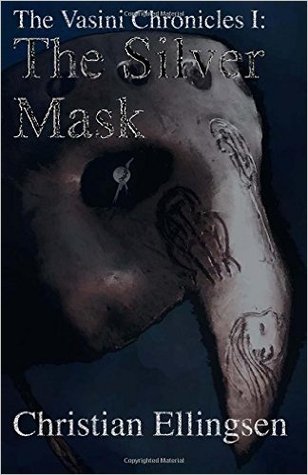
Book cover forDED: It took me a while to decide which book to pick for best of 2016. There were a few contenders, so I had to go back and revisit them all. After weighing the strengths and flaws of each, I finally reached a conclusion. My pick for best of 2016 is The Silver Mask by Christian Ellingsen. Yes, I was critical of the cover (I hope that Mr. Ellingsen invests in a better one), but the story was great. Ellingsen made use of a well developed cast of characters and excellent world-building to blend murder mystery, political thriller, and flintlock fantasy together to create a superb tale.

Congratulations to the winners!

Wednesday, December 28, 2016

The Silver Mask (The Vasini Chronicles #1) by Christian Ellingsen

book cover for The Silver MaskThe gods are dead, killed two hundred years ago. With their destruction the moon split apart, the sun dwindled and the land was devastated. Civilisation has re-emerged from the carnage, but twisted creatures still prowl the savage Wildlands between the city-states. In the skies above the city of Vasini, a falling star, a fragment of the dead moon goddess Serindra, heads to earth.

In the Palace district, Dame Vittoria Emerson, darling of the city, has been found dead. As Captain Marcus Fox of the Inspectorate hunts the killer, Dr. Elizabeth Reid searches for the remnants of Serindra determined to make sure the poisonous quicksilver it contains is not used. With Vittoria's death threatening to draw the city's political elite into a war of assassins, Fox and Reid must rush to expose the secrets that lie within Vasini before they tear the city-state apart.


The cover looks like a photograph of a museum piece. While accurate, I don't believe it's enough of a draw to pull in a reader. If this was non-fiction about said mask, maybe it would be sufficient. But even so, the lighting is too dim. The color chosen for the title font is muddled. It should stand out more, like the byline actually does. The typeface is fine. Still, there's so much going on in this novel that the cover should have been a scene from the book rather than the mask, which plays such a minor role in the book that I'm thinking the title should've been something else: City of the Dead Gods? Alchemy of Resurrection?

The chapters are broken into scenes which are occurring simultaneously, rather than devoting a single chapter to a character and his/her POV. It was a little confusing and took a little bit to get used to it and the characters sorted out. However, the opening chapter gave me the impression that a lot was happening on several fronts and thus drew me in. After a while I was able to discern the personalities of the major characters and what roles they played in the city of Vasini.

Ellingsen has invested a great deal of effort in developing the world wherein this story lies, but he doesn't drown you in backstory. It starts out with the familiarity of a mirror Earth and then the differences are sprinkled into the story. The culture of Vasini draws heavily upon the French—many French words frequent the manuscript—but there's a dead pantheon of gods that is complete fiction. There are sub-humans that live among the Vasinians as servants to the wealthy and strange monsters in the woods. And it rains all the time, which might be attributable to the heavily damaged moon in orbit.

To help the reader become more familiar with the city of Vasini, its inhabitants, and surroundings, Ellingsen has placed images of random documents highlighting Vasini's religious, philosophical, and cultural history between chapters. When I could read them, they were a nice touch. Unfortunately, I don't know how to enlarge images embedded in books on my Kindle Fire (just the text) so some of them were illegible.

Captain Fox and his assistant, Sergeant Locke, are the detectives charged with solving Emerson's murder. But as the investigation plays out, they discover that there is much more going on underneath the surface. Not only is Vasini a city that is divided between rich and poor, but the wealthy are bitterly divided into factions (Fishers and Scarlets) that manipulate the masses. Emerson's murder is the spark that sets off retaliatory assassinations on either side of the political divide. Reid and her friend, Catherine, are conducting their own investigation in parallel to Fox and Locke, for their own reasons. They're clearly in over their heads, and it isn't until Reid joins forces with Fox that they're able to see enough pieces of the puzzle to figure out how to solve it.

Christian Ellingsen has created a rich world within The Silver Mask, and despite 400+ pages of exploration, I feel like he's just scratched the surface. He carefully juggles a large cast of characters with ease, and it shows when we're afforded time to read from so many unique points of view (some extensive, some just a pivotal moment). While the mystery seems so Byzantine that Fox and Reid always seem to be three steps behind the antagonists, it only makes the resolution that much more satisfying.

For more information about The Silver Mask, please visit the author's website.

Tuesday, December 20, 2016

Too Wyrd by Sarah Buhrman

Sarah Buhrman’s Too Wyrd offers a welcome twist on the conventional fantasy protagonist who embarks on a quest.  As the story begins, Nicola Crandall is plucked from the comfort of home by a late-night summons for help, and she readily places her life on hold to combat a supernatural menace. But in this urban fantasy set in Indianapolis, the supernatural exists side by side with real-world problems that take the greatest toll on the most vulnerable.  So in addition to confronting otherworldly abominations, Nicola comes face to face with regular people scrabbling to survive on the fringes of society, and proves to be their staunchest defender. On the whole, her capacity for empathy and inclusiveness is what makes her a compelling hero, more so than her courage or resourcefulness when under threat.

The trouble begins when Nicola’s friend Joseph arrives at her door with worrisome news. Her half-sister Muriel, who has spent time living on the street, has been taken in by a cult that dabbles in magic. Nicola’s help is needed to extricate Muriel both because of Nicola’s skills as a magical practitioner and because one of the cult leaders is her ex, Keith, who is also the father of her child. Nicola and Joseph soon discover that Keith has become involved with very old magic connected to Norse mythology. Nicola and her allies must puzzle out Keith’s intentions and determine the source of his new powers and how they relate to the demons who keep materializing.

In keeping with Nicola’s compassionate nature is the type of magic that she practices. Rather than using magic for aggressive ends, she employs it to assess and affect others’ psychological states. In one scene, Nicola and Joseph use magic to calm an unruly crowd.
I quickly reached for the emotion I wanted: laying back with a cool drink in the shade of an umbrella, with a warm breeze, the soft roar of ocean waves, and the warm colors of a tropical sunset. It was calm, content, and sedate. I sent that feeling into our combined energies and projected it out in a broad arc over the crowd.

The result was subtle but quick, taking hold in a matter of minutes. People who were hyped up and bouncing on their toes, stepped back, rolled their shoulders and relaxed their stance. The crowd stopped its steady press forward and, after a momentary hesitation, began shuffling towards the doors. Instead of the aggressive shoving, people began to display more courtesies, letting people go before them, saying “thank you”.
But make no mistake, Nicola is no weakling. She pushes back hard against anyone who tries to prevent her from attaining her objective, whether it’s an old adversary out for revenge, a police detective trying to connect her with a crime she didn’t commit, or Keith confusing Muriel with glib obfuscations. In the latter instance, Nicola relentlessly interrogates Keith in hopes of getting at the truth.
“What about telling us who’s giving you this ‘truth’ that you’re calling destiny?” I said, pushing our advantage of having surprised him.

Keith frowned and took a step back. “I cannot reveal the name.”

“Because you don’t know?” Joseph asked, pressing forward at my side, “Or because no one would believe you?”

“Or because it’s just you making shit up?” I added. “Must be nice to have your life funded by the people you’ve conned with your line.”

I realized I’d made a mistake in my assumptions when Keith’s shoulders relaxed and he smiled. He shook his head and tsked.

“Nicola,” he drawled out my name. “You’ve grown so bitter and cynical…”

“I’m not bitter,” I continued. “Just because I don’t buy what you’re selling? That’s not bitter, that’s having half a brain.”
But in the end, Nicola is most admirable for the way she treats others.  While tracking down Muriel, she gets a tip that someone who frequents a local soup kitchen might have information. Nicola decides to combine her investigation with providing some much-needed volunteer help at the kitchen.
I talked Mercy into helping us convince some of the Bridge Kids to come with us to the city mission for supper. I knew most of them could use the meal, but the walk was too far for most of them to make the effort. Plus walking meant taking the risk of running into trouble with a capital fist to the gut…

At the mission, a flustered woman thanked us for our help and gave us our assignments… I was put at the end of the food line, helping people with walkers, wheelchairs and kids get all their silverware, food and drinks to their seats. I smiled and chatted up the guests, knowing that half the reason they came to the kitchen was for the small degree of human interaction they got.
Nicola ultimately manages to find the answers she’s looking for and faces down her enemies in a rip-roaring confrontation. However, her quest will continue. According to the author’s blog, she is writing a second installment in the Runespells series. The sequel would benefit greatly from more development of the secondary characters, many of whom are interesting, but lack sufficient depth and backstory. For example, two pivotal characters in Too Wyrd turn out to be not what they initially seemed. But their reversals are, for the most part, inexplicable and leave the reader longing for a greater understanding of their motivations.

At its core, Too Wyrd is an engaging adventure, propelled by a strong, eminently likable lead character. Sarah Buhrman has created an immersive fictional world that skillfully encompasses both the magically sublime and the poignant struggles of everyday people.

For more information, please visit the author's website.

Tuesday, November 22, 2016

Speck by L. Marshall James

book cover for SpeckA dark speck slips from dormancy, where it has been trapped for millennia. It is utterly alien, singularly enthralling, and devastatingly lethal. What follows in its wake are chaos and death.

There will be no escape.


The opening strikes me as a mashup of the first third of King's Dreamcatcher (the good part) and an incident that took place near the end of Koontz's Watchers. James offers us a lovely picture of an idyllic natural setting and then unleashes his "speck" upon a hapless marmot. The speck has the ability to control minds in close proximity through suggestion at the most primal level. As the speck grows in size, it gains strength and sophistication. Things spiral out of control, leaving the reader to hope that someone can get the speck under control before its destruction reaches catastrophic proportions.

The story starts with a universal omniscient narrator but switches to third person subjective once humans get involved in the story. The narrative is relayed through several characters, primarily those that encounter the speck. Characters are only given a chapter to carry the narrative, but James has them make the most of it. I never got the impression that these were disposable characters. Although their appearance on stage is brief, James invests the time in each to develop them. If the book had been a novel instead of a novella, I don't see any reason why the characters wouldn't be able to carry the story further.

But the length of the story is also something of a negative. The story reaches a point where the reader says, "Oh crap! What now?" The fast pace of the story comes to an abrupt halt. The ending comes as a bit of unsatisfying diabolus ex machina, which is followed by an epilogue that struck me as an outline for how the story could've carried on from novella to novel. I feel like the author hit a wall and either couldn't think of a way to continue or didn't want to (hence the epilogue).

Although only a novella, Speck demonstrates an author with a talent for creating believable characters, setting a good narrative pace, and establishing a realistic setting. He understands King's idiom that "bad things happen to good people" and handles it well. As James continues to develop his craft, I have no doubt that his potential will be realized.

For more information about Speck, please visit Goodreads.

Wednesday, November 16, 2016

The Interview by Damian Bruce

book cover for The InterviewIn a city racked by poverty and discontent, twelve people arrive for an interview with the all powerful Frontline Corporation. The successful candidate will trade hunger and hardship for a life of luxury and excess. However, it quickly becomes clear that the interview is nothing like they expected. Who will survive the brutal waiting game that unfolds? To what lengths are the candidates willing to go to secure the job? And what secrets are they hiding from one another?

Let me deal with the obvious: This is a terrible book cover. If I saw this in a book store or it came up on one of my recommendation feeds, I'd chuckle and move on (fortunately, I don't look at the covers for submissions). And that's too bad, because Bruce has written a good story. But this cover does nothing to support the blurb or hint at the content within. Please, Mr. Bruce, check out our list of book cover designers and invest in your cover.

Now onto the review.

There are two threads running through this book: the narrative of the interview and backstory chapters. The chapters alternate. First we have Edgar's narrative of the interview as it happens, and then the next chapter details the backstory of the interviewee that was just eliminated. But only the reader is aware of these backstories; Edgar is ignorant, free to reflect on his insecurity and low self-esteem. Tension is low at first, but as the more timid interviewees give up and depart, people come to realize that their odds of winning have improved and tensions rise. The longer the interview carries on, the more desperate everyone becomes.

One prize not mentioned in the blurb is that the winner of the interview will get to meet the "company alpha", Elise Villette, who has succeeded her recently deceased father as leader of the Frontline Corportation. Meeting Villette is more than just a formality; it becomes the goal of those involved.

We learn through the first few character backstory chapters about the background of this city-state that Frontline controls. Initially, I felt that these chapters were a distraction from the interview narrative. But over time, as more interesting characters were eliminated, they revealed that more is going on in this city than plain vanilla oppression. A revolt is brewing, born from the ashes of a failed one years ago. But the old leaders have split into two factions. One believes that the security forces can be defeated if the seemingly omniscient leader of Frontline is assassinated.

The other faction believes that peace is the answer. This faction is aware of an assassin but not his/her identity. The company already provides essential, albeit meager, services, and this infrastructure needs to be preserved. Villette just needs to change her tack from the oppressive stance of her father to benevolent leader. The peaceful faction attempts to contact interviewees to persuade them of the importance of their mission. They even try to get put their own people in place for the interview.

While I only found a handful of typos, comma punctuation was lacking. The book needs a lot more commas. They were left out of dialogue the majority of the times. Too often a sentence like this: "Where are you going, Harry?" was written as "Where are you going Harry?" If that doesn't bother you, then ignore me.

The Interview proves the adage that we shouldn't judge a book by its cover, but I know people will, and that's a shame. This is a well-crafted story with an assortment of characters with hidden agendas. Whether their goal is to escape poverty or transform the city from the top, the stakes couldn't be higher for the twelve assembled. What starts out as a simple dystopia gradually evolves into an intriguing game of "guess the assassin." Just when I thought I had it figured out, Bruce surprised me. So if you think you've got this book figured out from the cover, you're in for a pleasant surprise.

For more information about The Interview, please visit its page on Goodreads.

Friday, October 28, 2016

A Sickness in Time by MF Thomas and Nicholas Thurkettle

Cover: A Sickness in Time
THE MOST DANGEROUS OPERATION

In 2038, the human race is in a death spiral, and most people do not even know it yet. Technology that was supposed to make us better and stronger instead is birthing a strange and terrible plague we may not be able to stop. When the young daughter of Josh Scribner, a wealthy tech entrepreneur, starts to succumb to the illness, he dedicates his fortune in a desperate effort to save her life. Working with a friend & celebrated physicist, Josh develops the ability to send objects back through time. Their goal to recruit an agent in the past who might change our fatal path.

In our present day, a broken and traumatized Air Force veteran finds a strange message in the woods, drawing her into an adventure spanning decades. All humanity is at stake, as she and her small group of friends become the unlikely heroes taking up the secret fight against our future doom.

MF Thomas and Nicholas Thurkettle, authors of the acclaimed sci-fi thriller,
Seeing by Moonlight, are back with this time-twisting adventure that asks if our own destiny can be healed.

A Sickness in Time, by MF Thomas and Nicholas Thurkettle, is set in two time periods: one in the present day and one in 2039. It is a time travel plot with carefully defined limitations around what can be sent and how far back. The constraints are, of course, what makes the plot interesting. There can be no free-for-all in which the timeline gets increasingly muddied, but the various characters have to plan out very precisely what they intend to do. And the nearness of the two time periods—under twenty years—is very intriguing. There is no grandfather paradox here: the overlaps are much more immediate.

But before you reach the time travel elements of this story, and running along in parallel with it, is a plot dealing with the crossover between human and artificial intelligence. In this case, the artificial part takes the form of augments to human capability, rather than alternatives. The book's title refers to the discovery that the augments have a shadow side, the extent of which is largely unknown. They are not the unequivocal benefit first assumed, though puzzling out what the problems are takes a lot of time.

This story really worked for me. I liked the interplay between the different periods and the gradual alteration of the future line in response to successive changes. It's hard to tie up all the loose ends once you invoke time travel, but the authors do a convincing job. Inevitably, well before the halfway mark, you find yourself wondering how the tangle is going to resolve. Without giving anything away, the resolution had a clever twist. Every reader will—like me—wonder if that was the best choice to make, but it has certainly been done creatively.

There are two pairs of main characters, one pair in each of the two periods. But the pairs are contrasting in several ways rather than parallel. The authors do a good job of exploiting these contrasts. I found all four of the protagonists very credible, and quite individual.

In short, A Sickness in Time is well thought out, well planned, and well executed. If you like science fiction which doesn't just tell a story, but probes the difficult interface between scientific, social and ethical areas, this could be the book for you. I certainly really enjoyed it.

The book's website can be found here.

Wednesday, October 19, 2016

Kingdom's End by Charles D. Blanchard

book cover for Kingdom's EndIndio, a wise blind mole rat, has led a prosperous colony of sighted rats in the ruins of an old, abandoned movie theater for most of his thirty years. But the head of colony security, an ambitious Norway rat named Matthias, thinks he can do a better job and schemes to make a power grab. Meanwhile, the city recognizes that it has a rat infestation problem and decides to wage war on them, ultimately setting its sights on the theater.

Blanchard dedicates this novel to Richard Adams for writing Watership Down. While that book got people to look at cuddly rabbits in a new light, Kingdom's End attempts to take an animal often looked upon as vile and detestable and shine a more favorable light upon it. He makes no attempt to gloss over the rats' culinary preferences or nesting habits, but through anthropomorphization he imbues some of them with more admirable qualities of honor and service to community.

The story starts off with a group of rats out on a foraging mission. We start with one rat, then segue over to another rat, who then meets up with another rat, and so on. The focus of the story shifts from one rat to the next as Blanchard introduces us to parts of their world. Some rats that appear early in the story don't re-appear until much later. It's a bit dizzying as I wasn't sure which rats were important to the overall story and which weren't.

The story is told from a universal omniscient POV, which goes above and beyond third-person omniscient. Not only do we know what all of the rats are up to, but the nameless humans they encounter as well. Blanchard tells us everything, relevant or not to the adventures of the rats. I found it odd that we would be told a human character's backstory but not their name. And there's a lot of telling that goes on with this form of narration. The foreshadowing comes in the form of prophesies from an old rat that lives near the river. We know what's going to happen, it's just a question of when. I realize that this is a more traditional form of storytelling, but I find that it goes too far and leaves less for the reader to discover on their own.

I don't know if many people will get past the ick factor to follow Blanchard down into the grimy world that the rats live in. When I described the book as "Watership Down for rats" to my wife, that's how she replied. We like rabbits; they're soft, cuddly, and cute. It isn't hard to make your reader care about their fate. That's far from an easy thing to do with rats. Blanchard succeeds to some extent; I felt pity for the rats that were cruelly struck down by the hazards of urban living, and I rooted for the good and honorable rats. But too often a misapplied narrative focus and the deafening foreshadowing cut into my entertainment of the story.

To learn more about Kingdom's End, please visit the book's website.

Monday, October 10, 2016

Quest for Kriya by Rahul Deokar

Cover image - Quest for Kriya (Goodreads)
Haunted by tragic loss in the 1993 India earthquake, a broken Shakti with a tenuous hold on life is sheltered by her soul-sister Kriya. But when Kriya vanishes without a trace, Shakti is unwittingly swept into a cataclysmic vortex of greed, lust and betrayal. Shakti meets Shiva, a struggling Silicon Valley entrepreneur, and discovers that love is an enigmatic cosmic force.

Shakti and Shiva are thrust on a frantic race against time through the dark Mumbai underbelly, forbidden Thailand islands, and treacherous cliffs in the Andaman Sea, where danger lurks in every shadow. As they get closer to the truth, they realize that millions of innocent lives are at stake.

Quest for Kriya is an epic saga of love, friendship and sacrifice. The journey is incredible. The emotions are real. The transformation is eternal.

I was drawn to The Quest for Kriya by the names of some of the protagonists—Shiva, Shakti, and so on. I had imagined that it would explore deep issues, and make interesting mythological or religious connections. The preview passage that you get to see on Amazon and elsewhere tends to support this idea. The opening chapter, set around one person's terrible experiences of the 1993 Latur earthquake in India, was very successful at drawing me in and built up a lot of promise.

But we then jump to what might vaguely be called an earthquake-like change in another character's life in the United States. The parallel was loose, seeing as how the person concerned only lost their job, and was therefore motivated to start something new. Compared to losing one's home, family, friends and neighbours, suffering betrayal, and having to relocate to Mumbai, this seemed kind of lightweight, but I think the purpose was to set up friendships and enmities which would persist through the rest of the book.

From here on, though, the story suddenly diverted into a long, complex plot all about crime syndicates and drug dealers in India and nearby countries. Our two protagonists manage to break all this up almost without meaning to, by successfully threading their way through a series of amazing coincidences. Their rather bumbling approach to the whole affair mysteriously carries the day, aided by timely intervention from friends and well-wishers.

The plot is suspended between two cataclysms—the above-mentioned Latur earthquake and the 2004 Asian tsunami—and this basic device worked very well. But I got a bit lost in the intervening drug dealer story and didn't find the rather gooey romance between the male and female leads very believable. They seemed never able to get beyond a kind of adolescent idealisation of each other into a more credible and adult relationship. Insofar as the characters developed at all, they basically learned to conform to a set of behaviours and expectations set up by others. This is not a story of individuation or self-actualisation, but rather it is one of submission to external norms. As a result, everyone's emotional responses are very muted, as they increasingly take on board the philosophical position that nothing should disturb one's equanimity, and in the long run over many lifetimes everything will pan out for the best.

On the plus side, the book has been extremely well and carefully prepared, and for all of its heavy reliance on coincidence, the plot does keep moving along. I couldn't say if it accurately reflects police practice in the various countries, but to a casual reader it seems credible. And the basic structural device of hanging the story between two Asian natural disasters was a really compelling feature.

I guess my main difficulty was the mismatch of expectations. If there are parallels with any of the original tales of Shiva and Shakti, they are extremely well veiled. You will find little of the lively and authentic passion of the Khumarasambhavam, for example. The protagonists' potential for spirituality or real emotional engagement seems to be increasingly marginalised through the story, rather than liberated. I felt let down by the ways in which these two protagonists conducted themselves, given that their names hold so much mythological weight.

So, if you go in expecting a pacy crime plot set mostly in Asia, you will probably enjoy Quest for Kriya. If, like me, you were looking for something with more cosmic depths and resonances, it is best to revise your expectations and just go with the flow of what's there.

The author's website can be found here.

Monday, October 3, 2016

The Human and the Hunted by R.A. Burg

book cover for The Human and the HuntedEarth. 11,000 BCE.

A galaxy wide war between sentient machines rages and Earth is in the crossfire. Oblivious to the deadly peril above, Far Runner and his tribe face their own struggles. An unstable climate forces the group to migrate south and into the sights of a ruthless human foe.

A merciless attack tears Runner away from his family and friends.

A wounded alien cyborg soldier is stranded on Earth. Her views and identity are challenged when she finds herself face to face with a determined human named Far Runner.

As if there weren't enough problems, Moorr, a radioactive four-legged freighter pilot, prospector, and drug smuggler, is displaced by a relic of the war. Lost, he searches for his kin, but finds Earth instead. The defenseless planet is ripe for exploitation.

There's only one way for Far Runner to save his People. There's only one way for the stranded soldier to return home. And only one way Moorr's dangerous presence can be dealt with.

Earth is in peril. Time is running out...


Yeah, the cover isn't so good, but the story is. Rather than depicting an alien over a galactic backdrop, it would've been better if it had portrayed a scene from the book that included the alien.

The story is told from the viewpoint of Runner (human), En (alien #1), and Moorr (alien #2). Each brings a unique perspective to the story, and Burg gets points for how she handles them. The people of 11,000 BCE strike me as realistic, and the aliens are definitely alien. The humans are in transition from Paleolithic to Mesolithic—given to spirit worship and demonstrating a limited understanding for how the world works. En, the cyborg, is pictured on the cover. "Her" species was saved from extinction by a faction of sentient machines who don't believe that organic life sucks and has to die. Moorr's species are guided by taste and odor, and that's been built into the instrumentation of their spaceships. Moorr expresses surprise that life arose in water on Earth, but I don't recall if it was explained what Moorr expected. And Moorr's biology functions with radioisotopes. Yes, they're radioactive. That sets up an obvious problem when Moorr encounters humans.

Neither Moorr nor En is the omnipotent alien that is often portrayed in non-invasive human-alien encounters. Both aliens stumble in their attempts to understand human language and behavior, not to mention Earth's other native life. En even attempts to dispel Runner's belief that she is a sky spirit. The misunderstandings aren't limited to human-alien interactions, but alien-alien behavior as well. The confusion makes for some light humor when it's harmless, but when it turns serious the tension rises.

A good deal of the novel is centered on En helping Runner find the members of his tribe that were kidnapped by raiders. In the process, Burg showcases how Runner's hunter gatherer tribe's ways are losing out to those that have settled down and built villages. The rise of agriculture and the prospect of a steady food supply has a strong allure towards those who wake up each morning wondering where they'll find their next meal, or if they will at all. While this has some appeal from an anthropological perspective, it slows the pace down. One village is interesting; three becomes a bit tedious.

As for the technicals, the manuscript could've used another round of proofreading. Unfortunately I found plenty of spelling, capitalization, hyphenation, and punctuation errors. At times, Burg is guilty of too much telling and not enough showing. The end of the book had a couple of chapters that would've been better suited for the next novel in the series. It takes away from the feeling of closure for this book. But if these things don't bother you, then ignore me.

Despite these flaws, The Human and the Hunted is a good story and makes for a solid debut. Burg avoids first contact clichés and delivers two interesting aliens and believable prehistoric humans during a time of major sociological change.

For more information, please visit the author's website.

Thursday, September 29, 2016

Blogger Issue

It would seem that ours is one of several blogs that were damaged overnight. All of our links to our book reviews are gone. All of our links to other book review blogs are gone. Still trying to get a handle on this. I'm hoping that they can be restored from a backup as restoring all of them on my own would be exceedingly difficult.

UPDATE 9:25 AM EST: Used one of those archive websites to salvage the links just in case Google can't restore them. That knocks the task down from "Herculean" to a "slog."

UPDATE 9/30 12:00 PM EST: I received this message:
Restoring the gadgets may take up several days. You can add and fill the gadgets yourself, or wait for Blogger engineering to restore the repaired gadgets.
With no immediate resolution to this problem, I suppose I'll have to restore them myself when I find the time.

UPDATE 10/21 8:00 AM EST: I have finished restoring all of our blogrolls and book review link lists.

\_/
DED

Monday, August 29, 2016

100 by 100: Stories in 100 Words by M.L. Kennedy

Book cover for 100 by 100100 by 100 is a collection of 100 stories that are each 100 words long. Mathematically, that makes each worth 1/10 of a picture. Some of these 0.1 pictures are scary, some are funny, some are funny and scary, while others are just odd.

Reading this book reminds me of beer (or wine) tastings. When you finish sampling one and wish to try another, it is recommended that you cleanse your palate with some water. You're resetting your taste buds so that your new taste experience won't be unduly influenced by the previous sample. This book is like that. When switching from one novel to another, this book would serve as a great literary palate cleanser. It's refreshes your brain and has the bonus side effect of entertaining it as well.

Most of the stories have a twist at the end. But as I think about it, how else can one neatly wrap up a story that's only one hundred words long? The author quickly sets up the premise and then (bam!) there's the ending. I found that 93% of the stories worked (I kept track), and most of them relied on that format. It didn't matter if the twist was spooky, ironic, or humorous. That's what worked. Those that didn't just trailed off.

The stories cover the gamut from quirky sci-fi, suspense & horror, bizarre fantasy, and conversational satire. Santa Claus, vampires, clowns, ghosts, interdimensional travel, and alien invasions all make appearances. With a few exceptions, the stories remain light-hearted.

If you've just finished some 500-page behemoth and you're not ready to start the next one, but you need to read something, then consider 100 by 100. It's light and refreshing, and you'll be done with it in no time.

To learn more about 100 by 100 or M.L. Kennedy, please visit his website.

Monday, August 8, 2016

Madam Tulip by David Ahern

“All the world’s a stage” would be an apt subtitle for David Ahern’s madcap thriller/mystery novel Madam Tulip. Several characters are struggling actors, but even the non-thespians engage in performances of varying degrees of desperation. They include a steely businessman trying to disguise shady dealings, undercover police posing as wealthy socialites, and a murderous international criminal who assumes a more mundane persona to avoid detection.

Into this unfolding intrigue inadvertently stumbles 27-year-old out-of-work Dublin actor Derry O’Donnell. Prompted by her chronically poor finances, she decides to capitalize on the psychic abilities that run in her family by setting herself up as a fortune teller under the moniker “Madam Tulip.” She lands a gig at a glamorous charity event hosted by supermodel Marlene Doyle, wife of Peter Doyle, the aforementioned shady businessman. As Derry plies her new trade amidst the beautiful, the famous, the wealthy, and the venal, a promising pop star in attendance dies suddenly. Derry, by dint of information gleaned during fortune-telling sessions, begins piecing together the tragedy’s antecedents.  The well-meaning Derry also fears for Marlene’s safety, and in trying to avert another tragedy, she becomes drawn into an increasingly dangerous mystery.

Madam Tulip sets off at a brisk pace that accelerates as the book progresses. In the early chapters, Ahern deftly sets to the stage for the mayhem to come by hinting at secrets and questionable motives. On meeting Marlene and Peter Doyle at a racetrack, Derry’s immediately detects that they are not what they seem.
Doyle is an actor, thought Derry. He’s playing the rich and successful host, a man in control. He’s having an off-day for some reason, but he doesn’t forget his lines, and he stays in character no matter what.
Very quickly, Derry’s relatively uneventful life is upended. Following the death of the pop star Mojo, Derry’s friend Bella is unjustly detained by the police, collateral damage from the plot that Derry is investigating. Derry herself becomes a target. With the help of her friend Bruce, a former U.S. Navy SEAL, she embarks on a series of maneuvers to unmask a deadly conspiracy. Like many characters who are suddenly catapulted into an adventure for which they are ill prepared, Derry faces strange and sometimes comical dilemmas, such trying to figure out how to dispose of planted drug money without leaving forensic traces.
…Derry hadn’t got a shredder.
How do you get rid of money? Never in her life had Derry imagined she’d be asking herself that question. “I know,” she said, jumping up and rooting in a kitchen cupboard. She pulled out a blender, plugged it into the socket and poured in a little water from the tap.
“I guess if it’ll turn cabbage into a smoothie it can do it to twenties.”
Derry proves to be a perceptive observer, and her impressions effectively draw the reader into the story.  She quickly spots incongruities in the behavior of the Doyles’ chauffeur Paulo.  On one occasion when Peter summons Paulo, his response to his employer is unusual.
The chauffeur of a rich man might have been expected to jump to attention and follow his master meekly across the lobby. To Derry’s surprise, Paulo did nothing of the kind. He put his hands in his pockets, walked backwards towards the door and, as he had done once before, blew Derry a kiss.
Her instincts are unerring. Several times in the book, she must decide whom to trust without having all the facts. Her training as an actor stands her in good stead in these situations, enabling her to identify subterfuge and sincerity. After the pop singer Mojo’s death, suspicion falls on his girlfriend Sonya, but Derry is confident that she is innocent.
She couldn’t even begin to imagine Sonya killing Mojo. Nobody, not even the best actress in the world, could fake the feelings Sonya had shown.
Madam Tulip’s overall tone is light-hearted, with comic relief provided by a feud between Derry’s divorced parents – her mother Vanessa, a flamboyant art dealer, and her father Jacko, a raffish painter perpetually one step ahead of trouble of his own making. Ahern’s wry observations like the following also contribute to the book’s wittiness.
The phalanx of policemen now fanned out around the offending car as though the driver inside were a terrorist or a wanted gangster. Meanwhile, the helmeted motorcyclists tried to disperse the watching crowd, shouting, “Nothing to see here, nothing to see! Move on!”
No crowd of Dubliners promised the delightful spectacle of raised voices, shouted obscenities and discommoded policemen will willingly accept an instruction to disperse, especially if accompanied by the ludicrous statement that there is nothing to see. Plainly, there was lots to see. The mood was turning ugly.
The novel has a couple of minor weaknesses. One subplot explores Derry’s potential rekindling of a past romance; however, the interactions between Derry and her former boyfriend lack any spark, and his character is woodenly unappealing. Another flaw, in light of the fact that this is the first in a planned series, is that Madam Tulip does not introduce any compelling character or story arcs that would span multiple installments. Because the novel is very competently written and succeeds on many levels, this is not strictly necessary. But to keep readers strongly engaged with a series, a novel should leave interesting questions and conflicts unresolved.

On the whole, though, Madam Tulip is pure entertainment, striking an ideal balance of comedy and suspense, with a cast of delightful eccentrics flailing their way through a gripping adventure that culminates in a satisfyingly cataclysmic conclusion.

For more information, please visit the author's website.


Friday, July 29, 2016

Guns, Gods & Robots by Brady Koch

Book cover for Guns, Gods, and RobotsBrady Koch's Guns, Gods & Robots is a short story collection whose tales fall into one of those three categories. Three out of the seven stories had been released as standalones, but now they've been combined into one collection.

The collection opens with "Numbers 16:32", which was originally released as a standalone story, and I reviewed it here. The original blurb: Joseph's Sunday morning routine of church, beer and solitude is interrupted by a ragged screaming coming from the far side of his farm land. What he finds there will challenge his resolve in ways he hasn't faced since losing his wife or facing the horrors of the Korean War. I re-read the story and discovered that it had been slightly re-worked and edited. There was a definite improvement which increased my enjoyment of the tale. It makes for a solid opening to the collection.

"X-mas for a Half-Life": The story starts off with a typical "Dear Santa" letter, but the kicker is that it was written by a little girl living in an underground bunker after a nuclear war. So how do you make a child's Christmas wish come true when day-to-day survival is a struggle? A charming story in the face of grim circumstances.

"Popular Mechanics for Young Widows": A dying engineer builds a robot butler for his wife. Years later, she struggles to cope with his death and what the robot represents. I wasn't sure where this one was headed, but I suspected it would end tragically. Koch deftly resolves the situation.

"Fighting Weight": A son reflects upon the ritual of his mother cutting his hair. That doesn't sound like much of a story, but it actually provides a window into a destructive co-dependent relationship. I was so focused on the obvious developments that Koch presented that I didn't see the end coming.

"Sangrimal": A girl’s birthday wish comes true when she gets to spend an afternoon on a manhunt with her lawman father. I found this one to be the weakest in the group. The story is told from Katie's POV, so when events transpired, I didn't understand why. I don't recall there being any clues that the reader should've picked up on that Katie wouldn't because of her age.

"Timothy": In a world beset by a plague, human missionaries of all faiths have been replaced by robots. Something goes wrong with a robot named Timothy, and it is up to a pair of human engineers to figure it out before its malady spreads to the other robots. It's a story that explores faith in an interesting way. Tied with "X-mas for a Half-Life" for favorite story in this collection.

"3rd Flight": A marathon runner sets out for the third run of his life—tradition says it will be last. To say anything more would give too much away.

There's a Bradbury current running through the sci-fi stories. I don't know if the author is a fan, but I sense the vibe in his writing, enough to say there's an influence. The horror feels a bit more like King (short story King, not bloated novel King). He lacks Bradbury's poetic flourish, but Koch definitely has his own voice, which I imagine will grow stronger over time. But it's how everyday people deal with extraordinary circumstances, be they wonderful or horrific.

Unfortunately, I found a bunch of typos. I didn't let them distract me from my enjoyment of the stories, but they could've easily been caught by a proofreader. Other than that, the composition of the stories was sound.

Guns, Gods & Robots is a delightful collection of short stories by an author who's truly emerging in his own right. Any of these stories could've been sold to a zine for publication (after some tweaking for length). If you appreciate older sci-fi (and horror) that focuses on upheavals in the lives of everyday people (rather than grand galactic sagas or dystopian dramas), then check out Guns, Gods & Robots.

For more information, please visit the author's website.

Tuesday, July 12, 2016

Union of Souls by Scott Rhine

Book cover for Union of SoulsReuben Black Ram has been a hacker for Special Forces, a DJ for pirate radio, and a real pirate who hotwires spaceships. The richest Goat in the galaxy, he is being asked to give up everything to save a race of alien mimics and his Human girlfriend. To accomplish this, he must cross Union space to reach the Convocation of Souls. The space battles, spies, and dangerously experimental tech don’t bother him as much as what MI-23 expects of him—to grow up and become a world leader. Reuben still has a few tricks up his bulletproof sleeves, including a psi talent that up until now has only made him an object of ridicule.

Before I get into the review, I'd like to comment on the cover. Each of the books in this series has been told from the POV of a different character. In the first two books, that character was human and featured on the cover. Not this one. The main character is a "goat"—humans have applied Terran animal nicknames to many of the alien races they've encountered—but we don't get to see him on this cover. I was disappointed by that decision. And the spaceships on the cover don't look like the one the heroes fly around in. It's just a generic sci-fi cover. Don't get me wrong; it's a competent cover. I was just hoping that the main-character-on-the-cover trend was going to continue.

I've enjoyed watching Reuben evolve over the three books in the series. In Void Contract, he meant well, but was a screw-up. Max saw potential in him, especially considering his lineage, and made him his pupil. By the time we're knee deep in Supergiant, Reuben has matured into a responsible member of the crew, though one that wears his heart on his sleeve.

Early on in this book, Reuben is forced to come to terms with the events that came at the end of Supergiant. While he's still young and emotionally malleable enough to adapt and prepare for his destiny, Reuben faces many challenges along the way. There are many temptations, and he knows he has to resist them, well, most of them anyway. He longs for what he's lost and on come the temptations of sex and booze. He feels a burning need to right the wrongs that were inflicted upon his people by Phibs and Bankers and on comes the temptation to misuse the power of government to exact revenge. Rhine deftly steers Reuben through these challenges in believable ways.

Whereas Void Contract was primarily about the assembling the cast of characters, the series' plot lines were introduced, though Rhine barely scratched the surface. Supergiant went into detail about those plot lines and their implications. The stakes were raised, and the urgency of our heroes' mission was understood. Those plot lines are (mostly) resolved in Union of Souls, and it is Reuben who is the key to accomplishing this. So it totally makes sense for Union of Souls to be told from his perspective. Unlike Supergiant, which was told from Roz's perspective and where many action scenes took place "off camera", Reuben is in the thick of it. The reader doesn't miss out on anything.

Rhine's writing continues to be efficient. There are no wandering tangents or paragraphs of purple prose. Dialogue, internal and external, serves to advance the story or provide insight into the characters. The same goes for the action scenes.

The manuscript has been meticulously edited and is of professional quality.

Union of Souls is the best book in what has already been a great series. Reuben is an immensely likeable character due to his relatability. He has flaws like everyone else, but is thrust into a situation of great political power with debauchery and corruption tempting him all the time. Rhine does an excellent job resolving the plot lines he introduced in the first book. Switching the narrative character POV with each book has been a smart move as it enables the reader to be in on events as they unfold. It will be interesting to see who narrates the story in the next book in the series, Glory Point.

For more information, please visit the author's website.

UPDATE 7/27/16: The author informs me that he and his cover illustrator tried to come up with a proper sketch for Reuben, but they were unable to make one that did him justice. The cover is actually a scene from the huge convocation at Giragog that takes place at the climax of the story.

Tuesday, July 5, 2016

The Colony by RM Gilmour

Cover image (Goodreads)
When Lydia is pulled through spacetime into Jordan’s plane of existence, she finds herself immersed in a world controlled by the Guardian, an artificial intelligence. The Guardian’s sole purpose is to protect the power source that runs the planet; but it does so at the cost of all who live outside of its city.

Sheltered in the Colony, beyond the city’s borders, Lydia is befriended by an advanced race of hunters and warriors, who do all they can to protect her and themselves from the Guardian. To survive in this new world, she must find courage and strength, and learn to face her fears. But to save her soulmate and the colonists from the Guardian, she must overcome those fears and embrace her inner strength.

I was drawn to The Colony by reading an extract online—not a very long extract, but it convinced me that here was an interesting main character, dropped into a challenging situation. I was hooked.

RM Gilmour's story begins in a familiar Earth, but quite rapidly shifts to a wider focus. "Our" Earth is only one among a small set of alternate parallel worlds. The inhabitants are recognisable, but each has pursued a slightly different line of development, both biological and technological. There is a complementarity about the various groups; like any other kind of diversity, this has the potential to go well for the separate groups, or to go really badly. There are a lot of echoes of today's world, as a diverse group of people plucked from their own context tries to establish a kind of refugee existence.

The central character, Lydia, would be interesting in any story, but her complex and painful back story fits particularly well in this setting. She is constantly having to reassess who can be trusted and why, and whether she can rely on her own perceptions of the situation. Her personal history does not predispose her to depend on others, nor to feel that she herself is anything other than a destructive influence. Ironically, this very capacity for destruction proves to be crucial for the plot, once properly directed.

The story takes many twists and turns—it is at times a love story, an abduction, a rebellion, or a desperate defence against unthinking aggressors. It is to the author's credit that she has handled these possibilities without the story becoming bogged down and confusing. Since we follow Lydia throughout, these changes seem natural developments as her own awareness grows.

The book provokes thought about important personal issues. The one I grappled with most was what draws two people together. The book proposes that it is our similarities which make for compatibility and love. I feel it is more to do with complementarity and difference, but I appreciated the fact that the book tackled the question head on.

In terms of editing, there were a few more slips than I had expected, chiefly around homonym words such as your / you're. A few of them had me puzzled for a moment, but none of them interfered with my great enjoyment of the book.

The Colony ends with the defeat of the enemy, once its identity has been finally clarified. However, the closing words suggest that the victory has brought new risks, almost before the dust settles, which I am sure will be explored in a second story.

In short, The Colony is an engaging and stimulating book, providing a new twist on the theme of parallel worlds. Well worth reading.

The author's website can be found here.

Wednesday, June 29, 2016

Welcoming Our New Reviewer

Richard AbbottI'm pleased to announce that author Richard Abbott has joined the ranks of the New Podler Staff. Richard is the author of Far from the Spaceports, which I reviewed earlier this month. Besides science fiction, Richard also writes historical fiction. His other novels include The Flame Before Us, Scenes from a Life, In a Milk and Honeyed Land.

Richard will be joining us as a reviewer. He hopes to discover some science and speculative fiction that offers optimistic, rather than pessimistic, outlooks with good characters and prose to boot.

Welcome aboard, Richard!

Thursday, June 16, 2016

Far from the Spaceports by Richard Abbott

Book cover for Far from the SpaceportsQuick wits and loyalty confront high-tech crime in space.
Welcome to the Scilly Isles, a handful of asteroids bunched together in space, well beyond the orbit of Mars. This remote and isolated habitat is home to a diverse group of human settlers, and a whole flock of parakeets. But earth-based financial regulator ECRB suspects that it’s also home to serious large scale fraud, and the reputation of the islands comes under threat.

Enter Mitnash Thakur and his virtual partner Slate, sent out from Earth to investigate. Their ECRB colleagues are several weeks away at their ship’s best speed, and even message signals take an hour for the round trip. Slate and Mitnash are on their own, until they can work out who on Scilly to trust. How will they cope when the threat gets personal?


While the story got off to a slow start, it certainly wasn't dull. Abbott introduces us to Mitnash and does just enough world-building to hook the reader with an intriguing future. Humanity has colonized a good chunk of the solar system, and artificial intelligence (AI) has come to fruition. It's something that the technorati would approve of. And while space travel has improved, it still takes weeks to travel from Earth to the asteroid belt. This remoteness allows for a bit of self-governance that libertarians could find comfort in—it isn't anarchy or the Wild West. It does mean that there will be no cavalry coming to Mitnash's rescue should he get into trouble with the locals. He is very much alone, surviving by his wits.

The AI entities work alongside humans and have personalities that are indistinguishable from them. In this age of never ending Terminator films and Kurzweilian singularity worship, it's actually refreshing. One drawback is that Mitnash relies heavily on Slate to do the heavy lifting. While that comes in handy for number crunching, "she" executes some of the best action, leaving Mitnash as spectator too often. The story is told from his point of view so the reader misses out on Slate's version of events. Mitnash does get in a bit of peril when he finds himself unable to rely on her, and this winds up being the most tense scene in the book. I think I would've liked a bit more of that. They're a team, for sure, but it seemed to me that Mitnash needed Slate more than she needed him.

There's a tremendous attention to detail, which threatens to be too much for the casual reader, but Abbott stops short of going too far. It plays into his world-building. While it isn't all essential to the story, it does help the reader get the feel of the place. I never got a proper understanding of the local gravity—one-fiftieth that of Earth—but I'll chalk that up to my being stuck on Earth my whole life.

Only found a handful of typos, so the editing gets a thumbs up from me.

Far from the Spaceports is a delightful read. Abbott's characters are very personable and make for good companions as he carries us to a promising future. There's no dystopia here; man and machine work together to fight crime through skill and wit rather than heavy-handed government oversight or firearms. David Brin would approve.

For more information, please visit the author's website.

Wednesday, June 1, 2016

Muses of Roma by Rob Steiner

Reviewed by Erin Eymard.

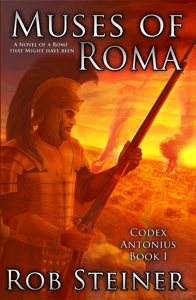
book cover for Muses of RomaMarcus Antonius Primus began a golden age for humanity when he liberated Roma from Octavian Caesar and became sole Consul. With wisdom from the gods, future Antonii Consuls conquered the world and spawned an interstellar civilization.

Three weeks before the millennial anniversary of the Antonii Ascension, star freighter captain Kaeso Aemelius, a blacklisted security agent from Roman rival world Libertus, is asked by his former commanders to help a high-ranking Roman official defect. Kaeso misses his lone wolf espionage days—and its freedom from responsibility for a crew—so he sees the mission as a way back into the spy business. Kaeso sells it to his crew of outcasts as a quick, lucrative contract…without explaining his plan to abandon them for his old job.

But Kaeso soon learns the defector’s terrifying secret, one that proves the last thousand years of history was built on a lie.

Can Kaeso protect his crew from Roman and Liberti forces, who would lay waste to entire worlds to stop them from revealing the civilization-shattering truth?


Rob Steiner's Muses of Roma is unlike any alternate history novel I've ever read. The premise of the novel is simple: Imagine that Rome never fell and is now bent on conquering the stars.

Steiner seamlessly blends historical fact into his story, slightly altering bits, but pulls no punches in this process. This is first evident with the quote preceding the prologue: "I found Roma a city of marble and left it a city of steel" - Marcus Antonius Primus. This is a play on Augustus Caesar's quote "I found Rome a city of bricks and left it a city of marble" (marmoream relinquo, quam latericiam accepi). The book is peppered with enough Latin phrases and tidbits to make the Romanophile in me giddy.

The prologue starts with Marcus Antonius taking the eternal city aided by cannons and muskets. His march through Rome amidst gunfire and smoke is a surreal scene. Steiner goes on to explain that deep in the deserts of Egypt, Marcus Antonius is bestowed upon "by the gods" the secrets of advanced technologies.

One of my favorite lines from the prologue is:
He passed the Circus Maximus on his left; its large walls were pockmarked with musket shots.
I found myself trying to imagine what the people of the city would have been thinking as a man leading an army with the power of the gods marched to take the city from a man they worshiped as a god.

The shock of the prologue (especially after the author deftly explains the rapid technological advancement) serves as a warning to the reader that this is going to be a wild ride.

Fast forward 1,000 years and we are on the streets of Roma. The city has all the feel of ancient Rome even after the characters catch a bus. A young woman, Ocella, is trying to smuggle a boy, Cordus, off planet, which is where the true sci-fi aspect of the book takes hold.

We meet Kaeso, former Umbra (secret agent) and captain of the Caduceus, as he is trying to keep his spaceship flying. His crew is a hodgepodge of people running from their pasts all with their own secrets. Kaeso’s own secrets could put the lives of his crew in jeopardy. The interaction between the crew is not unlike the Malcolm Reynolds' crew in Firefly. They fight like a family and would give their lives for their crewmates.

After a disastrous job and an injury to a crew member, Kaeso’s past catches up to him and he is tasked with returning to the eternal city to retrieve Ocella and Cordus. In the process, they discover a millennium's old secret that could change the course of humanity.

I have never gotten so wrapped up in a book. I will be purchasing the remaining books in the series but only once I have time to devote myself to being locked in a room and do nothing but read this. This is not a series that one reads in small spurts. Steiner constantly pulled me in and held me captive for hours on end.

For more information, please visit the author's website and read this interview.
The reviewer purchased a copy of this book. A review was not solicited.

Friday, May 13, 2016

Cloud Country by Andy Futuro

Book cover for Cloud CountryWell, that could’ve gone better. Saru had found the blue-eyed girl alright, but she’d blown up half of Philadelphia in the process. Whoops. Now she was a fugitive, robbed of her implants, relying on her "wits," hunted by aliens, Gods, and the monstrous spawn of fornicating universes. It was a crap deal, but it wasn’t all bad. She’d stolen a plane, a luxury model with a fully stocked minibar. And she had company, a rogue Gaesporan named John. And there was something strangely liberating about having screwed up so badly you couldn’t really do worse.

Cloud Country is the sequel to No Dogs in Philly and picks up within hours of its end. The story reads a bit like a bad acid trip version of Alice in Wonderland—I don't mean that as a complement. It's all about Saru wandering around aimlessly in real and imagined landscapes, encountering people, aliens, and monsters who want to do her harm. It isn't until about three-quarters of the way through that the point of it all was made clear. And that's far too long. If the first book hadn't been so good, I wouldn't have finished this one.

Saru remains an unlikable character. I like strong female characters, but I don't want them to be petulant brats. In the first book, I rooted for her. In this book, I was rooting against her. Self-confidence is sexy, but self-absorption is a turn off. I wanted her to fail so that maybe a shred of humility would creep into her consciousness and make her aware of how much of a jerk she is. I felt sorry for (almost) every other character that had to deal with her. Again, it was at that three-quarters point that we see any glimmer of hope that she realizes that it's not all about her. She actually cares about her native city of Philadelphia, though I'm not sure why. At the climax of the story, she finally shows some compassion, but I don't know if it made a lasting impression on her soul.

Unfortunately, the editing in this book is terrible. My experience was marred by comma problems (missing or too many), capitalization issues (gods not Gods), a lack of transition from narrator's voice to Saru's thoughts, scene inconsistencies, and run-on sentences. Sometimes Futuro tried to cram as many adjectives and phrases into his sentences as possible. It was like he was having a Special K power trip and was feverishly writing everything down that came to him. Here are a few examples:
She howled and leapt from her crouch at the nearest doctor, and the pain raced up to her brain, where it echoed like a tolling bell and grew and grew, so that her vision shook with its vibrations, and her legs spasmed like skewered insects, and the blackness filled her head again, her few seconds of consciousness swallowed by pain.
There was a whoosh and skitter, and tentacles wrapped around her body, ankles, shins, thighs, navel, breasts, arms, neck, wrapping tight, barbs digging into her skin with hornet-sting pain.
She took deep breaths, the stench bursting the vessels of her nose to gush blood, the air cutting her throat and jabbing acid holes in her seared lungs, lips burned and curled away, eyelids burned, the eyes steaming and boiling in their sockets.
She remembered this, this conversation, the two of them huddled in their makeshift sleeping bags in the tree fort back in the woods, the secret fort to get away, to hide, clinging to each other to stay warm, ears pricked, hearts pounding at every snapping twig and scuffling squirrel, alert, alert, alert, waiting afraid.
If the editing in No Dogs in Philly didn't bother you, then it won't here either.

In summary, Cloud Country is a disappointing sequel to No Dogs in Philly. The hard-boiled cyberpunk Lovecraftian vibe is gone, replaced with a bizarro fantasy that wanders aimlessly for far too long before getting to the point. This is reflected in the author's tendency to make sentences as long as possible through the use of commas and conjunctions. There's the kernel of a decent story here—you can see it in the imagery the author evokes—but the manuscript needs to be sent to an editor to bring it out in some coherent fashion.

For more information, please visit the author's website.

Thursday, May 5, 2016

How NOT to Take a Rejection from Us

While stumbling around the internet today, I came across this. In essence, it was an author bemoaning a rejection letter he received from us. He was having a bad day and chose to rant on his blog about it. I've copied the pertinent part below, but you can click on that link to read the whole thing and verify that I'm not misquoting him.

My magnum opus received a rejection today, not for publication, but rather, that it was not qualified for a review by any “reviewers” on the website “The New Podler Review of Books: Small Press and self-published books worth reading”. Now I don’t remember ever submitting a review request to this site, although it’s possible. I don’t normally ask for reviews except when I am just putting a book out there and need a few ARC reviews posted so that the almighty ad sites will consider my money worth spending (and then I normally impose shamelessly on fellow authors).

Now the facts that the aforementioned review site is built on the most hideous of the free backdrops on the free “blogspot.com” and that my rejection came from a (free) Gmail address notwithstanding, their subtitle would suggest that my self-published book is “[not] worth reading”. Now had the site just said “Podler Reviews” I probably wouldn’t have given it a second glance. Okay, that AND if the current book under review didn’t have a cover (and writing) quality equivalent to that of a sixth-grader (no, that’s not true—not true at all. Such a commentary insults the sixth-grader).

I know, we’re supposed to have thick skin. And I usually do. Or pretend I do. But just as each time a reader enjoys my work it makes my day, not matter how many books I ever sell or have reviewed, it also stings when someone takes time out of their day to reject you. Doesn’t it? Or am I alone here, wandering in the literary desert of criticism with eyes gouged out and a bloody wrap around my head? It’s a bummer when people that consider dog poop as literature reject you as unreadable. I know, I know, it actually defies logic, but what can I say?

Now while this post was made three years ago, I couldn't help but reply. Things posted to the internet live forever or, at least, until they're taken down. As I write this, my comment is awaiting moderation. So here it is just in case it's rejected:
Ha! This is wonderful. I’ve only just now stumbled upon this post, so I shall respond on behalf of the New Podler Review of Books.

Your scathing criticism of our usage of free stuff is spot on and accepted. But we’re hardly alone in this.

We have changed the motto since you visited us. It was there from the beginning and was established by the site’s founder, who is no longer with us. I never thought that it was intended to alienate authors whose work was rejected by us. More like, “Here are some indie books that we came across that are good. Obviously, there are more, but [insert lame reason here].” We didn’t get to read The Martian or Wool when they were indies. Doesn’t mean they sucked.

I won’t apologize for the lame covers of some of the books on the site. Indie publishing has been plagued with that from the start. Instead, we’ve had a page dedicated to sites where indie authors can find affordable book cover designers.

Yeah, Blood Land was submitted to us via MailChimp, that mass mailing service. I don’t know if you used them or someone did it on your behalf. Regardless, it means that someone didn’t read our submission guidelines. Mystery/Thrillers really aren’t our thing. Maybe one of the available reviewers at the time was into it, but he/she took a pass for whatever reason.

If you had read our submissions page, at the bottom you would’ve seen this:

“We reject over 95% of the submissions we receive, and that includes the very good along with the not so good. If you’re rejected, you’re in good company. One author we reviewed posted that he only received five reviews out of 144 submissions to book bloggers. Keep trying!”

We send out form rejections because it consumes less time, and when managing a slush pile, I like to take the easy route. Kind of like using MailChimp to send out a bunch of submissions to prospective reviewers.

I’m sorry if the rejection letter that was sent to you hurt your feelings. It wasn’t meant to do that. It was sent to provide closure. Some authors like to have that. Also, I’m sorry that you felt that rejecting your work meant that we thought it was crap. That was not the case. Yeah, the book cover on the site at the time was amateurish, but the writing was not. Judging books by covers…yeah, I know.

Anyway, I’m sure that you’ve moved on. I hope that this reply clears things up for you. I also hope that when you get rejected, you shrug and move on.

It just goes to show that you can't please everyone. Oh, and the book currently reviewed at the time was Embustero. I guess sci-fi isn't his thing.

\_/
DED