Showing posts with label anthology. Show all posts

Wednesday, November 6, 2024

Escalators to Hell: Shopping Mall Horrors

book cover for Escalators to HellThis anthology's theme is horror stories that have some connection to shopping malls, those dying bastions of consumerism. Not that consumerism is dead, mind you. It's that we're transitioning from roaming their vast corridors of myriad wares to surfing the digital versions on our phones and laptops. To wit, the editors thought that the demise of shopping malls would make for an excellent theme for a horror anthology. And I thought so too.

The stories cover a wide gamut of horror sub-genres, so it isn't all about gore. There's a "Content Warnings" section—something I've never seen in a horror anthology—which I thought was odd. I mean, it's horror. If your mental health is such that certain things will trigger a traumatic emotional reaction, maybe you shouldn't be reading horror. I know that there are certain aspects that I won't read because of my issues. So I guess a content warning is considerate of the authors, can one find it before purchasing it?

Author representation is quite diverse. While North American authors are present, there are stories from African and Asian authors. Also, there are many non-binary authors in this collection.

Ok, onto the stories. Of the 22 stories in this collection, I liked 15 of them. Of those that I didn't enjoy, a good deal of them were too focused on gender identity, with the mall serving as mere setting. A couple of the others were too esoteric or allegorical to connect with.

On with the good stuff! The opening story, "Hard to Be a Mall God," was excellent. It deals with a demonically possessed escalator. "The Intercessor" shows how retail associates deal with trollish customers. "Why I Won't Eat at the Food Court" is part of the Generation Dead series. It drags in some cosmic horror for teen mutant superheroes to deal with but doesn't forget to add a dash of humor. "A Plague Upon Both Our Houses" is Romeo and Juliet with Zombies in a mall. "A Quick Trip to Ryan's" delves into masochism on a whole another level. "Kim, Ray, Trey, and Morgan" delves into drugs as a mind expanding experience with a dash of cosmic horror.

Some stories confront serious matters. "You Must Drop Buy" tackles the subject of rampant materialism and false promises made by deceptive marketing. In "Poseurs," a teen girl deals with her father's suicide by re-enacting a drama with mannequins.

In case anyone feels I'm being unfair to non-binary character stories, there were good stories that had non-binary characters and authors. These stories didn't lose sight of the objective. For example, "The Basement of Crowley's Artefacts and Interests of the Occult" has some non-binary teens dealing with demonic invocation in the supply room of an odd store in the mall. "Cherry Cola Lips" features a woman reflecting on her first crush back in high school, a girl who wouldn't come out and later disappeared. Rumors are that she was murdered, but the truth is stranger.

My favorite story was the closer, "The Temple of All." Makoma is forced by ritual to take her dead husband's remains into the ancient ossuary. It's a post-apocalyptic story with a touch of Handmaid's Tale where the ultimate act of rebellion is to live.

Yes, I'm glad I read this anthology. While I wish some of the stories were better, the good stories made it worth the price and my time.
Full Disclosure: I backed this book on Kickstarter and received a digital copy as a reward.

\_/
DED

Monday, December 29, 2014

Shared Nightmares, an anthology from Cold Fusion Media

Cover for Shared NightmaresShared Nightmares is a collection of short stories whose central theme revolves around dreams, but more accurately, nightmares. That's about the only thing these stories have in common as the authors tell us tales that span all matter of genres. While horror is the overriding element, some authors make use of other elements: science fiction, historical fiction, and urban fantasy. Some stories rely on visceral action, while others suspense. Fortunately, none of these stories wander down Elm Street, and for that, I'm grateful.

Please indulge me as I offer brief comments about each story.

The anthology opens with “Father’s Day” by Larry Correia. Aliens have invaded Earth and are attacking us through our dreams. And we're losing. Correia does a stand up job with his protagonist, as he fights a bureaucracy in order to protect his daughter.

In “Dreamcatcher”, Sarah Hoyt warns us that things in the dream-world wants to become real. There are guardians who keep the nightmares at bay, and it helps to keep an ax—a very sharp ax—close at hand.

The message I got from D.J. Butler's “Incubation” is that regret is a nightmare that you can't wake up from. It takes some time before we learn what the unreliable narrator has done, but Butler drops us enough clues along the way to piece together this crime scene.

The devil has Adam's number in Tom Lloyd's “The Devil On My Shoulder”. Every time Adam wakes up, whether from actual sleep or blackouts, he discovers that he's been up to no good. Pity him, but pray you never meet him. Lloyd does a great job bringing the reader along on Adam's senseless ride through misery and then rewards Adam (and the reader) by revealing his purpose.

The first of the historical fiction pieces is “Onnen” by Paul Genesse. Having visited the Kyoto imperial palace, he was inspired by its strange, bleak history to write this story. It's an excellent tale of a woman's scorn and her unquenchable thirst for revenge.

In “To Dream Awake, to Sleep the Real” by Michaelbrent Collings, Booker Nyx talks about the dream-like bliss of the early days of marriage: "Existing with one foot in dream, and the other in a place where the world was seen as it truly was: a place of magic, and wonder, and light, and infinite possibility." But then children come along, and the responsibility of parenthood kills the dream. Booker yearns to return to that dream. Collins does a solid job with his sad yet familiar portrayal of Booker's life.

“What Hellhounds Dream” is an action-packed urban fantasy story from Steven Diamond, who's also one of the editors. It was a fun story that seemed like it could be expanded to novel length.

“The Damnation of St. Teresa of Ávila” by Marie Brennan is the other historical fiction piece. The titular character died right at the time when Spain transitioned from the Julian calendar to the Gregorian calendar, whereupon ten days were lost. In Brennan's story, St. Teresa's death lasted for those ten days. Drawing from St. Teresa's life and writings, Brennan skillfully paints an all too real picture of the woman as she hovered between life and death.

“Man in the Middle” by Max Gladstone was another fun piece. It appears to be something out of his Craft Sequence series. If you're like me and haven't read anything about it, there's a bit of dead gods and scientific sounding magic (which reminded me of Stross's Laundry) that keeps the world—at least an alternate version of ours—running. This story concerns a trip into a nightmare where Tara discovers a remnant from the God Wars. After reading this story, I feel compelled to dive into this series.

A video game that you play in your sleep is the subject of “U.I.” by Howard Tayler. The game is still in beta as the protagonist is testing it for the developer. Rather than just lamely showing the game action, Tayler presents their conversations, which shows the protagonist's progress in getting caught up in the game.

“The Quality of Light is Not Strain’d” by Peter Orullian was a difficult read due to the subject matter. That's not to say it wasn't a good story. It was well-written, and the difficult parts were tastefully composed. I find that the most disturbing horror stories are not the ones with visceral gore, but rather the mundane acts that are carried out by good people in desperate situations. This is one of those stories.

The anthology concludes with “Health and Wellness” by Dan Wells. It follows a pair of Indian immigrants who are here on work visas and take these special vitamins generously provided by the U.S. government. It's a delightful tale of paranoia and the paranormal.

Editors Steven Diamond and Nathan Shumate have done a fantastic job corralling these disparate tales into a cohesive collection. If you prefer your horror to be on the literary end of the spectrum, without the usual tired clichés, then check out Shared Nightmares. For more info and reading samples, visit the publisher's website.

Sunday, January 8, 2012

Derby Scribes 2011 Anthology

Derby Scribes 2011 AnthologyAnthologies typically have some theme or common element to them. It could be something specific like the impact of augmented reality upon society or Lovecraft mythos stories in a futuristic setting. It can also be something very general like "space opera" or "horror stories with an erotic element." You get the idea.
But in the case of the Derby Scribes 2011 Anthology the common element is that all of the writers are members, or guests, of the Derby Scribes writing group, a mix of veterans and the newly published, in Derby, England. As such, the stories are a mixed bag of genres and quality. Reading this anthology was a bit like going to a restaurant and asking for a sample of everything on the menu.

The anthology opens with an excellent piece, "In the Spirit of Darwin" by Simon Clark. In the story, Lloyd Jefferson encounters the eminent biologist while sitting in a park on a sunny day. But the dark secret Darwin reveals, and his subsequent offer, belie the pleasantness of the afternoon.

"Brylcreem and Pipe Tobacco" by Stuart Hughes follows it up rather well. In it, a widow seeks the blessing of her dead husband in her decision to re-marry. The outcome was a pleasant surprise.

"Stump" is a very short piece about a little girl whose pets tend to meet unfortunate ends. I was expecting a dark finish to this story, but the author kept it light all the way through. I admit I was let down by the course the author chose. After the first two stories, this was a sudden turn.

"Leaving Jessica" by Jennifer Brown was a really good thriller that left me wanting more. It seemed criminal that this was just a short story and not the first chapter in a novel.

"Last Respects" by Richard Barber is a somber, World War One piece. It has a Twilight Zone feel to it, which is good but a little predictable.

I didn't like "The Wake Up Call". It got off to a good start: Some bloke is pouring gasoline on his car and setting it ablaze, which instantly gets the reader to wondering, "Why is he doing this?" As the protagonist moves on from here, we get conflicting reports from reality as to what's truly happening. In the end, the author gave us a variance of the "it was all just a dream" story (I won't spoil the variation for would be readers).

These sorts of stories are tired and have been done to death. Several pro zines have gone so far as to state in their submission guidelines that they don't want "just a dream" stories because they've been so overplayed. Even Stephen King failed with his variance on it with Dreamcatcher and ruined an otherwise good story.

"The Gallery" by Conrad Williams is the longest piece in the anthology and just as excellent as the opening story. Williams drags us into a post-apocalyptic Orwellian future where the reading of unsanctioned books ("litcrime") is punishable by death. While the topic has been visited before, Williams puts his indelible stamp on it. Told in the first person, we get a visceral look at a ruined world, pockmarked with additions to the English language that come from the culture that precipitates out of rubble, brutality and cybernetics.

"Dave's Dinosaur" is a very short piece involving a couple out camping who are waylaid by a dinosaur. It plays on the absurd and attempts to resolve the situation with humor.

"An Interstellar Taxi Ride" tells us about a snooty interstellar diplomat who is forced to ride in a space taxi for various reasons. The author plays on the culture clash for humor.

"Obsolete" gets off to a good start. We're introduced to an old man who lives alone in a big house with a sprawling garden in the back. We learn that he's a prisoner here but we don't know if it's a figment of his imagination or true. Ultimately, when the "reveal" comes, it's handled rather awkwardly. The story ends not in resolution so much as the author just stopped writing.

The anthology ends with "The Smell of Fear". In this one, a bully terrorizes a neighborhood and everyone wants to get back at him. The author tries so hard not to reveal the nature of the characters of the story until the end that, except for the bully, we're left with faceless nobodies. It's a ham-fisted mess.

The Derby Scribes 2011 Anthology is a mix of stories comprising several genres and authors of varying skill level. While there are a few gems therein, the reader will have to sift through the slurry to get to them.

The book is available through in several formats. Check out the Derby Scribes website or from their publisher, Stumar Press, for your preferred platform.

Tuesday, September 20, 2011

Mirror Shards Anthology

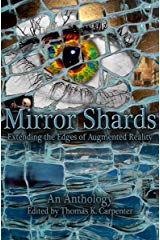
Mirror ShardsMirror Shards is a short story anthology published by Black Moon Books, the imprint of indie author, Thomas K. Carpenter. This time around, Carpenter serves as both author (he contributed one story) and editor. He accepted submissions from unpublished and published authors.

Much like Carpenter's novel, The Digital Sea (which was reviewed in this blog earlier this year), the stories in this anthology all have augmented reality (AR) as a common element integral to each story. However, how each author incorporates AR into their story is as varied as the authors themselves. It would be difficult to provide a detailed analysis of all 13 stories so I will provide a taste of each.

We're shown how a submarine pilot guides a gaggle of tourists in the depths of the Indian Ocean in "The Watcher" and jacked in with a bio-engineered assassin dropped on a distant ring world in "El Matador".

AR is a positive force that advances the effectiveness of smart detectives in "Witness Protection" while helping a young woman survive an encounter with a crime syndicate in the cold of eastern Russia in "Of Bone and Steel and Other Soft Materials". It enables a singer to adopt new personas while Earth is under the boot of alien overlords in "Stage Presence, Baby". And it enables revolutions in the corporate dictatorship of "Gift Horses".

The darker side of AR is explored as well. It is used to bring about an advertizing apocalypse in "Below the Bollocks Line" and adds a new dimension to imprisonment in "The Sun is Real." It fosters the ugliness of narcissism in "A Book By Its Cover".

Some stories balance the two. It props up the ego of the actors in "These Delicate Creatures" but also restores their humanity when art becomes protest. And in the sexual slavery of "More Real Than Flesh" it provides an escape hatch.

I have to say that there isn't a bad story in the bunch but I was still able to pick out two stellar stories that rose above the rest: "Music of the Spheres" and "The Cageless Zoo".

"Music of the Spheres" is probably the best math story I've ever read. A math major helps his sister with her geometry homework and it doesn't come across as dull, instead it turns into a lesson she has to teach him later in life. The underlying theme is about what happens to those who are left behind when AR takes over society. The author, Ken Liu, poignantly shows how one can cope with watching dreams die.

My favorite is Carpenter's own, "The Cageless Zoo", which is about a widow and her two children visiting a zoo full of predators who are kept from eating people by AR implants. The mother is confronted by a zoo official who demands a copy of her late husband's research, which she doesn't want to surrender for fear of it being buried by the Darwin Institute. Not only does Carpenter's story present us with a unique use for AR but it provides us with an excellent demonstration for how epigenetics could work in nature on a fictional beast. But forgetting the science for a moment, it was a fun read along the lines of Jurassic Park, but without the dinosaurs.

Carpenter has amassed a diverse collection of highly entertaining and thought provoking AR stories in Mirror Shards, Volume 1. As with all good anthologies, I now have another list of talented writers whose works I can explore further. I look forward to the next installment of this series. Highly recommended for all sci-fi fans.

Mirror Shards is available in print and ebook formats through the publisher's website.

Friday, March 20, 2009

The Faber Book of Utopias

The Faber Book of Utopias
Edited by John Carey
528 pages
Faber and Faber (1999)

Anthologies are a wonderful way of exploring a genre or theme; not as a substitute for wide reading but as pointers to make your reading more rewarding. I’ve discovered some of my favourite books and authors through anthologies such as The Art of the Story edited by Daniel Halpern, and Alberto Manguel's Black Water: The Book of Fantastic Literature, which is a wonderful collection of fantastic/speculative tales.

Given a fair number of this site's readers declare an interest in post-apocalypse and alternate history titles, I suspect they might also be interested in an anthology such as this. The Faber Book of Utopias edited by John Carey is a fascinating survey of writing dealing with one of the most recurrent concerns in speculative literature and philosophy.

As Carey explains in his introduction, utopia actually means nowhere or no-place. It has often been taken to mean good place, through confusion of its first syllable with the Greek eu as in euphemism or eulogy. As a result of this mix-up, another word dystopia has been invented, to mean bad place. But, strictly speaking, imaginary good places and imaginary bad places are all utopias, or nowheres. Both are represented in this book and Carey uses the word dystopia for the bad places simply because it now has currency.

Not every imaginary nowhere counts as a utopia, however. To qualify as a utopia, an imaginary place must be an expression of desire. To count as a dystopia, it must be an expression of fear. This book, then, is a collection of humanity’s desires and fears over several millennia. The instant we recognise that everything inside our heads, and much outside, consists of human constructs that can be changed, we want to change them. This belief in the perfectibility of human life and society encourages many noble and selfless schemes but it's also inspired a trail of folly, tyranny and attempts at social control. They tend to centre around genetic engineering, education, crime and punishment, the prevention of ageing and the avoidance of death (or painless ways of inducing it).

Carey’s scope is vast, in terms of both period and genre. The first extract, “Holy Snakes”, comes from an Egyptian manuscript written 2000 years before the birth of Christ. The last comes from Lee M. Silver’s 1998 book Remaking Eden and concerns the fate of humankind in a post-cloning America of the year 2350. In between there are fiction and non-fiction selections from Plato, Tacitus, Francis Bacon, Jonathan Swift, Milton, Hobbes, Voltaire, Samuel Johnson, the Marquis de Sade, Robert Owen, Karl Marx, Oscar Wilde, William Morris, H. G. Wells, W. B. Yeats, D. H. Lawrence, George Orwell, Aldous Huxley, Italo Calvino, Julian Barnes and many more. As other reviewers have noted, while many of the selections are predictable, some are surprising: Carey has defined utopian writing widely enough to include an extract from Hitler's Mein Kampf and Abraham Lincoln's “Gettysburg Address” as examples. (Sidenote: Did you know there is actually a photograph of Lincoln delivering that speech?)

Each has a brief introduction which provides enough context for you to appreciate an unfamiliar piece without ruining it for you (a lesson the editors of many anthologies should learn, including the aforementioned Manguel). Carey’s impressions are sometimes radical: on Plato’s Republic he argues that, however benevolent its goals, the imagined world is maintained by a mixture of force and lies and depends on squashing the aspirations of ordinary people. This points to a theme that emerges consistently here. Utopias obviously offer warnings, promises and social critiques by encouraging us to compare imagined realms with our own. But the meaning we make of the comparison will differ depending on the nature of where, and when, we live. In the mid-twentieth century, Karl Popper criticized Plato’s Republic because he saw in such a seemingly benign utopian model the beginning of, and justification for, totalitarian states. The force of a utopia seems to rely on how readily it thrusts us into a re-evaluation of our own world and its current trends. This can change over time.

Overall this is a vast and rewarding work that should appeal to anyone interested in the idea of utopia/dystopia. Ultimately, utopias seem to be attempts to address the insoluble problems of human life, but utopians tend to falsify these problems by regarding them as simple. They build their utopias on universal human longings. But what they build usually carries within it its own potential for crushing or limiting human life. As this anthology shows, how that particular contradiction plays out can be endlessly fascinating.