Showing posts with label crime. Show all posts

Thursday, September 14, 2017

Timing (Far from the Spaceports #2) by Richard Abbott

Hi all! Briefly coming out of hibernation to post a review of the sequel to Richard Abbott's Far from the Spaceports.
book cover for TimingWhen quick wits and loyalty are put to the test...

Mitnash and his AI companion Slate, coders and investigators of interplanetary fraud, are at work again in
Timing, the sequel to Far from the Spaceports.

This time their travels take them from Jupiter to Mars, chasing a small-scale scam which seems a waste of their time. Then the case escalates dramatically into threats and extortion. Robin's Rebels, a new player in the game, is determined to bring down the financial world, and Slate's fellow AIs are the targets. Will Slate be the next victim?

The clues lead them back to the asteroid belt, and to their friends on the Scilly Isles. The next attack will be here, and Mitnash and Slate must put themselves in the line of fire. To solve the case, they need to team up with an old adversary - the only person this far from Earth who has the necessary skills to help them. But can they trust somebody who keeps their own agenda so well hidden?


It was good to get back to Abbott's Far from the Spaceports series. In the first book, we're introduced to Mitnash and his AI companion, Slate. They work for the financial regulatory body ECRB (Economic Crime Review Board) and are periodically sent off-world to investigate financial shenanigans. I found Abbott's world-building solid and his take on AI refreshing (full review here).

This book adds more of the travelogue aspect of this series. Abbott sends his duo to Phobos and Mars before their return to the Scilly Isles, a cluster of settlements in the asteroid belt that was the setting for the first book. Abbott provides more detail on life on Phobos, demonstrating how the geology of the fragile moon has shaped the culture of the settlements there.

Abbott also delves more into the characters' relationships. Mitnash struggles with maintaining a long distance relationship (astronomical units!) while a local woman intrigues him. And it's not just Mitnash's relationships, but Slate's as well. I don't know how we'll imbue emotion into AIs, but in Abbott's universe, it happened and each AI has a unique personality. With their consciousness capable of living the human equivalent of decades in a fraction of the time, they seek out relationships with other AIs, hoping for a match. Mitnash is put into a situation where he has to consider that Slate's feelings are no less valid than his.

While the story remains non-violent, save for a couple of off-camera incidents, Abbott manages to build tension, primarily through the "old adversary" mentioned in the blurb. Mitnash is slowly learning that life (on multiple fronts) is seldom as simple and straightforward as it seems. There are complications during the investigation, and Mitnash finds himself in a predicament that isn't easily remedied and will hang over his head as his story continues.

4.2 out of 5 stars. I'm looking forward to the next book in the series.
Just to be clear. This book was not submitted to us. I went out and bought it on my own. Now, back to hibernation!

\_/
DED

Monday, October 10, 2016

Quest for Kriya by Rahul Deokar

Cover image - Quest for Kriya (Goodreads)
Haunted by tragic loss in the 1993 India earthquake, a broken Shakti with a tenuous hold on life is sheltered by her soul-sister Kriya. But when Kriya vanishes without a trace, Shakti is unwittingly swept into a cataclysmic vortex of greed, lust and betrayal. Shakti meets Shiva, a struggling Silicon Valley entrepreneur, and discovers that love is an enigmatic cosmic force.

Shakti and Shiva are thrust on a frantic race against time through the dark Mumbai underbelly, forbidden Thailand islands, and treacherous cliffs in the Andaman Sea, where danger lurks in every shadow. As they get closer to the truth, they realize that millions of innocent lives are at stake.

Quest for Kriya is an epic saga of love, friendship and sacrifice. The journey is incredible. The emotions are real. The transformation is eternal.

I was drawn to The Quest for Kriya by the names of some of the protagonists—Shiva, Shakti, and so on. I had imagined that it would explore deep issues, and make interesting mythological or religious connections. The preview passage that you get to see on Amazon and elsewhere tends to support this idea. The opening chapter, set around one person's terrible experiences of the 1993 Latur earthquake in India, was very successful at drawing me in and built up a lot of promise.

But we then jump to what might vaguely be called an earthquake-like change in another character's life in the United States. The parallel was loose, seeing as how the person concerned only lost their job, and was therefore motivated to start something new. Compared to losing one's home, family, friends and neighbours, suffering betrayal, and having to relocate to Mumbai, this seemed kind of lightweight, but I think the purpose was to set up friendships and enmities which would persist through the rest of the book.

From here on, though, the story suddenly diverted into a long, complex plot all about crime syndicates and drug dealers in India and nearby countries. Our two protagonists manage to break all this up almost without meaning to, by successfully threading their way through a series of amazing coincidences. Their rather bumbling approach to the whole affair mysteriously carries the day, aided by timely intervention from friends and well-wishers.

The plot is suspended between two cataclysms—the above-mentioned Latur earthquake and the 2004 Asian tsunami—and this basic device worked very well. But I got a bit lost in the intervening drug dealer story and didn't find the rather gooey romance between the male and female leads very believable. They seemed never able to get beyond a kind of adolescent idealisation of each other into a more credible and adult relationship. Insofar as the characters developed at all, they basically learned to conform to a set of behaviours and expectations set up by others. This is not a story of individuation or self-actualisation, but rather it is one of submission to external norms. As a result, everyone's emotional responses are very muted, as they increasingly take on board the philosophical position that nothing should disturb one's equanimity, and in the long run over many lifetimes everything will pan out for the best.

On the plus side, the book has been extremely well and carefully prepared, and for all of its heavy reliance on coincidence, the plot does keep moving along. I couldn't say if it accurately reflects police practice in the various countries, but to a casual reader it seems credible. And the basic structural device of hanging the story between two Asian natural disasters was a really compelling feature.

I guess my main difficulty was the mismatch of expectations. If there are parallels with any of the original tales of Shiva and Shakti, they are extremely well veiled. You will find little of the lively and authentic passion of the Khumarasambhavam, for example. The protagonists' potential for spirituality or real emotional engagement seems to be increasingly marginalised through the story, rather than liberated. I felt let down by the ways in which these two protagonists conducted themselves, given that their names hold so much mythological weight.

So, if you go in expecting a pacy crime plot set mostly in Asia, you will probably enjoy Quest for Kriya. If, like me, you were looking for something with more cosmic depths and resonances, it is best to revise your expectations and just go with the flow of what's there.

The author's website can be found here.

Thursday, June 16, 2016

Far from the Spaceports by Richard Abbott

Book cover for Far from the SpaceportsQuick wits and loyalty confront high-tech crime in space.

Welcome to the Scilly Isles, a handful of asteroids bunched together in space, well beyond the orbit of Mars. This remote and isolated habitat is home to a diverse group of human settlers, and a whole flock of parakeets. But earth-based financial regulator ECRB suspects that it’s also home to serious large scale fraud, and the reputation of the islands comes under threat.

Enter Mitnash Thakur and his virtual partner Slate, sent out from Earth to investigate. Their ECRB colleagues are several weeks away at their ship’s best speed, and even message signals take an hour for the round trip. Slate and Mitnash are on their own, until they can work out who on Scilly to trust. How will they cope when the threat gets personal?


While the story got off to a slow start, it certainly wasn't dull. Abbott introduces us to Mitnash and does just enough world-building to hook the reader with an intriguing future. Humanity has colonized a good chunk of the solar system, and artificial intelligence (AI) has come to fruition. It's something that the technorati would approve of. And while space travel has improved, it still takes weeks to travel from Earth to the asteroid belt. This remoteness allows for a bit of self-governance that libertarians could find comfort in—it isn't anarchy or the Wild West. It does mean that there will be no cavalry coming to Mitnash's rescue should he get into trouble with the locals. He is very much alone, surviving by his wits.

The AI entities work alongside humans and have personalities that are indistinguishable from them. In this age of never ending Terminator films and Kurzweilian singularity worship, it's actually refreshing. One drawback is that Mitnash relies heavily on Slate to do the heavy lifting. While that comes in handy for number crunching, "she" executes some of the best action, leaving Mitnash as spectator too often. The story is told from his point of view so the reader misses out on Slate's version of events. Mitnash does get in a bit of peril when he finds himself unable to rely on her, and this winds up being the most tense scene in the book. I think I would've liked a bit more of that. They're a team, for sure, but it seemed to me that Mitnash needed Slate more than she needed him.

There's a tremendous attention to detail, which threatens to be too much for the casual reader, but Abbott stops short of going too far. It plays into his world-building. While it isn't all essential to the story, it does help the reader get the feel of the place. I never got a proper understanding of the local gravity—one-fiftieth that of Earth—but I'll chalk that up to my being stuck on Earth my whole life.

Only found a handful of typos, so the editing gets a thumbs up from me.

Far from the Spaceports is a delightful read. Abbott's characters are very personable and make for good companions as he carries us to a promising future. There's no dystopia here; man and machine work together to fight crime through skill and wit rather than heavy-handed government oversight or firearms. David Brin would approve.

For more information, please visit the author's website.

Monday, July 27, 2015

Void Contract by Scott Rhine

book cover for Void ContractA veteran of the Gigaparsec War, Dr. Max Culp catches alien war criminals with his skills as a !Kung tribal hunter. Suddenly, his only surviving teammate is kidnapped. To free his friend, Max is forced to take a mob contract on a Saurian fugitive hiding at the borders of Human space. But Max is tired of wet work and alien conspiracies. Can he find a path back to civilian life without losing what’s left of his soul or those closest to him?

This is the first book in a new series, but it takes place in the same universe as Jezebel's Ladder, just 400 years later. While several books followed Jezebel's Ladder, they are not required reading for this book. However, if you enjoy this book and want to know how Earth got to this point, then you should consider picking them up.

The book starts off with a fair amount of action. Rhine does a good job introducing us to Max and the universe he lives in without drowning us in background. Once Max is forced to accept the job from the alien mobster, the action is replaced by intrigue as Max rides a starship to find the fugitive. While there's FTL travel, it's slow enough (weeks instead of years) that Max has time to work on a way to manipulate the situation to accomplish his goals. The action returns in time for an early climax. The last 20% of the story, while still interesting, serves more to set up the next book in the series.

The blurb made it sound to me like Max was an old world bushman living in the Star Wars universe, but that's definitely not the case. Max may have grown up among the !Kung, but he has a modern education and has been culturally assimilated. He was given a new name to fit in. "Max Culp" is actually derived from mea maxima culpa—through my most grievous fault. The story is told from Max's POV, and Rhine is adept at revealing his character and why that name suits him. His past haunts him and affects how he conducts himself. When it comes to planning operations or assessing a rapidly changing situation, Max is sharp as a tack. But when it comes to relationships with women, not being around humans for several years has left him weak. He grovels at the feet of the first one and is hopelessly naive with the second. He's a bit too much the perfect gentleman with the third, but there's still hope he'll get it right.

Rhine makes good use of dialogue to advance the story, and the pacing is solid. His characters have depth, even the aliens. While Rhine tries to keep the story accessible to most adult readers, he's smart about how he does it (i.e. alien foul language gets mistranslated by translator tech). And while there's plenty of the usual sci-fi stuff like spaceships and cool tech, it never steals the show. With Rhine, the plot and the characters keep us engaged.

Rhine has kept busy since Jezebel's Ladder, writing over a dozen books since then. While he's been prolific, I can see that his writing has matured as well. It's nice to see an indie writer work to improve his craft instead of just churning out product.

For more information, please visit the author's website.

Friday, November 28, 2014

Poole's Paradise by John Vorhaus

Poole's ParadiseWhen you're Alexander Poole, everyone’s your teacher: a skeevy stereo salesman, master of the bait and switch; a flaky folk singer and his dog that reads Tolkien; a drug dealer loan shark with a passion for trees; a ballsy townie chick who turns you on to Springsteen; your wiseass roommate whose favorite pastime is smoking your dope; even your one true love. Together they point you to paradise — Poole's Paradise – but what will it cost to get in?

Poole's Paradise is set in 1974 in the "wilds of Western Connecticut", among the Berkshires to be more specific. It's the story of Alexander Poole, a Cort College sophomore in the fictional town of Greenville. As the blurb implies, Poole is trying to assemble a personal code of ethics, or philosophy for life, from the interactions he has with several people in his life. There's a certain level of naïveté to his demeanor. He's too trusting and deals with the world in an open and honest way that, while admirable, is dangerous—the cover features the tarot card of "The Fool" for a reason. As Poole is willing to apply this approach to everyone, he inevitably winds up in a serious predicament involving a sizable stash of drugs and cash. Ultimately, he has to choose between abandoning this philosophy or figuring out how to make it work in order to save himself and his friends.

In the first third of the book, Poole's Paradise seems like it's going to be "Zen and the pursuit of the perfect stereo." Poole engages in several discussions about stereo equipment, and it serves as a great introduction to those characters. My father is something of an audiophile, and I grew up listening to him expound upon the merits of music media (vinyl vs tape) and the constant refinement of his stereo gear: turntables, amplifiers, speakers, and more. Reading the exchange between the characters on this subject had me fondly recalling those days.

There are also other conversations that ring true in the story, particularly between Poole and his roommate, Dawkins. Whether they're talking about music, weed, or women, the dialogue is dead on for the 70's. The college kid vs. townie dynamic is accurate, having witnessed it myself in the small towns of Western Connecticut. Vorhaus knows people and how they interact. Each character, major and minor, is finely crafted. He has a mastery of dialogue and characterization that strikes me as effortless.

There were two problems I had with the story. The first was that I live in Western Connecticut and the setting didn't match in the slightest. The second was with the ending. At first, I was shocked and confused. It took a couple read throughs and some thought before it clicked. It wasn't the ending I was expecting, but as I reflected on the course Poole took, it made sense.

Poole's Paradise is a solid coming of age story set in the 70's. With a well-rounded cast of characters and accurate dialogue, Vorhaus places the reader smack dab in the middle of the most important days of Alexander Poole's life. Whether you fondly recall vinyl, want to know what college life was like for your parents, or just enjoy stories with realistic characters, Poole's Paradise is for you.

For more information about Poole's Paradise, check out the author's website.

Monday, September 12, 2011

Candy and Cigarettes by CS DeWildt

Candy and Cigarettes, by CS DeWildt, is a literary dark crime novella that's as dark and grim as they come.

Lloyd Bizbang has had a hard life. His two-year-old sister accidentally drowned in the bathtub while he was supposed to be watching her. After the accident, he moved in with his grandparents where he also, accidentally, caused his grandmother to fall down the basement stairs and break her neck. He spent his remaining childhood moving from foster care to foster care, enduring beatings and cruel mocking over his death-filled past.

Lloyd is now in his twenties living in the small, dying town of Horton. After enduring another cruel attack by the town's two sociopaths, Lloyd escapes to a junkyard and stumbles upon something no sane person would want to find. He's soon accused of more murders by the town's vile police chief, who seeks to clear up his own loose ends before his forced retirement.

If DeWildt sought to leave his readers tense and depressed after finishing the book, he certainly nailed it. That's not a criticism. DeWildt's style and language were spot on for this type of story, and I found myself cringing with dread at each turn of the page. Not dread in the classic horror sense, but a profound uneasiness regarding what the characters would soon endure.

For me, it brought to mind Cormac McCarthy's No Country for Old Men. Though the stories were completely different, the writing style and the matter-of-fact way both authors show their villains conduct their gruesome business were very similar.

The only nitpick I had was that there were no characters I wanted to root for. Lloyd was the "good guy" in the sense that he was the protagonist, but he wasn't someone I respected. I mostly felt sorry for him. However, that could also have been what DeWildt was trying to do, and if so, he succeeded.

Overall, I highly recommend Candy and Cigarettes to fans of McCarthy and dark literary fiction. It won't disappoint.

Candy and Cigarettes is available through Amazon.

Friday, January 16, 2009

The Curse of the Red Dragon * * *

book cover for the curse of the red dragonTitle: The Curse of the Red Dragon
Author: Vinny Do
Genre: crime drama
Pages: 136
Available from Lulu

Lee is a teenage boy living with his mother when he first kills a man in an initiation into one of Melbourne's underworld factions, a triad called the Red Dragon. Will he continue on his path of violence, encouraged by the dark father figure of John Lang, the triad boss, or will he bail out before he becomes like John?

Lee's home life is saddening, for it is filled with deep emotional pain. There are many reasons for this pain: he doesn't have a father in his life; he is a failure, unable to be the man of the house and take care of his mother; and he is unable to succeed in the mainstream world. Understandably, he also wants to make good in the only way that seems, to him, to make sense.

Gangster John Lang, the boss of the Red Dragon triad, takes Lee under his wing, testing him, shaping him through various assignments into a gangster like himself all the while remaining unusually gentle with the boy. But Lee's course is complicated by the desire of his heart for meaningful human contact, which he finds in the embrace of a prostitute, who listens to his story. She is the only person he opens up to, revealing to her the hole in his heart. But in revealing this he makes himself vulnerable and puts himself in danger. It also causes a problem for John, for Lee is more than just another kid to him.

The Curse of the Red Dragon presents characters with real dilemmas. A young man searching for fulfillment. A deeply flawed father who tries to make his son see the world in the way that it appears to him. And the rest of the cast whose lives are empty and flawed because they have given up on faith in love and in humanity. One of the lessons that John wants to teach Lee that love doesn't exist. His intent is to spare his son the feelings of failure and despair that come when love ends. Money is the source of power, John believes, and the only saving grace. To teach these lessons to Lee, John orders him to kill two members of a rival triad.

One thing that's missing in this book, and in many self-published books for that matter, is a better sense of place and time. Some writers may feel that by generalizing, they make their work universal. But nothing could be farther from the truth. Don Maas, in his masterful book, Writing the Breakout Novel, argues that it is the powerfully evoked sense of time and place, which creates a powerful sense of reality, that marks the breakout work from the average. I tend to agree. For example, I would like to see the place and time of The Curse of the Red Dragon more clearly evoked in the story. It would certainly add to the story's power if the reader knew more about the particulars of the life of Lee, John Lang, and the Asian world in Melbourne.

Tuesday, April 10, 2007

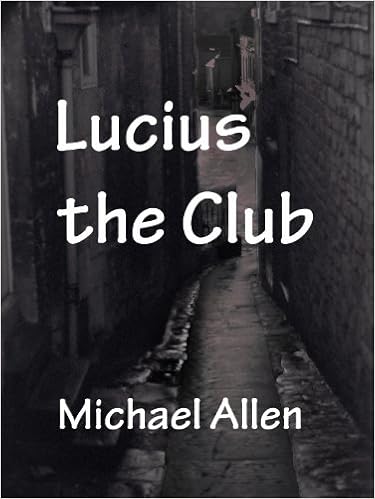
Lucius the Club by Michael Allen (A+)

Lucius the ClubA worthy addition to a mystery/crime aficionado's collection.

Available at: Amazon

First impression: cover could use some work.

The first thing that strikes me as I read is the quality of the editing and the writing. This is high-grade stuff, folks. I mean, the editing alone raises the book to B level, and that's just before I get involved with the story. Why? Editing makes the story come to the surface; it makes the voice of the author speak in your ear, pulling you along. Punctuation errors and other editing problems submerge the story under a layer of haze, forcing the reader to strain and go back and forth in search of the narrative threads—and that's just wrong. There's none of that here.

The story opens in the middle of action: a 19 year old Oxford freshman's mother comes to him with a problem—she's being blackmailed. The son, college boy, decides that he will kill the blackmailer. The question that suggests itself is—what will happen to these characters? Good writing, interesting premise, and well-developed characters—the book is hard to put down. In fact, it almost reads itself. I found myself reading it in one sitting.

The writing is very impressive. Consider, for example, the bit below:

Naughty, dirty, dangerous Soho. It was the perfect place for us, really, because as Mama never ceased to point out, we were not a respectable family. We came from a line of thieves, brothel-keepers and publicans.

The suspense is clearly set up—how will a college boy deal with the blackmailer? Will he carry out the murder? How? Will he get away? These questions dangle over the action of this short but masterfully written novel. Tension mounts as the mother plans out the hit. And the resolution? Well, you'll have to read the novel yourself to find that. All I can tell you here is that it's unexpected, and in a good way. The final revelation of who Lucius really killed and why is shocking, illuminating the mother and her desire to make Lucius into a man who would be respected.